, um zu prüfen, ob Sie einen Vollzugriff auf diese Publikation haben.
Monographie Kein Zugriff
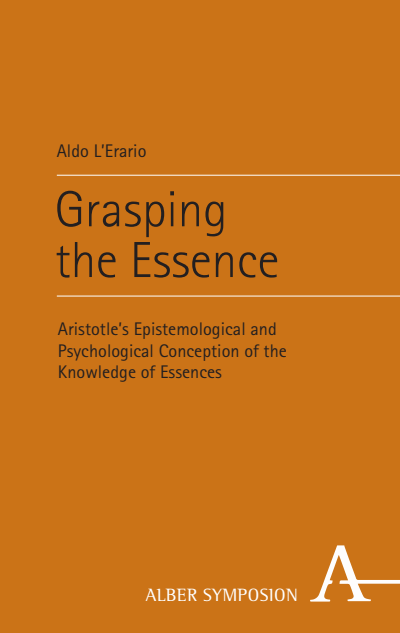
Grasping the Essence
Aristotle’s Epistemological and Psychological Conception of the Knowledge of Essences- Autor:innen:
- Reihe:
- Symposion, Band 142
- Verlag:
- 2024
Zusammenfassung
Dieser Band rekonstruiert Aristoteles' Auffassung von der Wesenserkenntnis und setzt sich mit der aktuellen Debatte darüber auseinander. Seine Hauptthese ist, dass die Quelle einiger gegenwärtiger interpretatorischer Spannungen bei Aristoteles selbst liegt, der die Auffassung vertritt, dass Wesenserkenntnis a posteriori gewonnen wird und dass sie zugleich nicht auf Wahrnehmungserfahrung reduzierbar ist. Ziel des Buches ist es, durch die Gegenüberstellung von Aristoteles' Wissenschaftsphilosophie und seiner philosophischen Psychologie zu zeigen, dass seine Position dennoch kohärent ist. Während diese Strategie in neueren Studien aus methodischen Gründen oft vernachlässigt wurde, soll diese Studie zeigen, wie fruchtbar sie ist.
Schlagworte
Publikation durchsuchen
Bibliographische Angaben
- Copyrightjahr
- 2024
- ISBN-Print
- 978-3-495-99253-1
- ISBN-Online
- 978-3-495-99254-8
- Verlag
- Karl Alber, Baden-Baden
- Reihe
- Symposion
- Band
- 142
- Sprache
- Englisch
- Seiten
- 334
- Produkttyp
- Monographie
Inhaltsverzeichnis
KapitelSeiten
- Titelei/Inhaltsverzeichnis Kein Zugriff Seiten 1 - 10
- Abbreviations of Titles of Aristotle’s Works Kein Zugriff Seiten 11 - 12
- i. »Essential Knowledge« from Epistemology to Psychology Kein Zugriff
- ii. Possibility of Juxtaposing the Posterior Analytics with De Anima Kein Zugriff
- iii. Further Methodological Remarks Kein Zugriff
- iv. Overview of What Follows Kein Zugriff
- 1.1 The Origin of the Dilemma and Plato’s Solution Kein Zugriff
- 1.2 Aristotle’s Solution: A General Sketch Kein Zugriff
- 1.3 The Paradox in the Context of the Analytics Kein Zugriff
- 1.4 »Back Again as Well«: The Structure of Inquiry Kein Zugriff
- 1.5 Hypothesis about the »Dynamics of Knowledge« Kein Zugriff
- 2.1 How Much of an Empiricist Was Aristotle? Kein Zugriff
- 2.2 The Intertwining of Cause, Essence, and Existence Kein Zugriff
- a) At What Stage of Inquiry Is the »Proper Object of Thought« Achieved? Kein Zugriff
- b) What Does the Grasp of the Essence Entail? Kein Zugriff
- c) Conclusions Kein Zugriff
- 2.4 Essential Knowledge and Per Se Predication Kein Zugriff
- 2.5 The Importance of the Leap to Essential Knowledge Kein Zugriff
- a) What Kind of Alteration is Perception? Kein Zugriff
- b) How Does Aristotelian Perception Work? Kein Zugriff
- c) What Is the Scope of Aristotle’s Perceptual Realism? Kein Zugriff
- 3.2 The Nature of Complex Perceptual Objects Kein Zugriff
- 3.3 What Does φαντασία Add to Perception? Kein Zugriff
- 3.4 The Peculiarities of νοῦς and Its Objects Kein Zugriff
- 3.5 The Distinction between φαντασία and νοῦς Kein Zugriff
- 4.1 The Concept of Form Applied to Essential Knowledge Kein Zugriff
- 4.2 Achieving νοῦς: ἐπίδοσις as Key Cognitive Actualization Kein Zugriff
- 4.3 Understanding νοῦς as a Form »Taking Place« in the Soul Kein Zugriff
- 4.4 What Does It Mean to Be Affected by Intelligible Objects? Kein Zugriff
- 4.5 The Priority of Actuality as Foundational Principle Kein Zugriff
- i. Summary of the Argument Kein Zugriff
- ii. The Foundation of Theory of Knowledge on Metaphysics Kein Zugriff
- iii. Limits of the Present Inquiry and Further Developments Kein Zugriff
- iv. Perspectives on Potential Theoretical Applications Kein Zugriff
- Ancient Works Kein Zugriff
- Modern Works Kein Zugriff