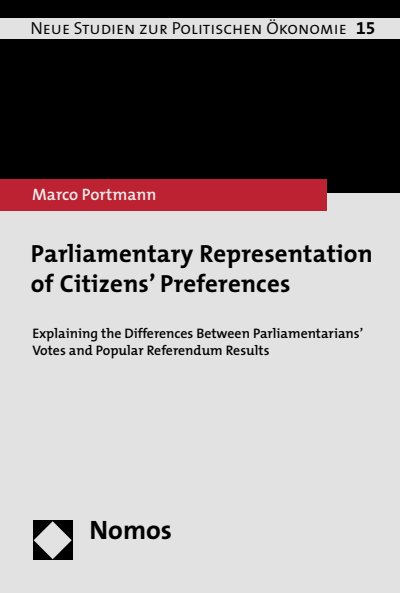
Parliamentary Representation of Citizens’ Preferences
Explaining the Differences Between Parliamentarians’ Votes and Popular Referendum Results- Autor:innen:
- Reihe:
- Neue Studien zur Politischen Ökonomie, Band 15
- Verlag:
- 2014
Zusammenfassung
Die Vertretung von Wählerpräferenzen ist eine zentrale Aufgabe von Parlamenten, deren Gesetzgebung alle Lebensbereiche der Bürger betreffen. Wie Vertretung verstanden und gemessen werden kann und letztlich die Frage, wie Institutionen die Beziehung zwischen Parlamentsmitgliedern und Bürgern formen, ist indes schwer zu beantworten.
Diese Studie bietet einen innovativen Ansatz, die Vertretung von Wählerpräferenzen durch Parlamentsmitglieder zu konzeptualisieren. Anhand des Vergleichs von schweizerischen Parlamentsabstimmungen mit den Resultaten von Volksabstimmungen werden zahlreiche Determinanten und Konsequenzen einer höheren oder tieferen Kongruenz zwischen Politiker- und Wählerentscheidungen untersucht.
Der Fokus der Analyse liegt auf dem Einfluss von Wahlsystemen, etwa den Unterschieden zwischen der Verhältnis- und Mehrheitswahl und der Wirkungsweise der Wahlkreisgröße. Weitere Analysen beleuchten, unter anderem, den Zusammenhang zwischen Repräsentation und Wiederwahlchancen.
In englischer Sprache.
Publikation durchsuchen
Bibliographische Angaben
- Auflage
- 1/2014
- Copyrightjahr
- 2014
- ISBN-Print
- 978-3-8487-1288-5
- ISBN-Online
- 978-3-8452-5386-2
- Verlag
- Nomos, Baden-Baden
- Reihe
- Neue Studien zur Politischen Ökonomie
- Band
- 15
- Sprache
- Englisch
- Seiten
- 230
- Produkttyp
- Monographie
Inhaltsverzeichnis
- Titelei/Inhaltsverzeichnis Kein Zugriff Seiten 1 - 14
- Thesis Overview Kein Zugriff Seiten 15 - 24
- Using Referenda and Roll Call Votes as a Measure for Representation: Methodological Principles Kein Zugriff Seiten 25 - 78
- Evaluating the Median Voter Model’s Explanatory Power Kein Zugriff Seiten 79 - 85
- Voters Elect Politicians Who Closely Matched Their Preference Kein Zugriff Seiten 86 - 95
- Quantifying Parliamentary Representation of Constituents’ Preferences and Explaining Divergence Kein Zugriff Seiten 96 - 114
- District Magnitude and Representation of the Majority’s Preferences: Evidence from Popular and Parliamentary Votes Kein Zugriff Seiten 115 - 144
- A Refined View on the Relationship Between District Magnitude and Representation Kein Zugriff Seiten 145 - 159
- Representatives’ Majority Decisions: The law of Large Numbers Kein Zugriff Seiten 160 - 180
- A Comparative Analysis of the Voting Behavior of Constituents and Their Representatives for Public Debts Kein Zugriff Seiten 181 - 194
- Conclusion and Research Perspective Kein Zugriff Seiten 195 - 206
- Appendix Kein Zugriff Seiten 207 - 216
- Bibliography Kein Zugriff Seiten 217 - 230
Literaturverzeichnis (226 Einträge)
Es wurden keine Treffer gefunden. Versuchen Sie einen anderen Begriff.
- Achen, Christopher H. 1977. “Measuring Representation: Perils of the Correlation Coefficient.” American Journal of Political Science, 21(4): 805–15. Google Scholar öffnen DOI: 10.5771/9783845253862
- Ågren, Hanna, Matz Dahlberg, and Eva Mörk. 2006. “Do politicians’ preferences correspond to those of the voters? An investigation of political representation.” Public Choice, 130(1–2): 137–62. Google Scholar öffnen DOI: 10.5771/9783845253862
- Ai, Chunrong and Edward C. Norton. 2003. “Interaction Terms in logit and probit Models.” Economics Letters, 80(1): 123–29. Google Scholar öffnen DOI: 10.5771/9783845253862
- Albouy, David. 2011. “Do voters affect or elect policies? A new perspective, with evidence from the U.S. Senate.” Electoral Studies, 30(1): 162–73. Google Scholar öffnen DOI: 10.5771/9783845253862
- Alesina, Alberto and Alex Cukierman. 1990. “The Politics of Ambiguity.” Quarterly Journal of Economics, 105(4): 829–50. Google Scholar öffnen DOI: 10.5771/9783845253862
- Alesina, Alberto and Allan Drazen. 1991. “Why Are Stabilizations Delayed?” American Economic Review, 81(5): 1170–88. Google Scholar öffnen DOI: 10.5771/9783845253862
- Alesina, Alberto and Roberto Perotti. 1995. “The Political Economy of Budget Deficits.” Staff Papers – International Monetary Fund, 42(1): 1–31. Google Scholar öffnen DOI: 10.5771/9783845253862
- Americans for Democratic Action. 2012. Voting Records. http://www.adaction.org/pages/publications/voting-records.php (accessed January 18, 2013). Google Scholar öffnen DOI: 10.5771/9783845253862
- Amtliches Bulletin. 2013. Parlamentarische Initiative Jenny This. Transparentes Abstimmungsverhalten (March 7, 2013). http://www.parlament.ch/ab/frameset/d/s/4907/399930/d_s_4907_399930_400013.htm (accessed April 1, 2013). Google Scholar öffnen DOI: 10.5771/9783845253862
- Amtliches Bulletin. 2012. Parlamentarische Initiative Jenny This. Transparentes Abstimmungsverhalten (June 11, 2012). http://www.parlament.ch/ab/frameset/f/s/4904/383503/f_s_4904_383503_383749.htm (accessed April 3, 2013). Google Scholar öffnen DOI: 10.5771/9783845253862
- Ansolabehere, Stephen, James M. Snyder, Jr., and Charles Stewart, III. 2001a. “Candidate Positioning in U.S. House Elections.” American Journal of Political Science, 45(1): 136–59. Google Scholar öffnen DOI: 10.5771/9783845253862
- Ansolabehere, Stephen, James M. Snyder, Jr., and Charles Stewart, III. 2001b. “The Effects of Party and Preferences on Congressional Roll-Call Voting.” Legislative Studies Quarterly, 26(4): 533–72. Google Scholar öffnen DOI: 10.5771/9783845253862
- Arrow, Kenneth J. 1951. Social Choice and Individual Values. New York: John Wiley & Sons. Google Scholar öffnen DOI: 10.5771/9783845253862
- Austen-Smith, David and Jeffrey S. Banks. 1996. “Information Aggregation, Rationality, and the Condorcet Jury Theorem.” American Political Science Review, 90(1): 34–45. Google Scholar öffnen DOI: 10.5771/9783845253862
- Austen-Smith, David and John R. Wright. 1992. “Competitive lobbying for a legislator’s vote.” Social Choice and Welfare, 9(3): 229–57. Google Scholar öffnen DOI: 10.5771/9783845253862
- Baddeley, Alan. 1994. “The Magical Number Seven: Still Magic After All These Years?” Psychological Review, 101(2): 353–56. Google Scholar öffnen DOI: 10.5771/9783845253862
- Bafumi, Joseph and Michael C. Herron. 2007. “Preference aggregation, representation, and elected American political institutions.” Annual Meeting of the Midwest Political Science Association. Google Scholar öffnen DOI: 10.5771/9783845253862
- Bailer, Stefanie, Sarah Bütikofer, Simon Hug, and Tobias Schulz. 2008. “Preferences, Party Discipline and Constituency Pressure in Swiss parliamentary Decisions.” Annual Meeting of the Swiss Political Science Association. Google Scholar öffnen DOI: 10.5771/9783845253862
- Bawn, Kathleen and Michael F. Thies. 2003. “A Comparative Theory of Electoral Incentives: Representing the Unorganized Under PR, Plurality and Mixed-Member Electoral Systems.” Journal of Theoretical Politics, 15(1): 5–32. Google Scholar öffnen DOI: 10.5771/9783845253862
- Bender, Bruce and John R. Lott, Jr. 1996. “Legislator Voting and Shirking: A Critical Review of the Literature.” Public Choice, 87(1–2): 67–100. Google Scholar öffnen DOI: 10.5771/9783845253862
- Benesch, Christine. 2010. “Local TV Markets and Elections.” Mimeo, University of Zurich. Google Scholar öffnen DOI: 10.5771/9783845253862
- Bennedsen, Morten and Sven E. Feldmann. 2002. “Lobbying Legislatures.” Journal of Political Economy, 110(4): 919–46. Google Scholar öffnen DOI: 10.5771/9783845253862
- Benoit, Kenneth. 2001. “District Magnitude, Electoral Formula, and the Number of Parties.” European Journal of Political Research, 39(2): 203–22. Google Scholar öffnen DOI: 10.5771/9783845253862
- Benz, Matthias and Alois Stutzer. 2004. “Are Voters Better Informed When They Have a Larger Say in Politics? – Evidence for the European Union and Switzerland.” Public Choice, 119(1–2): 31–59. Google Scholar öffnen DOI: 10.5771/9783845253862
- Berry, Christopher R. and William G. Howell. 2007. “Accountability and Local Elections: Rethinking Retrospective Voting.” Journal of Politics, 69(03): 844–58. Google Scholar öffnen DOI: 10.5771/9783845253862
- Berry, William D., Evan J. Ringquist, Richard C. Fording, and Russell L. Hanson. 1998. “Measuring Citizen and Government Ideology in the American States, 1960–93.” American Journal of Political Science, 42(1): 327–48. Google Scholar öffnen DOI: 10.5771/9783845253862
- Besley, Timothy and Stephen Coate. 1997. “An Economic Model of Representative Democracy.” Quarterly Journal of Economics, 112(1): 85–114. Google Scholar öffnen DOI: 10.5771/9783845253862
- Besley, Timothy and Stephen Coate. 2001. “Lobbying and Welfare in a Representative Democracy.” Review of Economic Studies, 68(1): 67–82. Google Scholar öffnen DOI: 10.5771/9783845253862
- Besley, Timothy and Stephen Coate. 2008. “Issue Unbundling via Citizens' Initiatives.” Quarterly Journal of Political Science, 3(4): 379–97. Google Scholar öffnen DOI: 10.5771/9783845253862
- Besley, Timothy and Anne Case. 2003. “Political Institutions and Policy Choices: Evidence from the United States.” Journal of Economic Literature, 41(1): 7–73. Google Scholar öffnen DOI: 10.5771/9783845253862
- Black, Duncan. 1948. “On the Rationale of Group Decision-making.” Journal of Political Economy, 56(1): 23–34. Google Scholar öffnen DOI: 10.5771/9783845253862
- Blais, Andre and Marc A. Bodet. 2006. “Does Proportional Representation Foster Closer Congruence Between Citizens and Policy Makers?” Comparative Political Studies, 39(10): 1243–62. Google Scholar öffnen DOI: 10.5771/9783845253862
- Blume, Lorenz, Jens Müller, Stefan Voigt, and Carsten Wolf. 2009. “The Economic Effects of Constitutions: Replicating and Extending Persson and Tabellini.” Public Choice, 139(1): 197–225. Google Scholar öffnen DOI: 10.5771/9783845253862
- Blume, Lorenz, Jens Müller, and Stefan Voigt. 2009. “The Economic Effects of Direct Democracy – A First Global Assessment.” Public Choice, 140(3): 431–61. Google Scholar öffnen DOI: 10.5771/9783845253862
- Blumkin, Tomer and Volker Grossmann. 2010. “May increased partisanship lead to convergence of parties’ policy platforms?” Public Choice, 145(3-4): 547–69. Google Scholar öffnen DOI: 10.5771/9783845253862
- Boehmke, Frederick J. 2008. “The Initiative Process and the Dynamics of State Interest Group Populations.” State Politics & Policy Quarterly, 8(4): 362–83. Google Scholar öffnen DOI: 10.5771/9783845253862
- Boehmke, Frederick J. and Daniel C. Bowen. 2010. “Direct Democracy and Individual Interest Group Membership.” Journal of Politics, 72(3): 659–71. Google Scholar öffnen DOI: 10.5771/9783845253862
- Bohnet, Iris and Bruno S. Frey. 1994. “Direct-Democratic Rules: The Role of Discussion.” Kyklos, 47(3): 341–54. Google Scholar öffnen DOI: 10.5771/9783845253862
- Bordignon, Massimo and Guido Tabellini. 2010. “Moderating Political Extremism: Single Round vs Runoff Elections under Plurality Rule.” CESifo Group Munich. CESifo Working Paper Series 2600. Google Scholar öffnen DOI: 10.5771/9783845253862
- Bowler, Shaun and Todd Donovan. 1998. Demanding Choices: Opinion, Voting, and Direct Democracy. Ann Arbor: University of Michigan Press. Google Scholar öffnen DOI: 10.5771/9783845253862
- Brändle, Thomas and Alois Stutzer. 2010. “Public servants in parliament: theory and evidence on its determinants in Germany.” Public Choice, 145(1): 223–52. Google Scholar öffnen DOI: 10.5771/9783845253862
- Brändle, Thomas and Alois Stutzer. 2013. “Political Selection of Public Servants and Parliamentary Oversight.” Economics of Governance, 14(1): 45–76. Google Scholar öffnen DOI: 10.5771/9783845253862
- Brennan, Geoffrey. 2012. “The Political Economy of Public Debt.” Constitutional Political Economy, 23(3): 182–98. Google Scholar öffnen DOI: 10.5771/9783845253862
- Brunner, Eric J., Stephen L. Ross, and Ebonya L. Washington. 2013. “Does Less Income Mean Less Representation?” American Economic Journal: Economic Policy, 5(2): 53–76. Google Scholar öffnen DOI: 10.5771/9783845253862
- Buchanan, James M. and Gordon Tullock. 1962. The calculus of consent: logical foundations of constitutional democracy. 1st ed. Ann Arbor: University of Michigan Press. Google Scholar öffnen DOI: 10.5771/9783845253862
- Buchanan, James M. and Richard E. Wagner. 1976. Democracy in Deficit: The Political Legacy of Lord Keynes. New York: Academic Press. Google Scholar öffnen DOI: 10.5771/9783845253862
- Burke, Edmund. 1775. Mr. Edmund Burke’s Speech to the Electors of Bristol: On His Being Declared by the Sheriffs, Duly Elected One of the Representatives in Parliament for That City on Thursday the 3d of November, 1774: J. Dodsley. Google Scholar öffnen DOI: 10.5771/9783845253862
- Calvert, Randall L. 1985. “Robustness of the Multidimensional Voting Model: Candidate Motivations, Uncertainty, and Convergence.” American Journal of Political Science, 29(1): 69–95. Google Scholar öffnen DOI: 10.5771/9783845253862
- Calvert, Randall L. 1992. “Leadership and Its Basis in Problems of Social Coordination.” International Political Science Review, 13(1): 7–24. Google Scholar öffnen DOI: 10.5771/9783845253862
- Carey, John M. 2007. “Competing Principals, Political Institutions, and Party Unity in Legislative Voting.” American Journal of Political Science, 51(1): 92–107. Google Scholar öffnen DOI: 10.5771/9783845253862
- Carey, John M. and Simon Hix. 2011. “The Electoral Sweet Spot: Low-Magnitude Proportional Electoral Systems.” American Journal of Political Science, 55(2): 383–97. Google Scholar öffnen DOI: 10.5771/9783845253862
- Carey, John M. and Simon Hix. 2013. “District magnitude and representation of the majority’s preferences: a comment and reinterpretation.” Public Choice, 154(1–2): 139–48. Google Scholar öffnen DOI: 10.5771/9783845253862
- Carey, John M. and Matthew S. Shugart. 1995. “Incentives to Cultivate a Personal Vote: A Rank Ordering of Electoral Formulas.” Electoral Studies, 14(4): 417–39. Google Scholar öffnen DOI: 10.5771/9783845253862
- Clinton, Joshua D. 2012. “Using Roll Call Estimates to Test Models of Politics.” Annual Review of Political Science, 15(1): 79–99. Google Scholar öffnen DOI: 10.5771/9783845253862
- Clinton, Joshua D. and John Lapinski. 2008. “Laws and Roll Calls in the U.S. Congress, 1891–1994.” Legislative Studies Quarterly, 33(4): 511–41. Google Scholar öffnen DOI: 10.5771/9783845253862
- Coate, Stephen. 2004. “Pareto-Improving Campaign Finance Policy.” American Economic Review, 94(3): p 628–655. Google Scholar öffnen DOI: 10.5771/9783845253862
- Condorcet, Jean A. N. de. 1785. Essai sur l' application de l' analyse à la probabilité des décisions. Rendues à la pluralité des voix. Google Scholar öffnen DOI: 10.5771/9783845253862
- Congleton, Roger. 2007. “Informational Limits to Democratic Public Policy: The Jury Theorem, Yardstick Competition, and Ignorance.” Public Choice, 132(3): 333–52. Google Scholar öffnen DOI: 10.5771/9783845253862
- Constitutional Court of the Free State of Bavaria. 2008. Betreffend den Antrag auf Zulassung eines Volksbegehrens über den “Entwurf eines Gesetzes über eine Nichtbeteiligung des Freistaates Bayern an der Finanzierung der Transrapid-Magnetschwebebahn in München.” http://www.bayern.verfassungsgerichtshof.de/8-IX-08-Entscheidung.htm (accessed April 22, 2013). Google Scholar öffnen DOI: 10.5771/9783845253862
- Cooper, Alexandra and Michael C. Munger. 2000. “The (un)predictability of primaries with many candidates: Simulation evidence.” Public Choice, 103(3–4): 337–55. Google Scholar öffnen DOI: 10.5771/9783845253862
- Coppedge, M. 1997. “District Magnitude, Economic Performance, and Party-System Fragmentation in Five Latin American Countries.” Comparative Political Studies, 30(2): 156–85. Google Scholar öffnen DOI: 10.5771/9783845253862
- Cox, Gary W. 1987. “Electoral Equilibria under Alternative Voting Institutions.” American Journal of Political Science, 31(1): 82–108. Google Scholar öffnen DOI: 10.5771/9783845253862
- Cox, Gary W. 1990. “Centripetal and Centrifugal Incentives in Electoral Systems.” American Journal of Political Science, 34(4): 903–35. Google Scholar öffnen DOI: 10.5771/9783845253862
- Cox, Gary W. 1997. Making Votes Count: Strategic Coordination in the World's Electoral System. New York: Cambridge University Press. Google Scholar öffnen DOI: 10.5771/9783845253862
- Crane, Wilder W., Jr. 1960. “Do Representatives Represent?” Journal of Politics, 22(2): 295–99. Google Scholar öffnen DOI: 10.5771/9783845253862
- Crisp, Brian F., Maria C. Escobar-Lemmon, Bradford S. Jones, Mark P. Jones, and Michelle M. Taylor-Robinson. 2004. “Vote-Seeking Incentives and Legislative Representation in Six Presidential Democracies.” Journal of Politics, 66(3): 23–846. Google Scholar öffnen DOI: 10.5771/9783845253862
- DeBacker, Jason. 2012. “Political parties and political shirking.” Public Choice, 150(3–4): 651–70. Google Scholar öffnen DOI: 10.5771/9783845253862
- Delli Carpini, Michael X. and Scott Keeter. 1997. What Americans Know About Politics and Why It Matters. New Haven: Yale University Press. Google Scholar öffnen DOI: 10.5771/9783845253862
- Denzau, Arthur T., Amoz Kats, and Steven Slutsky. 1985. “Multi-Agent Equilibria with Market Share and Ranking Objectives.” Social Choice and Welfare, 2(2): 95–117. Google Scholar öffnen DOI: 10.5771/9783845253862
- Denzau, Arthur T. and Michael C. Munger. 1986. “Legislators and Interest Groups: How Unorganized Interests Get Represented.” American Political Science Review, 80(1): 89–106. Google Scholar öffnen DOI: 10.5771/9783845253862
- Dovi, Suzanne. 2011. “Political Representation.” In The Stanford Encyclopedia of Philosophy, ed. Edward N. Zalta. http://plato.stanford.edu/archives/win2011/entries/political-representation (accessed April 22, 2013). Google Scholar öffnen DOI: 10.5771/9783845253862
- Dow, Jay K. 2001. “A comparative spatial analysis of majoritarian and proportional elections.” Electoral Studies, 20(1): 109–25. Google Scholar öffnen DOI: 10.5771/9783845253862
- Downs, Anthony. 1957. An Economic Theory of Democracy. New York: Harper. Google Scholar öffnen DOI: 10.5771/9783845253862
- Drazen, Allan and Vittorio Grilli. 1993. “The Benefit of Crises for Economic Reforms.” American Economic Review, 83(3): 598–607. Google Scholar öffnen DOI: 10.5771/9783845253862
- Duverger, Maurice. 1954. Political Parties: Their Organization and Activity in the Modern State. New York: Wiley. Google Scholar öffnen DOI: 10.5771/9783845253862
- Dykstra, Robert R. and Harlan Hahn. 1968. “Northern Voters and Negro Suffrage: The Case of Iowa, 1868.” Public Opinion Quarterly, 32(2): 202–15. Google Scholar öffnen DOI: 10.5771/9783845253862
- Egger, Peter and Marko Koethenbuerger. 2010. “Government Spending and Legislative Organization: Quasi-Experimental Evidence from Germany.” American Economic Journal: Applied Economics, 2(4): 200–12. Google Scholar öffnen DOI: 10.5771/9783845253862
- Eichenberger, Reiner. 1999. “Mit direkter Demokratie zu besserer Wirtschafts- und Finanzpolitik: Theorie und Empirie.” In Schriftenreihe der Hochschule Speyer, Adäquate Institutionen. Voraussetzungen für "gute" und bürgernahe Politik?: Vorträge auf dem 2. Speyerer Demokratie-Forum vom 14. bis 16. Oktober 1998 an der Deutschen Hochschule für Verwaltungswissenschaften Speyer, ed. Hans-Herbert von Arnim, 259–88. Berlin: Duncker & Humblot. Google Scholar öffnen DOI: 10.5771/9783845253862
- Eichenberger, Reiner, David Stadelmann, and Marco Portmann. 2011a. “Dunkelkammer mit Videoüberwachung.” Weltwoche. October 20, 2011: 44. Google Scholar öffnen DOI: 10.5771/9783845253862
- Eichenberger, Reiner, David Stadelmann, and Marco Portmann. 2011b. “Ständerat am Puls des Volks.” NZZ am Sonntag. August 28, 2011: 15. Google Scholar öffnen DOI: 10.5771/9783845253862
- Eichenberger, Reiner, David Stadelmann, and Marco Portmann. 2012. “A comparative analysis of the voting behavior of constituents and their representatives for public debts.” Constitutional Political Economy, 23(3): 244–60. Google Scholar öffnen DOI: 10.5771/9783845253862
- Eichenberger, Reiner, David Stadelmann, and Marco Portmann. 2013. “Voting against the separation of powers between legislature and administration.” Mimeo, University of Fribourg. Google Scholar öffnen DOI: 10.5771/9783845253862
- Enelow, James M. and Michael C. Munger. 1993. “The elements of candidate reputation: The effect of record and credibility on optimal spatial location.” Public Choice, 77(4): 757–72. Google Scholar öffnen DOI: 10.5771/9783845253862
- Erikson, Robert S. and Gerald C. Wright, Jr. 1980. “Policy Representation of Constituency Interests.” Political Behavior, 2(1): 91–106. Google Scholar öffnen DOI: 10.5771/9783845253862
- Feddersen, Timothy J. and Wolfgang Pesendorfer. 1996. “The Swing Voter’s Curse.” American Economic Review, 86(3): 408–24. Google Scholar öffnen DOI: 10.5771/9783845253862
- Federal Chancellery. 2006. Die politischen Rechte im Bund. http://www.bk.admin.ch/themen/pore/01514/index.html?lang=de&unterseite=yes# (accessed April 21, 2013). Google Scholar öffnen DOI: 10.5771/9783845253862
- Federal Chancellery. 2012. Volksinitiativen. http://www.bk.admin.ch/themen/pore/vi/index.html?lang=de# (accessed April 21, 2013). Google Scholar öffnen DOI: 10.5771/9783845253862
- Feld, Lars P., Christoph A. Schaltegger, and Jan Schnellenbach. 2008. “On government centralization and fiscal referendums.” European Economic Review, 52(4): 611–45. Google Scholar öffnen DOI: 10.5771/9783845253862
- Feld, Scott L. and Bernard Grofman. 2003. “Stuck in Space: The Neglected Importance of Issue Salience for Political Competition.” European Public Choice Society annual meeting. Google Scholar öffnen DOI: 10.5771/9783845253862
- Fernandez, Carmen, Eduardo Ley, and Mark F. Steel. 2001. “Model Uncertainty in Cross-Country Growth Regressions.” Journal of Applied Econometrics, 16(5): 563–76. Google Scholar öffnen DOI: 10.5771/9783845253862
- Fiorina, Morris P. 1978. “Economic Retrospective Voting in American National Elections: A Micro-Analysis.” American Journal of Political Science, 22(2): 426–43. Google Scholar öffnen DOI: 10.5771/9783845253862
- Frey, Bruno S. 1994. “Direct Democracy: Politico-Economic Lessons from Swiss Experience.” American Economic Review, 84(2): 338–42. Google Scholar öffnen DOI: 10.5771/9783845253862
- Frey, Bruno S. and Alois Stutzer. 2000. “Happiness, Economy and Institutions.” Economic Journal, 110(466): 918–38. Google Scholar öffnen DOI: 10.5771/9783845253862
- Funk, Patricia and Christina Gathmann. 2011. “Does Direct Democracy Reduce the Size of Government? New Evidence from Historical Data, 1890–2000.” Economic Journal, 121(557): 1252–80. Google Scholar öffnen DOI: 10.5771/9783845253862
- Gagliarducci, Stefano, Tommaso Nannicini, and Paolo Naticchioni. 2011. “Electoral Rules and Politicians’ Behavior: A Micro Test.” American Economic Journal: Economic Policy, 3(3): 144–74. Google Scholar öffnen DOI: 10.5771/9783845253862
- Galasso, Vincenzo and Tommaso Nannicini. 2011. “Competing on Good Politicians.” American Political Science Review, 105(01): 79–99. Google Scholar öffnen DOI: 10.5771/9783845253862
- Gallup. 2013. Presidential Job Approval Center. http://www.gallup.com/poll/124922/presidential-approval-center.aspx (accessed April 1, 2013). Google Scholar öffnen DOI: 10.5771/9783845253862
- Garrett, Thomas A. 1999. “A Test of Shirking under Legislative and Citizen Vote: The Case of State Lottery Adoption.” Journal of Law and Economics, 42(1): 189–208. Google Scholar öffnen DOI: 10.5771/9783845253862
- Gerber, Elisabeth R. 1996. “Legislative Response to the Threat of Popular Initiatives.” American Journal of Political Science, 40(1): 99–128. Google Scholar öffnen DOI: 10.5771/9783845253862
- Gerber, Elisabeth R. 1999. The Populist Paradox. Interest Group Influence and the Promise of Direct Legislation. Princeton: Princeton University Press. Google Scholar öffnen DOI: 10.5771/9783845253862
- Gerber, Elisabeth R. and Jeffrey B. Lewis. 2004. “Beyond the Median: Voter Preferences, District Heterogeneity, and Political Representation.” Journal of Political Economy, 112(6): 1364–83. Google Scholar öffnen DOI: 10.5771/9783845253862
- Gilligan, Thomas W. and John G. Matsusaka. 1995. “Deviations from Constituent Interests: The Role of Legislative Structure and Political Parties in the States.” Economic Inquiry, 33(3): 383–401. Google Scholar öffnen DOI: 10.5771/9783845253862
- Goff, Brian L. and Kevin B. Grier. 1993. “On the (mis)measurement of legislator ideology and shirking.” Public Choice, 76(1–2): 5–20. Google Scholar öffnen DOI: 10.5771/9783845253862
- Golder, Matt and Jacek Stramski. 2010. “Ideological Congruence and Electoral Institutions.” American Journal of Political Science, 54(1): 90–106. Google Scholar öffnen DOI: 10.5771/9783845253862
- Gouveia, Miguel and Neal. A. Masia. 1998. “Does the median voter model explain the size of government?: Evidence from the states.” Public Choice, 97(1-2): 159–77. Google Scholar öffnen DOI: 10.5771/9783845253862
- Graf, Martin. “Bundesversammlung.” In Historisches Lexikon der Schweiz. http://www.hls-dhs-dss.ch/textes/d/D10081.php (accessed April 22, 2013). Google Scholar öffnen DOI: 10.5771/9783845253862
- Greene, William H. 2012. Econometric Analysis. 7th ed. Boston & London: Pearson. Google Scholar öffnen DOI: 10.5771/9783845253862
- Grofman, Bernard. 2004. “Downs and Two-Party Convergence.” Annual Review of Political Science, 7: 25–46. Google Scholar öffnen DOI: 10.5771/9783845253862
- Grofman, Bernard. 2008. “A taxonomy of runoff methods.” Electoral Studies, 27(3): 395–99. Google Scholar öffnen DOI: 10.5771/9783845253862
- Groseclose, Tim, Steven D. Levitt, and James M. Snyder, Jr. 1999. “Comparing Interest Group Scores across Time and Chambers: Adjusted ADA Scores for the U.S. Congress.” American Political Science Review, 93(1): 33–50. Google Scholar öffnen DOI: 10.5771/9783845253862
- Grossman, Gene M. and Elhanan Helpman. 1994. “Protection for Sale.” American Economic Review, 84(4): 833–50. Google Scholar öffnen DOI: 10.5771/9783845253862
- Grossman, Gene M. and Elhanan Helpman. 1996. “Electoral Competition and Special Interest Politics.” Review of Economic Studies, 63(2): 265–86. Google Scholar öffnen DOI: 10.5771/9783845253862
- Grossman, Gene M. and Elhanan Helpman. 2001. Special Interest Politics. Cambridge: MIT Press. Google Scholar öffnen DOI: 10.5771/9783845253862
- Harsanyi, John C. 1955. “Cardinal Welfare, Individualistic Ethics, and Interpersonal Comparisons of Utility.” Journal of Political Economy, 63(4): 309–21. Google Scholar öffnen DOI: 10.5771/9783845253862
- Hayo, Bernd and Florian Neumeier. 2012. “Leaders’ Impact on Public Spending Priorities: The Case of the German Laender.” Kyklos, 65(4): 480–511. Google Scholar öffnen DOI: 10.5771/9783845253862
- Hedlund, Ronald D. and H. Paul Friesema. 1972. “Representatives’ Perceptions of Constituency Opinion.” Journal of Politics, 34(3): p 730–752. Google Scholar öffnen DOI: 10.5771/9783845253862
- Hermann, Michael and Heiri Leuthold. 2007. “Zwischen Konsens und Polarisierung Volksabstimmungen und Parlamentsentscheide im direkten Vergleich.” In Direkte Demokratie: Bestandsaufnahmen und Wirkungen im internationalen Vergleich, ed. Markus Freitag and Uwe Wagschal, 277–302. Münster: LIT Verlag. Google Scholar öffnen DOI: 10.5771/9783845253862
- Herrera, Cheryl L., Richard Herrera, and Eric R. A. N. Smith. 1992. “Public Opinion and Congressional Representation.” Public Opinion Quarterly, 56(2): 185–205. Google Scholar öffnen DOI: 10.5771/9783845253862
- Hersch, Philip L. and Gerald S. McDougall. 1988. “Voting for ‘Sin’ in Kansas.” Public Choice, 57(2): 127–39. Google Scholar öffnen DOI: 10.5771/9783845253862
- Hoeting, Jennifer A., David Madigan, Adrian E. Raftery, and Chris T. Volinsky. 1999. “Bayesian Model Averaging: A Tutorial (with Discussion).” Statistical Science, 14(4): 382–417. Google Scholar öffnen DOI: 10.5771/9783845253862
- Hotelling, Harold. 1929. “Stability in Competition.” Economic Journal, 39(153): 41–57. Google Scholar öffnen DOI: 10.5771/9783845253862
- Hug, Simon. 2010. “Selection Effects in Roll Call Votes.” British Journal of Political Science, 40(1): 225–35. Google Scholar öffnen DOI: 10.5771/9783845253862
- Hug, Simon. 2011. “Policy consequences of direct legislation theory, empirical models and evidence.” Quality & Quantity, 45(3): 559–78. Google Scholar öffnen DOI: 10.5771/9783845253862
- Kalt, Joseph P. and Mark A. Zupan. 1984. “Capture and Ideology in the Economic Theory of Politics.” American Economic Review, 74(3): 279–300. Google Scholar öffnen DOI: 10.5771/9783845253862
- Kau, James B., Donald Keenan, and Paul H. Rubin. 1982. “A General Equilibrium Model of Congressional Voting.” Quarterly Journal of Economics, 97(2): 271–93. Google Scholar öffnen DOI: 10.5771/9783845253862
- Kau, James B. and Paul H. Rubin. 1978. “Voting on Minimum Wages: A Time-Series Analysis.” Journal of Political Economy, 86(2): 337–42. Google Scholar öffnen DOI: 10.5771/9783845253862
- Kau, James B. and Paul H. Rubin. 1979. “Self-Interest, Ideology, and Logrolling in Congressional Voting.” Journal of Law and Economics, 22(2): 365–84. Google Scholar öffnen DOI: 10.5771/9783845253862
- Kau, James B. and Paul H. Rubin. 1993. “Ideology, Voting, and Shirking.” Public Choice, 76(1–2): 151–72. Google Scholar öffnen DOI: 10.5771/9783845253862
- Keane, Michael P. and Antonio M. Merlo. 2010. “Money, Political Ambition, and the Career Decisions of Politicians.” American Economic Journal: Microeconomics, 2(3): 186–215. Google Scholar öffnen DOI: 10.5771/9783845253862
- Kenny, Lawrence W. and Babak Lotfinia. 2005. “Evidence on the importance of spatial voting models in presidential nominations and elections.” Public Choice, 123(3–4): 439–62. Google Scholar öffnen DOI: 10.5771/9783845253862
- Kirchgässner, Gebhard. 2000. “Probabilistic voting and equilibrium: An impossibility result.” Public Choice, 103(1-2): 35–48. Google Scholar öffnen DOI: 10.5771/9783845253862
- Krehbiel, Keith. 1993. “Constituency characteristics and legislative preferences.” Public Choice, 76(1): 21–37. Google Scholar öffnen DOI: 10.5771/9783845253862
- Lancaster, Thomas D. 1986. “Electoral Structures and Pork Barrel Politics.” International Political Science Review, 7(1): 67–81. Google Scholar öffnen DOI: 10.5771/9783845253862
- Lancaster, Tony. 2000. “The incidental parameter problem since 1948.” Journal of Econometrics, 95(2): 391–413. Google Scholar öffnen DOI: 10.5771/9783845253862
- Lancaster, Thomas D. and David W. Paterson. 1990. “Comparative Pork Barrel Politics: Perceptions from the West German Bundestag.” Comparative Political Studies, 22(4): 458–77. Google Scholar öffnen DOI: 10.5771/9783845253862
- Larcinese, Valentino. 2007. “Does political knowledge increase turnout? Evidence from the 1997 British general election.” Public Choice, 131(3): 387–411. Google Scholar öffnen DOI: 10.5771/9783845253862
- Lassen, David D. 2005. “The Effect of Information on Voter Turnout: Evidence from a Natural Experiment.” American Journal of Political Science, 49(1): 103–18. Google Scholar öffnen DOI: 10.5771/9783845253862
- Le Maux, Benoît. 2009. “Governmental behavior in representative democracy: a synthesis of the theoretical literature.” Public Choice, 141(3): 447–65. Google Scholar öffnen DOI: 10.5771/9783845253862
- Lee, David S., Enrico Moretti, and Matthew J. Butler. 2004. “Do Voters Affect or Elect Policies? Evidence from the U.S. House.” Quarterly Journal of Economics, 119(3): 807–59. Google Scholar öffnen DOI: 10.5771/9783845253862
- Levitt, Steven D. 1996. “How Do Senators Vote? Disentangling the Role of Voter Preferences, Party Affiliation, and Senator Ideology.” American Economic Review, 86(3): 425–41. Google Scholar öffnen DOI: 10.5771/9783845253862
- Lijphart, Arend. 1990. “The Political Consequences of Electoral Laws, 1945–85.” American Political Science Review, 84(2): 481–96. Google Scholar öffnen DOI: 10.5771/9783845253862
- Lizzeri, Alessandro and Nicola Persico. 2001. “The Provision of Public Goods under alternative electoral Incentives.” American Economic Review, 91(1): 225–39. Google Scholar öffnen DOI: 10.5771/9783845253862
- Lott, John R., Jr. and Michael L. Davis. 1992. “A Critical Review and an Extension of the Political Shirking Literature.” Public Choice, 74(4): 461–84. Google Scholar öffnen DOI: 10.5771/9783845253862
- Lupia, Arthur and John G. Matsusaka. 2004. “Direct Democracy: New Approaches to Old Questions.” Annual Review of Political Science, 7(1): 463–82. Google Scholar öffnen DOI: 10.5771/9783845253862
- Majumdar, Sumon and Sharun W. Mukand. 2004. “Policy Gambles.” American Economic Review, 94(4): 1207–22. Google Scholar öffnen DOI: 10.5771/9783845253862
- Matsusaka, John G. 1995. “Fiscal Effects of the Voter Initiative: Evidence from the Last 30 Years.” Journal of Political Economy, 103(3): 587–623. Google Scholar öffnen DOI: 10.5771/9783845253862
- Matsusaka, John G. 2001. “Problems with a Methodology Used to Evaluate the Voter Initiative.” Journal of Politics, 63(4): 1250–56. Google Scholar öffnen DOI: 10.5771/9783845253862
- Matsusaka, John G. 2005. “Direct Democracy Works.” Journal of Economic Perspectives, 19(2): 185–206. Google Scholar öffnen DOI: 10.5771/9783845253862
- Matsusaka, John G. 2010. “Popular Control of Public Policy: A Quantitative Approach.” Quarterly Journal of Political Science, 5(2): 133–67. Google Scholar öffnen DOI: 10.5771/9783845253862
- Matsusaka, John G. and Nolan M. McCarty. 2001. “Political Resource Allocation: Benefits and Costs of Voter Initiatives.” Journal of Law, Economics and Organization, 17(2): 413–48. Google Scholar öffnen DOI: 10.5771/9783845253862
- May, Kenneth O. 1952. “A Set of Independent Necessary and Sufficient Conditions for Simple Majority Decision.” Econometrica, 20(4): 680–84. Google Scholar öffnen DOI: 10.5771/9783845253862
- McCrone, Donald J. and James H. Kuklinski. 1979. “The Delegate Theory of Representation.” American Journal of Political Science, 23(2): 278–300. Google Scholar öffnen DOI: 10.5771/9783845253862
- McDonagh, Eileen L. 1993. “Constituency Influence on House Roll-Call Votes in the Progressive Era, 1913–1915.” Legislative Studies Quarterly, 18(2): 185–210. Google Scholar öffnen DOI: 10.5771/9783845253862
- McGrath, Robert J. 2011. “Electoral Competition and the Frequency of Initiative Use in the U.S. States.” American Politics Research, 39(3): 611–38. Google Scholar öffnen DOI: 10.5771/9783845253862
- McKelvey, Richard D. 1986. “Covering, Dominance, and Institution-Free Properties of Social Choice.” American Journal of Political Science, 30(2): 283–314. Google Scholar öffnen DOI: 10.5771/9783845253862
- Meltzer, Allan H. and Scott F. Richard. 1981. “A Rational Theory of the Size of Government.” Journal of Political Economy, 89(5): 914–27. Google Scholar öffnen DOI: 10.5771/9783845253862
- Milesi-Ferretti, Gian M., Roberto Perotti, and Massimo Rostagno. 2002. “Electoral Systems and Public Spending.” Quarterly Journal of Economics, 117(2): 609–57. Google Scholar öffnen DOI: 10.5771/9783845253862
- Miller, George A. 1956. “The Magical Number Seven, Plus or minus Two: Some Limits on Our Capacity for Processing Information.” Psychological Review, 63(2): 81–97. Google Scholar öffnen DOI: 10.5771/9783845253862
- Miller, Warren E. and Donald E. Stokes. 1963. “Constituency Influence in Congress.” American Political Science Review, 57(1): 45–56. Google Scholar öffnen DOI: 10.5771/9783845253862
- Milligan, Kevin and Michael Smart. “Regional Grants as Pork Barrel Politics.” CESifo Group Munich. CESifo Working Paper Series 1453. Google Scholar öffnen DOI: 10.5771/9783845253862
- Mueller, Dennis C. 2003. Public Choice III. Cambridge: Cambridge University Press. Google Scholar öffnen DOI: 10.5771/9783845253862
- Müller, Reinhard. 2011. Wie demokratisch ist direkte Demokratie? http://www.faz.net/aktuell/volksentscheide-wie-demokratisch-ist-direkte-demokratie-11520785.html (accessed April 16, 2013). Google Scholar öffnen DOI: 10.5771/9783845253862
- Nannestad, Peter and Martin Paldam. 1994. “The VP-Function: A Survey of the Literature on Vote and Popularity Functions after 25 Years.” Public Choice, 79(3-4): 213–45. Google Scholar öffnen DOI: 10.5771/9783845253862
- Neto, Octavio A. and Gary W. Cox. 1997. “Electoral Institutions, Cleavage Structures, and the Number of Parties.” American Journal of Political Science, 41(1): 149–74. Google Scholar öffnen DOI: 10.5771/9783845253862
- Noam, Eli M. 1980. “The Efficiency of Direct Democracy.” Journal of Political Economy, 88(4): 803–10. Google Scholar öffnen DOI: 10.5771/9783845253862
- Nordhaus, William D. 1975. “The Political Business Cycle.” Review of Economic Studies, 42(2): 169–90. Google Scholar öffnen DOI: 10.5771/9783845253862
- Ordeshook, Peter C. and Olga V. Shvetsova. 1994. “Ethnic Heterogeneity, District Magnitude, and the Number of Parties.” American Journal of Political Science, 38(1): 100–23. Google Scholar öffnen DOI: 10.5771/9783845253862
- Osborne, Martin J. and Al Slivinksi. 1995. “A Model of Political Competition with Citizen-Candidates.” Quarterly Journal of Economics, 111(1995–01): 65–96. Google Scholar öffnen DOI: 10.5771/9783845253862
- Osborne, Martin J. and Matthew A. Turner. 2010. “Cost Benefit Analyses versus Referenda.” Journal of Political Economy, 118(1): 156–87. Google Scholar öffnen DOI: 10.5771/9783845253862
- Padovano, Fabio. 2013. “Are we witnessing a paradigm shift in the analysis of political competition?” Public Choice, 156(3–4): 631–51. Google Scholar öffnen DOI: 10.5771/9783845253862
- Peltzman, Sam. 1984. “Constituent Interest and Congressional Voting.” Journal of Law and Economics, 27(1): 181–210. Google Scholar öffnen DOI: 10.5771/9783845253862
- Persson, Torsten, Gerard Roland, and Guido Tabellini. 2007. “Electoral Rules and Government Spending in Parliamentary Democracies.” Quarterly Journal of Political Science, 2(2): 155–88. Google Scholar öffnen DOI: 10.5771/9783845253862
- Persson, Torsten and Guido Tabellini. 1999. “The Size and Scope of Government: Comparative Politics with Rational Politicians.” European Economic Review, 43(4–6): 699–735. Google Scholar öffnen DOI: 10.5771/9783845253862
- Persson, Torsten and Guido Tabellini. 2000. Political Economics: Explaining Economic Policy. Cambridge: MIT Press. Google Scholar öffnen DOI: 10.5771/9783845253862
- Pettersson-Lidbom, Per. 2012. “Does the size of the legislature affect the size of government? Evidence from two natural experiments.” Journal of Public Economics, 96(3): 269–78. Google Scholar öffnen DOI: 10.5771/9783845253862
- Pitkin, Hanna F. 1967. The Concept of Representation. Berkeley: University of California Press. Google Scholar öffnen DOI: 10.5771/9783845253862
- Pommerehne, Werner W. 1983. “Private versus öffentliche Müllabfuhr – nochmals betrachtet.” Finanzarchiv, 41(3): 466–75. Google Scholar öffnen DOI: 10.5771/9783845253862
- Poole, Keith T. 2005. Analytical Methods for Social Research (Spatial Models of Parliamentary Voting). Cambridge: Cambridge University Press. Google Scholar öffnen DOI: 10.5771/9783845253862
- Poole, Keith T. and Howard Rosenthal. 1984. “The Polarization of American Politics.” Journal of Politics, 46(4): 1061–79. Google Scholar öffnen DOI: 10.5771/9783845253862
- Poole, Keith T. and Howard Rosenthal. 1985. “A Spatial Model for Legislative Roll Call Analysis.” American Journal of Political Science, 29(2): 357–84. Google Scholar öffnen DOI: 10.5771/9783845253862
- Poole, Keith T. and Howard Rosenthal. 1997. Congress: A Political-Economic History of Roll Call Voting. New York: Oxford University Press. Google Scholar öffnen DOI: 10.5771/9783845253862
- Poole, Keith T. and Howard Rosenthal. 2007. Ideology & Congress. 2nd ed. New Brunswick: Transaction Publishers. Google Scholar öffnen DOI: 10.5771/9783845253862
- Portmann, Marco and David Stadelmann. 2013. “Testing the Median Voter Model and Moving Beyond its Limits: Do Characteristics of Politicians Matter?” Center for Research in Economics, Management and the Arts. CREMA Working Paper Series 2013–05. Google Scholar öffnen DOI: 10.5771/9783845253862
- Portmann, Marco, David Stadelmann, and Reiner Eichenberger. 2012. “District magnitude and representation of the majority's preferences: Evidence from popular and parliamentary votes.” Public Choice, 151(3–4): 585–610. Google Scholar öffnen DOI: 10.5771/9783845253862
- Portmann, Marco, David Stadelmann, and Reiner Eichenberger. 2013. “District magnitude and representation of the majority’s preferences – a reply and new perspectives.” Public Choice, 154(1–2): 149–51. Google Scholar öffnen DOI: 10.5771/9783845253862
- Powell, G. Bingham, Jr. and Georg S. Vanberg. 2000. “Election Laws, Disproportionality and Median Correspondence: Implications for Two Visions of Democracy.” British Journal of Political Science, 30(3): 383–411. Google Scholar öffnen DOI: 10.5771/9783845253862
- Rae, Douglas W. 1971. The Political Consequences of Electoral Laws. New Haven & London: Yale University Press. Google Scholar öffnen DOI: 10.5771/9783845253862
- Raftery, Adrian E. 1995. “Bayesian Model Selection in social Research.” Sociological Methodology, 25: 111–63. Google Scholar öffnen DOI: 10.5771/9783845253862
- Raftery, Adrian E., Jennifer Hoeting, Chris Volinsky, Ian Painter, and Ka Yee Yeung. 2011. “BMA: Bayesian Model Averaging.” R package version 3.14.1. http://CRAN.R-project.org/package=BMA (accessed January 16, 2012). Google Scholar öffnen DOI: 10.5771/9783845253862
- Raftery, Adrian E., David Madigan, and Jennifer A. Hoeting. 1997. “Bayesian Model Averaging for Linear Regression Models.” Journal of the American Statistical Association, 92(437): 179–91. Google Scholar öffnen DOI: 10.5771/9783845253862
- Rawls, John A. 1971. Theory of Justice. Cambridge: Belknap Press. Google Scholar öffnen DOI: 10.5771/9783845253862
- Romer, Thomas. 1975. “Individual welfare, majority voting, and the properties of a linear income tax.” Journal of Public Economics, 4(2): 163–85. Google Scholar öffnen DOI: 10.5771/9783845253862
- Romer, Thomas and Howard Rosenthal. 1978. “Political Resource Allocation, Controlled Agendas, and the Status Quo.” Public Choice, 33(4): 27–43. Google Scholar öffnen DOI: 10.5771/9783845253862
- Sala-I-Martin, Xavier, Gernot Doppelhofer, and Ronald I. Miller. 2004. “Determinants of Long-Term Growth: A Bayesian Averaging of Classical Estimates (BACE) Approach.” American Economic Review, 94(4): 813–35. Google Scholar öffnen DOI: 10.5771/9783845253862
- Scervini, Francesco. 2012. “Empirics of the median voter: democracy, redistribution and the role of the middle class.” Journal of Economic Inequality, 10(4): 529–50. Google Scholar öffnen DOI: 10.5771/9783845253862
- Schneider, Friedrich, Werner W. Pommerehne, and Bruno S. Frey. 1981. “Politico-Economic Interdependence in a Direct Democracy: The Case of Switzerland.” In Contemporary Political Economy, ed. Douglas A. Hibbs and Heino Fassbender, 231–48. Amsterdam: North Holland. Google Scholar öffnen DOI: 10.5771/9783845253862
- Schwarz, Daniel. 2005. “How representative are published votes for legislative voting behaviour?” ECPR General Conference. Google Scholar öffnen DOI: 10.5771/9783845253862
- Schwarz, Hans-Rudolf and Norbert Köckler. 2004. Numerische Mathematik. Wiesbaden: Teubner Verlag. Google Scholar öffnen DOI: 10.5771/9783845253862
- Shepsle, Kenneth A. 1972. “The Strategy of Ambiguity: Uncertainty and Electoral Competition.” American Political Science Review, 66(2): 555–68. Google Scholar öffnen DOI: 10.5771/9783845253862
- Snyder, James M., Jr. 1992. “Artificial Extremism in Interest Group Ratings.” Legislative Studies Quarterly, 17(3): 319–45. Google Scholar öffnen DOI: 10.5771/9783845253862
- Stadelmann, David, Reiner Eichenberger, and Marco Portmann. 2011. “Parliaments as Condorcet Juries: Quasi-Experimental Evidence on the Representation of Majority Preferences.” Center for Research in Economics, Management and the Arts. CREMA Working Paper Series 2011–14. Google Scholar öffnen DOI: 10.5771/9783845253862
- Stadelmann, David, Marco Portmann, and Reiner Eichenberger. 2012a. “Evaluating the Median Voter Model’s Explanatory Power.” Economics Letters, 114(3): 312–14. Google Scholar öffnen DOI: 10.5771/9783845253862
- Stadelmann, David, Marco Portmann, and Reiner Eichenberger. 2012b. “Do Female Representatives Adhere More Closely to Citizens’ Preferences Than Male Representatives?” Center for Research in Economics, Management and the Arts. CREMA Working Paper Series 2012–02. Google Scholar öffnen DOI: 10.5771/9783845253862
- Stadelmann, David, Marco Portmann, and Reiner Eichenberger. 2012c. “Preference Representation and the Influence of Political Parties in Majoritarian vs. Proportional Systems: An Empirical Test.” Center for Research in Economics, Management and the Arts. CREMA Working Paper Series. Google Scholar öffnen DOI: 10.5771/9783845253862
- Stadelmann, David, Marco Portmann, and Reiner Eichenberger. 2013a. “Quantifying parliamentary representation of constituents’ preferences with quasi-experimental data.” Journal of Comparative Economics, 41(1): 170–80. Google Scholar öffnen DOI: 10.5771/9783845253862
- Stadelmann, David, Marco Portmann, and Reiner Eichenberger. 2013b. “Voters elect politicians who closely matched their preferences.” Economics Bulletin, 33(2): 1001–09. Google Scholar öffnen DOI: 10.5771/9783845253862
- Stadelmann, David, Marco Portmann, and Reiner Eichenberger. 2013c. “How Do Female Preferences Influence Political Decisions by Female and Male Representatives?” Mimeo, University of Bayreuth. Google Scholar öffnen DOI: 10.5771/9783845253862
- Stadelmann-Steffen, Isabelle and Adrian Vatter. 2012. “Does Satisfaction with Democracy Really Increase Happiness? Direct Democracy and Individual Satisfaction in Switzerland.” Political Behavior, 34(3): 535–59. Google Scholar öffnen DOI: 10.5771/9783845253862
- Stratmann, Thomas. 2005. “Some talk: Money in politics. A (partial) review of the literature.” In Policy Challenges and Political Responses, ed. William F. Shughart and Robert D. Tollison, 135–56. Boston: Springer. Google Scholar öffnen DOI: 10.5771/9783845253862
- Stratmann, Thomas and Martin Baur. 2002. “Plurality Rule, Proportional Representation, and the German Bundestag: How Incentives to Pork-Barrel Differ across Electoral Systems.” American Journal of Political Science, 46(3): 506. Google Scholar öffnen DOI: 10.5771/9783845253862
- Svaleryd, Helena. 2009. “Women’s representation and public spending.” European Journal of Political Economy, 25(2): 186–98. Google Scholar öffnen DOI: 10.5771/9783845253862
- Swiss Parliamentary Services. 2004. Bundesgesetz über die Änderung von Erlassen im Bereich der Ehe- und Familienbesteuerung, der Wohneigentumsbesteuerung und der Stempelabgaben. http://www.parlament.ch/d/dokumentation/dossiers/dossiers-archiv/steuerpaket/seiten/steuerpaket-referendum.aspx (accessed April 21, 2013). Google Scholar öffnen DOI: 10.5771/9783845253862
- Swiss Parliamentary Services. 2013a. Namentliche Abstimmungen – das Abstimmungsverhalten der Ratsmitglieder. http://parlament.ch/D/WAHLEN-ABSTIMMUNGEN/ABSTIMMUNGEN-IM-PARLAMENT/NAMENTLICHE-ABSTIMMUNGEN/Seiten/default.aspx (accessed March 6, 2013). Google Scholar öffnen DOI: 10.5771/9783845253862
- Swiss Parliamentary Services. 2013b. Parliamentary procedure. http://parlament.ch/E/WISSEN/TAETIGKEITEN/PARLVERFAHREN/Pages/default.aspx (accessed March 6, 2013). Google Scholar öffnen DOI: 10.5771/9783845253862
- Taagepra, Rein and Matthew S. Shugart. 1989. Seats and Votes. The Effects and Determinants of Electoral Systems. New Haven & London: Yale University Press. Google Scholar öffnen DOI: 10.5771/9783845253862
- Tideman, Nicholaus. 1976. “The capabilities of voting rules in the absence of coalitions.” Policy and Politics, 4(4): 23–44. Google Scholar öffnen DOI: 10.5771/9783845253862
- Tien, Charles. 2001. “Representation, Voluntary Retirement, and Shirking in the Last Term.” Public Choice, 106(1): 117–30. Google Scholar öffnen DOI: 10.5771/9783845253862
- Torgler, Benno, David Stadelmann, and Marco Portmann. 2013. “Religious preferences matter for voting decisions.” Mimeo, Queensland University of Technology. Google Scholar öffnen DOI: 10.5771/9783845253862
- Tullock, Gordon. 1981. “Why so much stability.” Public Choice, 37(2): 189–204. Google Scholar öffnen DOI: 10.5771/9783845253862
- Vatter, Adrian. 2003. “Legislative Party Fragmentation in Swiss Cantons: A Function of Cleavage Structures or electoral Institutions?” Party Politics, 9(4): 445–61. Google Scholar öffnen DOI: 10.5771/9783845253862
- Vatter, Adrian. 2007. “Lijphart goes regional: Different patterns of consensus in Swiss democracies.” West European Politics, 30(1): 148–71. Google Scholar öffnen DOI: 10.5771/9783845253862
- Wahlke, John C., Heinz Eulau, William Buchanan, and LeRoy C. Ferguson. 1962. The Legislative System. New York: John Willey. Google Scholar öffnen DOI: 10.5771/9783845253862
- Washington, Ebonya L. 2008. “Female Socialization: How Daughters Affect Their Legislator Fathers’ Voting on Women's Issues.” American Economic Review, 98(1): 311–32. Google Scholar öffnen DOI: 10.5771/9783845253862
- Weissberg, Robert. 1978. “Collective vs. Dyadic Representation in Congress.” American Political Science Review, 72(2): 535–47. Google Scholar öffnen DOI: 10.5771/9783845253862
- Wittman, Donald. 1983. “Candidate Motivation: A Synthesis of Alternative Theories.” American Political Science Review, 77(1): 142–57. Google Scholar öffnen DOI: 10.5771/9783845253862
- Wolfinger, Raymond E. and Steven J. Rosenstone. 1980. Who Votes? (Yale Fastback Series) New Haven: Yale University Press. Google Scholar öffnen DOI: 10.5771/9783845253862