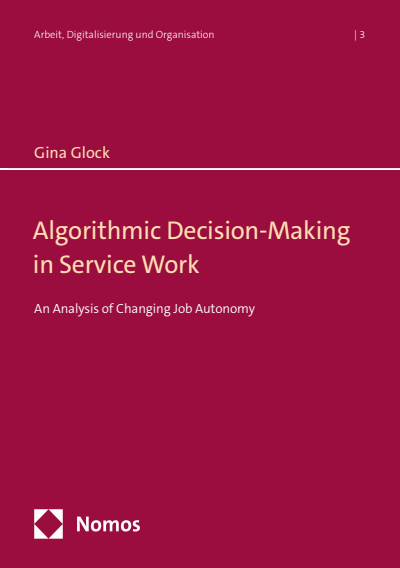
Cover des Buchs: Algorithmic Decision-Making in Service Work
Monographie Open Access Vollzugriff

Algorithmic Decision-Making in Service Work

An Analysis of Changing Job Autonomy
Autor:innen:
Verlag:
 04.12.2024

Zusammenfassung

Unter dem Schlagwort „Künstliche Intelligenz“ werden weitreichende Veränderungen in der Arbeitswelt verhandelt. Es stellen sich Fragen nach der veränderten Rolle von Menschen in Arbeitsprozessen sowie ihrer Entscheidungsfreiheit über Arbeitsinhalte und -bedingungen. Dieses Buch geht diesen potenziellen Konfliktfeldern nach und untersucht, wie algorithmische Entscheidungssysteme die Arbeitsautonomie von Beschäftigten im Dienstleistungssektor beeinflussen. Anhand von Fallbeispielen aus der ambulanten Pflege und dem Bankwesen wird aufgezeigt, unter welchen organisatorischen Bedingungen positive Autonomieerfahrungen ermöglicht werden. Dr. Gina Glock ist Arbeitssoziologin und forscht zum Zusammenspiel von Arbeit und Digitalisierung.

Schlagworte


Publikation durchsuchen


Bibliographische Angaben

Erscheinungsjahr
2024
Erscheinungsdatum
04.12.2024
ISBN-Print
978-3-7560-1013-4
ISBN-Online
978-3-7489-4666-3
Verlag
Nomos, Baden-Baden
Reihe
Arbeit, Digitalisierung und Organisation
Band
3
Sprache
Englisch
Seiten
401
Produkttyp
Monographie

Inhaltsverzeichnis

KapitelSeiten
  1. Titelei/Inhaltsverzeichnis Seiten 1 - 16 Download Kapitel (PDF)
  2. Download Kapitel (PDF)
    1. 1.1. The necessity of a sociological lens on AI Download Kapitel (PDF)
    2. 1.2. Avoiding confusion: workers' autonomy and machine automation Download Kapitel (PDF)
    3. 1.3. Framing job autonomy in the organization of work Download Kapitel (PDF)
    4. Download Kapitel (PDF)
      1. Download Kapitel (PDF)
        1. Relation to job motivation Download Kapitel (PDF)
        2. Relation to personal and organizational outcomes Download Kapitel (PDF)
    5. Download Kapitel (PDF)
      1. Download Kapitel (PDF)
        1. Employment situation Download Kapitel (PDF)
        2. Who is (not) working autonomously? Download Kapitel (PDF)
  3. 2. Research objective and structure Seiten 48 - 52 Download Kapitel (PDF)
  4. Download Kapitel (PDF)
    1. Download Kapitel (PDF)
      1. 3.1. From AI to algorithmic decision-making Download Kapitel (PDF)
      2. 3.2. Differentiating affected tasks Download Kapitel (PDF)
      3. Download Kapitel (PDF)
        1. Download Kapitel (PDF)
          1. Augmenting-Complementing ADM Download Kapitel (PDF)
          2. Automating-Substituting ADM Download Kapitel (PDF)
      4. 3.4. Excursus: Digitalization, ADM, and AI in figures Download Kapitel (PDF)
    2. Download Kapitel (PDF)
      1. 4.1. Call for conceptual renewal Download Kapitel (PDF)
      2. Download Kapitel (PDF)
        1. Download Kapitel (PDF)
          1. Definition Download Kapitel (PDF)
          2. In context Download Kapitel (PDF)
        2. Download Kapitel (PDF)
          1. Definition Download Kapitel (PDF)
          2. In context Download Kapitel (PDF)
        3. Download Kapitel (PDF)
          1. Definition Download Kapitel (PDF)
          2. In context Download Kapitel (PDF)
        4. Download Kapitel (PDF)
          1. Definition Download Kapitel (PDF)
          2. In context Download Kapitel (PDF)
        5. Download Kapitel (PDF)
          1. Definition Download Kapitel (PDF)
          2. In context Download Kapitel (PDF)
        6. Download Kapitel (PDF)
          1. Definition Download Kapitel (PDF)
          2. In context Download Kapitel (PDF)
        7. Download Kapitel (PDF)
          1. Definition Download Kapitel (PDF)
          2. In context Download Kapitel (PDF)
    3. Download Kapitel (PDF)
      1. 5.1. Rationalization at its core: minimizing job autonomy and direct control Download Kapitel (PDF)
      2. 5.2. Exploiting the subject: granting job autonomy and indirect control Download Kapitel (PDF)
      3. 5.3. Digital Taylorism: Just old wine in new bottles? Download Kapitel (PDF)
      4. 5.4. Corporate strategies as drivers between technology and job autonomy Download Kapitel (PDF)
      5. 5.5. Expectations of ADM in service work and missing pieces Download Kapitel (PDF)
  5. Download Kapitel (PDF)
    1. 6. Objective Download Kapitel (PDF)
    2. Download Kapitel (PDF)
      1. 7.1. A question of operationalization Download Kapitel (PDF)
      2. Download Kapitel (PDF)
        1. Download Kapitel (PDF)
          1. Method Autonomy Download Kapitel (PDF)
          2. Criteria Autonomy Download Kapitel (PDF)
          3. Scheduling Autonomy Download Kapitel (PDF)
          4. Working Time Autonomy Download Kapitel (PDF)
          5. Locational Autonomy Download Kapitel (PDF)
          6. Interactional Autonomy Download Kapitel (PDF)
      3. 7.3. Calculation, sample, and variable description Download Kapitel (PDF)
    3. Download Kapitel (PDF)
      1. 8.1. By service branch and task type Download Kapitel (PDF)
      2. 8.2. By selected socio-economic aspects Download Kapitel (PDF)
      3. 8.3. By selected ADM aspects Download Kapitel (PDF)
      4. 8.4. Changes between 2012 and 2018 Download Kapitel (PDF)
    4. 9. Limitations Download Kapitel (PDF)
    5. 10. Summary: solidified polarizations, less intensity for some Download Kapitel (PDF)
  6. Download Kapitel (PDF)
    1. 11. Objective Download Kapitel (PDF)
    2. Download Kapitel (PDF)
      1. 12.1. What is a case? Download Kapitel (PDF)
      2. 12.2. Data collection Download Kapitel (PDF)
      3. 12.3. Interview initiation and conduction Download Kapitel (PDF)
      4. 12.4. Data preparation and analysis Download Kapitel (PDF)
    3. Download Kapitel (PDF)
      1. Download Kapitel (PDF)
        1. 13.2.1. Retrospective: What do we know so far? Download Kapitel (PDF)
        2. 13.2.2. Employment, content & work demands Download Kapitel (PDF)
        3. 13.2.3. Job autonomy in (outpatient) care & technology use Download Kapitel (PDF)
      2. 13.2. Case summary Download Kapitel (PDF)
      3. 13.3. On company and employees Download Kapitel (PDF)
      4. Download Kapitel (PDF)
        1. 13.4.1. Basic functional spectrum Download Kapitel (PDF)
        2. 13.4.2. Elements of learning ADM Download Kapitel (PDF)
      5. Download Kapitel (PDF)
        1. 13.5.1. Overall evaluation Download Kapitel (PDF)
        2. Download Kapitel (PDF)
          1. Task Autonomy Download Kapitel (PDF)
          2. Information access and standardization (+) Download Kapitel (PDF)
          3. Lower work quantity (+) Download Kapitel (PDF)
          4. Method Autonomy Download Kapitel (PDF)
          5. Execution of care work unaffected (+) Download Kapitel (PDF)
          6. Deviation from system instructions (+) Download Kapitel (PDF)
          7. Reminder feature (+) Download Kapitel (PDF)
          8. Criteria Autonomy Download Kapitel (PDF)
          9. Higher sense of security (+) Download Kapitel (PDF)
          10. Better results in tour planning (+) Download Kapitel (PDF)
          11. Reliance on planning and information (–) Download Kapitel (PDF)
          12. Nuances of performance measurement (–) Download Kapitel (PDF)
          13. Scheduling Autonomy Download Kapitel (PDF)
          14. Time gains (+) Download Kapitel (PDF)
          15. Sequence of tasks unaffected (+) Download Kapitel (PDF)
          16. Work speed unaffected (+) Download Kapitel (PDF)
          17. Higher predictability of the tour (+) Download Kapitel (PDF)
          18. Breaks unaffected (+) Download Kapitel (PDF)
          19. Sequence of clients given (–) Download Kapitel (PDF)
          20. Working Time Autonomy Download Kapitel (PDF)
          21. Gains in time off work (+) Download Kapitel (PDF)
          22. Higher predictability of work schedule (+) Download Kapitel (PDF)
          23. Risk of delimitation (–) Download Kapitel (PDF)
          24. Locational Autonomy Download Kapitel (PDF)
          25. Information at PoC (+) Download Kapitel (PDF)
          26. Location-independent administrative tasks (+) Download Kapitel (PDF)
          27. New meaning of office (+) Download Kapitel (PDF)
          28. Home as place, start and end of work (+) Download Kapitel (PDF)
          29. Interactional Autonomy Download Kapitel (PDF)
          30. Higher quality of information and communication (+) Download Kapitel (PDF)
          31. Administrative tasks away from client (+) Download Kapitel (PDF)
          32. Support from colleagues (+) Download Kapitel (PDF)
      6. Download Kapitel (PDF)
        1. Download Kapitel (PDF)
          1. Patchy synchronization Download Kapitel (PDF)
          2. Missing functions Download Kapitel (PDF)
          3. Usability issues Download Kapitel (PDF)
          4. Manual corrections Download Kapitel (PDF)
          5. System coverage Download Kapitel (PDF)
      7. 13.7. Impact and conditions of changed job autonomy Download Kapitel (PDF)
    4. Download Kapitel (PDF)
      1. Download Kapitel (PDF)
        1. 14.2.1. Retrospective: What do we know so far? Download Kapitel (PDF)
        2. 14.2.2. Employment, work organization & perpetual structural change Download Kapitel (PDF)
        3. 14.2.3. Job autonomy in banking services & technology use Download Kapitel (PDF)
      2. 14.2. Case summary Download Kapitel (PDF)
      3. 14.3. On company and employees Download Kapitel (PDF)
      4. Download Kapitel (PDF)
        1. 14.4.1. Basic functional spectrum Download Kapitel (PDF)
        2. 14.4.2. Elements of learning ADM Download Kapitel (PDF)
      5. Download Kapitel (PDF)
        1. 14.5.1. Overall evaluation Download Kapitel (PDF)
        2. Download Kapitel (PDF)
          1. Task Autonomy Download Kapitel (PDF)
          2. Supplementation of task variability (+) Download Kapitel (PDF)
          3. Holism of advisory service increased (+) Download Kapitel (PDF)
          4. Less workload in client selection (+) Download Kapitel (PDF)
          5. Non-transparency and missing information (–) Download Kapitel (PDF)
          6. Higher workload with passive/new clients (–) Download Kapitel (PDF)
          7. Higher workload for advisors, not seniors (–) Download Kapitel (PDF)
          8. Method Autonomy Download Kapitel (PDF)
          9. Options for action expanded by recommendation (+) Download Kapitel (PDF)
          10. Execution of advisory work unaffected (+) Download Kapitel (PDF)
          11. Semi-prescriptive following of system instructions (–) Download Kapitel (PDF)
          12. Criteria Autonomy Download Kapitel (PDF)
          13. Support for target achievement (+) Download Kapitel (PDF)
          14. Replacement of campaign system (+) Download Kapitel (PDF)
          15. Work through an infinite to-do list (–) Download Kapitel (PDF)
          16. The question of control (–) Download Kapitel (PDF)
          17. Scheduling Autonomy Download Kapitel (PDF)
          18. Time gains (+) Download Kapitel (PDF)
          19. More independent prioritization, mid-term (+) Download Kapitel (PDF)
          20. Work speed and breaks unaffected (+) Download Kapitel (PDF)
          21. Sticking to the right timing, short-term (–) Download Kapitel (PDF)
          22. Parallelism of tasks (–) Download Kapitel (PDF)
          23. Dealing with unpredictability (–) Download Kapitel (PDF)
          24. Working Time Autonomy Download Kapitel (PDF)
          25. Flexibility demands (–) Download Kapitel (PDF)
          26. Locational Autonomy Download Kapitel (PDF)
          27. Remote work optional (+) Download Kapitel (PDF)
          28. Decisive client demand (–) Download Kapitel (PDF)
          29. Competition with online branch (–) Download Kapitel (PDF)
          30. Interactional Autonomy Download Kapitel (PDF)
          31. More individualized advisory services (+) Download Kapitel (PDF)
          32. Facilitated teamwork (+) Download Kapitel (PDF)
          33. Emotional demand with new clients (–) Download Kapitel (PDF)
      6. Download Kapitel (PDF)
        1. Download Kapitel (PDF)
          1. Risk of non-acceptance Download Kapitel (PDF)
      7. 14.7. Impact and conditions of changed job autonomy Download Kapitel (PDF)
    5. 15. Experts' views: pending issues and power imbalance Download Kapitel (PDF)
    6. 16. Limitations Download Kapitel (PDF)
    7. Download Kapitel (PDF)
      1. Download Kapitel (PDF)
        1. Download Kapitel (PDF)
          1. Impact on seven dimensions of job autonomy Download Kapitel (PDF)
          2. Effects and conditions of autonomy-enhancing technology use Download Kapitel (PDF)
          3. Interplay of technology use and interaction work Download Kapitel (PDF)
  7. Download Kapitel (PDF)
    1. Download Kapitel (PDF)
      1. 18.1. Less and highly autonomous services: distinct yet converging Download Kapitel (PDF)
      2. 18.2. Assisting, augmenting, automating … liberating? Download Kapitel (PDF)
      3. 18.3. The distinctive features of learning ADM Download Kapitel (PDF)
    2. 19. Corporate strategies becoming tangible Download Kapitel (PDF)
    3. 20. Outlook and reflections Download Kapitel (PDF)
    4. Appendix - Introduction - Part I Download Kapitel (PDF)
    5. Appendix - Part II Download Kapitel (PDF)
    6. Appendix - Part III Download Kapitel (PDF)
    7. References Download Kapitel (PDF)

Ähnliche Veröffentlichungen

aus dem Schwerpunkt "Soziologie allgemein", "Betriebswirtschaftslehre", "Unternehmensführung & Management & Organisation"
Cover des Buchs: Intersektionalität in Therapie und Beratung
Sammelband Vollzugriff
(Un-)Möglichkeiten
Intersektionalität in Therapie und Beratung
Cover des Buchs: Sichtbarkeit von weiblicher wissenschaftlicher Leistung im Fokus
Sammelband Vollzugriff
Ergebnisse aus drei Projekten der BMBF-Förderlinie „Innovative Frauen im Fokus"
Sichtbarkeit von weiblicher wissenschaftlicher Leistung im Fokus
Cover des Buchs: Sportmanagement
Sammelband Kein Zugriff
Praxishandbuch
Sportmanagement
Cover des Buchs: Hybride Arbeitsmärkte
Monographie Kein Zugriff
Die Entgrenzung von Arbeit und die Strukturierung interner und externer Arbeitsmärkte
Hybride Arbeitsmärkte