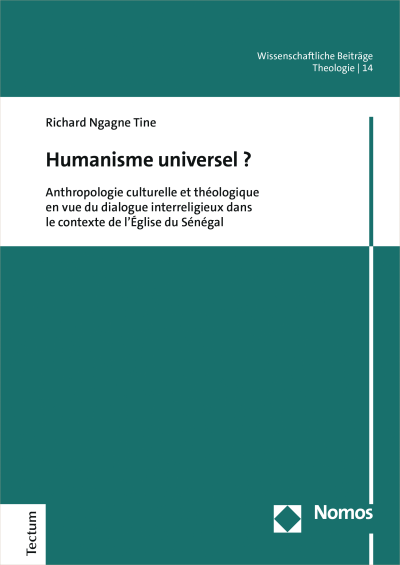
Humanisme universel ?
Anthropologie culturelle et théologique en vue du dialogue interreligieux dans le contexte de l’Église du Sénégal- Autor:innen:
- Reihe:
- Wissenschaftliche Beiträge aus dem Tectum Verlag: Theologie, Band 14
- Verlag:
- 2021
Zusammenfassung
Interreligious dialogue is a decisive aspect in the dynamic of "aggiornamento", which the Catholic Church has initiated since the Second Vatican Council. In order to walk this path of renewal, the Church of Senegal must promote a dialogue of multiform dimensions: doctrinal, cognitive, pragmatic, ethical and spiritual. The concept of dialogue, developed through this book, is a form of contribution to this theological and pastoral task. It calls on the Church in Senegal to draw on the African genius to practice a dialogue rooted in the existence of the Senegalese people. Through this approach, it is possible to break down ethnic and religious barriers in order to open up a new horizon of brotherhood and human development. The Author Richard Ngagne Tine, born in 1975 in Senegal, is a priest of the Diocese of Thiès. He obtained his doctorate in systematic theology in 2021 from the Catholic theological faculty of the University of Münster, Germany. He specialised in anthropology, ecclesiology and the theological foundations of interreligious dialogue in Senegal.
Schlagworte
Publikation durchsuchen
Bibliographische Angaben
- Auflage
- 1/2021
- Copyrightjahr
- 2021
- ISBN-Print
- 978-3-8288-4661-6
- ISBN-Online
- 978-3-8288-7737-5
- Verlag
- Nomos, Baden-Baden
- Reihe
- Wissenschaftliche Beiträge aus dem Tectum Verlag: Theologie
- Band
- 14
- Sprache
- Deutsch
- Seiten
- 374
- Produkttyp
- Monographie
Inhaltsverzeichnis
- Titelei/Inhaltsverzeichnis Kein Zugriff Seiten I - XIV
- A. Introduction générale Kein Zugriff Seiten 1 - 10
- B. Introduction de la partie I Kein Zugriff
- 1.1. Introduction Kein Zugriff
- 1.2.1. Un homme de politique Kein Zugriff
- 1.2.2. Un homme de culture et de fraternité Kein Zugriff
- 1.3. L’arrière-fond de sa vision Kein Zugriff
- 1.4.1.1. L’appartenance communautaire et la relation parentale Kein Zugriff
- 1.4.1.2. La solidarité et l’hospitalité Kein Zugriff
- 1.4.1.3. La parole et le dialogue dans la culture africaine Kein Zugriff
- 1.4.2. Le mouvement de la négritude Kein Zugriff
- 1.5. La crise de l’humanisme du XXème siècle en Occident Kein Zugriff
- 1.6. La civilisation de l’universel Kein Zugriff
- 1.7. Les rapports entre le christianisme et l’islam pour un humanisme universel Kein Zugriff
- 1.8. Conclusion Kein Zugriff
- 2.1. Introduction Kein Zugriff
- 2.2. Le contexte Kein Zugriff
- 2.3. La vision thomiste de l’homme Kein Zugriff
- 2.4.1. Le paradoxe chrétien de l’homme Kein Zugriff
- 2.4.2. La genèse de l’idée de Dieu Kein Zugriff
- 2.4.3. Le sens du surnaturel Kein Zugriff
- 2.4.4. La gratuité du surnaturel Kein Zugriff
- 2.5.1. Précisions sur le concept d’humanisme Kein Zugriff
- 2.5.2. L’apport de sa vision sur l’homme Kein Zugriff
- 2.6. La rencontre de sa vision avec celle de Senghor Kein Zugriff
- 2.7. Conclusion Kein Zugriff
- 3.1. Introduction Kein Zugriff
- 3.2.1. Un homme de dialogue et de culture Kein Zugriff
- 3.2.2. Un homme de science Kein Zugriff
- 3.2.3. Un poète Kein Zugriff
- 3.3.1. L’aspect spirituel Kein Zugriff
- 3.3.2. L’aspect théologique Kein Zugriff
- 3.4. Son expérience de la mystique musulmane Kein Zugriff
- 3.5. Son héritage pour le dialogue islamo-chrétien Kein Zugriff
- 3.6. Conclusion Kein Zugriff
- C. Conclusion de la Partie I Kein Zugriff
- D. Introduction de la partie II Kein Zugriff
- 4.1. Introduction Kein Zugriff
- 4.2.1. Une réflexion sur certaines attitudes à l’égard de cette religion Kein Zugriff
- 4.2.2.1. L’existence d’un Être suprême Kein Zugriff
- 4.2.2.2. Les ancêtres Kein Zugriff
- 4.2.2.3. Les rites et les symboles Kein Zugriff
- 4.2.3. Une compréhension de l’homme et de la vie sociale Kein Zugriff
- 4.2.4. Sa pertinence sur le chemin vers la déclaration "Nostra aetate" Kein Zugriff
- 4.3.1. Réflexion sur la vision de l’islam sur l’homme Kein Zugriff
- 4.3.2. La présence islamique au Sénégal Kein Zugriff
- 4.3.3.1. La tidjaniyya Kein Zugriff
- 4.3.3.2. La mouridiyya Kein Zugriff
- 4.3.3.3. La qadiriyya Kein Zugriff
- 4.3.3.4. La layeniyya Kein Zugriff
- 4.4.1. La figure de la mère Anne Marie Javouhey Kein Zugriff
- 4.4.2. Les pères du Ploërmel Kein Zugriff
- 4.4.3. Les pères du Saint-Esprit Kein Zugriff
- 4.4.4. Les religieuses de l’Immaculée Conception Kein Zugriff
- 4.4.5. La figure de Mgr Kobès Kein Zugriff
- 4.4.6. La figure de Mgr Lefebvre Kein Zugriff
- 4.5. Conclusion Kein Zugriff
- 5.1. Introduction Kein Zugriff
- 5.2.1. Un homme de science et de dialogue Kein Zugriff
- 5.2.2. Un homme de culture Kein Zugriff
- 5.3. Une entreprise culturelle au service de l’homme noir Kein Zugriff
- 5.4.1. La rencontre d’Alioune Diop avec le christianisme Kein Zugriff
- 5.4.2. La préparation de l’Église d’Afrique à l’évènement conciliaire Kein Zugriff
- 5.5. Conclusion Kein Zugriff
- 6.1. Introduction Kein Zugriff
- 6.2. Paragraphe 1 : Préambule Kein Zugriff
- 6.3. Le paragraphe 2 : Les diverses religions non-chrétiennes Kein Zugriff
- 6.4. Le paragraphe 4 : La religion juive Kein Zugriff
- 6.5. Le paragraphe 5 : La fraternité universelle excluant toute discrimination Kein Zugriff
- 6.6.1. Les fondements théologiques du dialogue islamo-chrétien Kein Zugriff
- 6.6.2.1. La promotion de l’unité, de la charité et de la paix dans le monde Kein Zugriff
- 6.6.2.2. La promotion du respect et de l’estime mutuels Kein Zugriff
- 6.6.2.3. Construire ensemble le royaume de Dieu Kein Zugriff
- 6.7.1. L’exclusivisme Kein Zugriff
- 6.7.2. Le fondamentalisme religieux Kein Zugriff
- 6.8. Conclusion Kein Zugriff
- E. Conclusion de la partie II Kein Zugriff
- F. Introduction de la partie III Kein Zugriff
- 7.1. Introduction Kein Zugriff
- 7.2.1. Le sens de la notion d’inculturation Kein Zugriff
- 7.2.2. Le rapport entre la foi et la culture Kein Zugriff
- 7.2.3. L’Église famille de Dieu Kein Zugriff
- 7.3.1. Le dialogue avec la religion traditionnelle africaine Kein Zugriff
- 7.3.2. Le dialogue avec l’islam Kein Zugriff
- 7.4. Conclusion Kein Zugriff
- 8.1. Introduction Kein Zugriff
- 8.2. Construire ensemble une société de paix, de justice et de fraternité Kein Zugriff
- 8.3. La mission de l’Église auprès de la femme au Sénégal Kein Zugriff
- 8.4. La mission de l’Église envers les enfants et les jeunes Kein Zugriff
- 8.5. Conclusion Kein Zugriff
- G. Conclusion de la partie III Kein Zugriff
- H. Conclusion générale Kein Zugriff
- I. Bibliographie générale Kein Zugriff Seiten 359 - 374