Non-take-up of financial social benefits is a prominent issue for contemporary welfare states, and studies exploring its causes have proliferated recently. However, most analyses are based on an “incapacity framework” or refer to a “rational...
Non-take-up, describing the situation in which an eligible person does not benefit from one or more rights to which he or she is entitled, is a topic of growing interest in most European welfare states. A large volume of literature now documents the...
The issue of non-take-up has increasingly been brought to light by scholars and field actors during the past decade. As a result, the issue gained political traction, and programs have been designed to reduce it. In canton Geneva, Switzerland, a...
Although the private rental sector has registered growth in recent years, knowledge about small-scale landlords (SSL) as key actors in housing provision is still scant, especially when it comes to their social position. From an inequality...
This paper explores the financialisation of housing in Germany’s social rental housing sector, focusing on the lived experiences of tenants. Drawing on a relational feminist lens, the study examines how macro-level policy shifts, financialised...
The central element of a housing market crisis is the unmet housing demand of the population, especially for the socio-economically disadvantaged. In the Austrian province of Tyrol, unmet housing demand has long been a social and political concern...
Land and housing are in crisis. Rising rents and land prices have triggered severe housing problems, particularly for low-income and average-income households. In addition to residential apartment distribution, land speculation has become...
This research note presents a comparative analysis of Syrian refugee family integration in France and Germany, focusing on challenges related to housing, language acquisition, and employment. Through a comparative ethnography involving 20 Syrian...
The political use of mass accommodation for governing asylum seekers is growing in frequency, despite its documented disadvantages for asylum seekers’ wellbeing and protection. So long as mass accommodation of asylum seekers is used by states, it...
Externalisation is a core structural feature of capitalist societies. The negative effects of a capitalist mode of society and economy are externalised to other countries and later generations. The question that will be addressed in this paper is...
The rapidly increasing numbers of refugees and asylum seekers in Europe since 2014 have given the topic of refugee migration heightened public and scholarly attention. Starting from the observation that the legal status and rights of refugees from...
Since the outbreak of the Russian invasion of Ukraine, about one million people have fled to Germany in 2022. Due to the gender-specific policies for staying and leaving Ukraine, the socio-demographic composition of the refugees differs markedly...
After criticising a lack of rescue capacities and an increase in border deaths at the maritime EU external borders, search and rescue (SAR) NGOs have been sending out vessels since 2014. While the responsibility for SAR lies with the coastal states,...
Drawing on a series of interviews with four Ukrainian refugee women in Berlin, this essay employs the lens of emotions to discern which integration opportunity structures shape their settlement, and how they do so. To capture the latter, we approach...
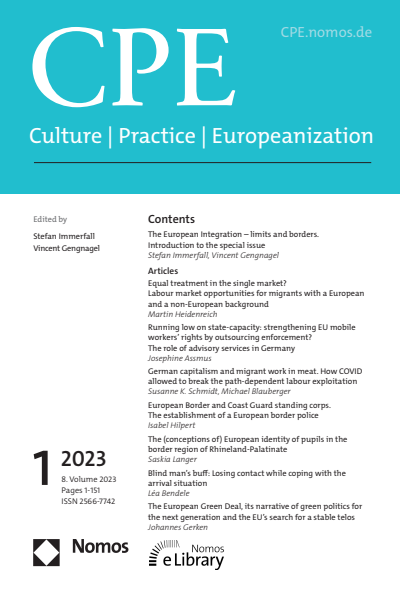
What happens when newly arrived EU citizens lose their point of contact in Germany? Most migrants have a trusted person in the destination area, for example a relative or friends. These people usually help immigrants register, find housing or jobs...
This article discusses whether the single market contributes to the Europeanisation of labour markets by comparing the employment and wage conditions of European and non-European migrants. Such a Europeanisation can be expected from the fact that...
In the European Union, borders are largely communitised. With the creation of the European Border and Coast Guard standing corps, their Europeanisation has reached its temporary climax in the expansion of the Frontex mandate decided in 2019. This...
Major COVID-19 outbreaks in slaughterhouses brought the extent of migrant labour exploitation in the German meat sector to the limelight. Adopting a historical-institutionalist perspective, we argue that the COVID-19 pandemic marked a critical...
During the Covid-19 pandemic, the precarious working and living conditions of mobile workers made headlines across Europe. The challenges of securing better working conditions are inherent in the integration of the European single market, which...
Do you identify with Europe, and if so, why? 248 lower secondary school students answered this question in a survey conducted in Rhineland-Palatinate, Germany. The area is part of the so-called Greater Region, which is a cross-border region between...
This paper presents the European Green Deal (EGD) as a political project based on a renewed accumulation strategy with green growth at its heart and a new overall narrative of ‘green politics for the next generation’. Together both EGD pillars...