Official Journal of the International Society for Knowledge Organization
Editors:
Natália Bolfarini Tognoli (Universidade Federal Fluminense - UFF, Brasil) | Lu An (Wuhan University, China) (Deputy Editor) | Thiago Barros (Federal University of Rio Grande do Sul, Brazil) (Managing Editor) | Maja Žumer (University of Ljubljana, Slovenia) (Deputy Editor)
A work is a deliberately created informing entity intended for communication. A work consists of abstract intellectual content that is distinct from any object that is its carrier. In library and information science, the importance of the work lies...
The article provides definitions of alphabetization and related concepts and traces its historical development and challenges, covering analog as well as digital media. It introduces basic principles as well as standards, norms, and guidelines. The...
The novelty of knowledge claims in a research paper can be considered an evaluation criterion for papers to supplement citations. To provide a foundation for research evaluation from the perspective of innovativeness, we propose an automatic...
Flickr was launched when digital cameras first began to outsell analog cameras, and people were drawn to the site for the opportunities it offered them to store, organize, and share their images, as well as for the connections that could be made...
The purpose of this research is to develop an ontology with subsequent testing and evaluation, for identifying utility and value. The domain that has been chosen is human nervous system (HNS) disorders. It is hypothesized here that an ontology-based...
The organization of musical resources in a piece of music is opaque for everyone but for those with the highest levels of musical education. For the average listener, the specific vocabulary of musical organization is usually replaced by...
Through their work as instructors in a master of library science program, the authors observed a sharp increase in students’ desire to adopt the reader-interest classification approach of genrefication for their school libraries’ fiction...
Automatic subject indexing addresses problems of scale and sustainability and can be at the same time used to enrich existing metadata records, establish more connections across and between resources from various metadata and resource collections,...
The goal of this study is to develop a taxonomy of earthquake response and recovery using online information resources for organizing and sharing earthquake-related online information resources. A constructivist/interpretivist research paradigm was...
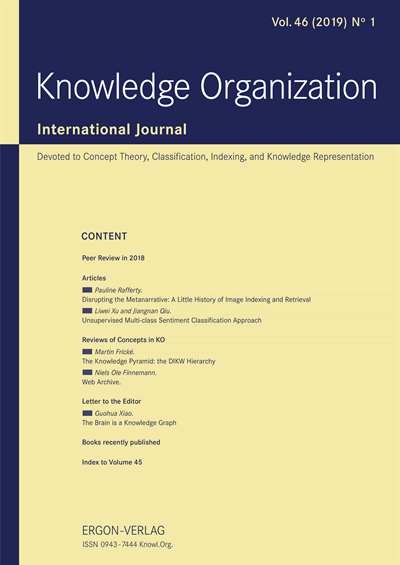
Recent years have seen the rise of user-generated contents (UGCs) in online social media. Diverse UGC sources and information overload are making it increasingly difficult to satisfy personalized information needs. To organize UGCs in a...
Interoperability refers to the ability of two or more systems or components to exchange information and to use the information that has been exchanged. This article presents the major viewpoints of interoperability, with the focus on semantic...
The aims of this paper are twofold: to offer a short history of image retrieval, and secondly and relatedly, to critique the metanarrative of modernity emerging in the literature of knowledge organization and information retrieval. The paper reviews...
The data-information-knowledge-wisdom (DIKW) hierarchy or pyramid is a model or construct that has been used widely within information science and knowledge management. The nature of the pyramid is explained, and its historical origin is described....