, to see if you have full access to this publication.
Journal Partial access
ZParl Zeitschrift für Parlamentsfragen
Zeitschrift für Parlamentsfragen
Editors:
Deutsche Vereinigung für Parlamentsfragen | Chefredaktion: Prof. Dr. Suzanne S. Schüttemeyer, Martin-Luther-Universität Halle-Wittenberg | Mitglieder der Redaktion: Prof. Dr. Jörg-Detlef Kühne, Leibniz Universität Hannover; Prof. Dr. Werner J. Patzelt, Technische Universität Dresden; Thomas Hadamek, Ministerialrat, Verwaltung des Deutschen Bundestages, Berlin; Prof. Dr. Sven T. Siefken, Hochschule des Bundes für öffentliche Verwaltung. Beauftragter des Vorstands der DVParl: Prof. Dr. Heinrich Oberreuter, Universität Passau. Gründer der Zeitschrift: Winfried Steffani† und Uwe Thaysen †
The German Bundestag is caught in an endless cycle of tortuous amendments of its electoral system. Past attempts were restricted by retaining the traditional ballot design. Without this restriction new options become feasible. The article outlines a...
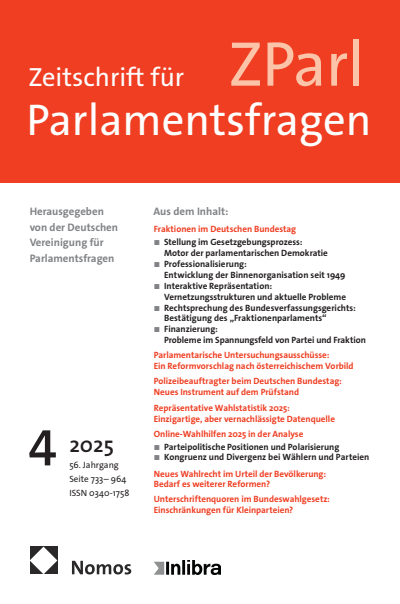
With its ruling of December 10, 2024, on signature quorums, the Second Senate of the Federal Constitutional Court abandoned the principle that strict constitutional control is necessary when parliamentary majorities act on their own behalf. Instead,...
Parliamentary party groups (PPGs) are crucial actors within the German Bundestag. As such, they fundamentally contributed to both the stability and the performance of Germany’s representative democracy after its new formation in 1949. Building on...
With the Act on the Federal Police Commissioner at the German Bundestag (Police Commissioner Act – PolBeauftrG) of February 28, 2024 (BGBl. 2024 I Nr. 72), the Bundestag created a new instrument for monitoring the federal government, but also the...
The representative election statistics in Germany, which have existed since the 1953 federal election (with the exception of the 1994 and 1998 federal elections), are unique worldwide. They document voter turnout by ten age groups and voting...
Parliamentary inquiry committees in the German Bundestag have extensive powers. Their purpose is to investigate and scrutinize state conduct. Their members can question witnesses just as in criminal proceedings, but without the judicial independence...
The new electoral law passed in 2023 was primarily intended to prevent dramatic increases in the size of the Bundestag, as had occurred in 2017 and 2021 due to overhang and compensation mandates. Thanks to the newly introduced mechanism of second...
Parliamentary party groups (PPG) are the central actors in Germany’s political system, yet their mode of operation is often misunderstood. To adequately assess PPG’s role, the entire legislative process must be considered and an enlightened...
This article examines the role of parliamentary party groups (PPGs) of the German Bundestag in the jurisdiction of the Federal Constitutional Court (BVerfG). Although the Basic Law mentions PPGs only marginally, the court qualifies them as necessary...
The parliamentary party group (PPG) and the political party are regularly perceived by the public as a single entity; the success and failure of one is also attributed to the other. The aim of both is to gain public trust and approval for their own...
“Interactive representation” refers to an ongoing interaction between representatives and those they represent, where a reliable balance of responsiveness and leadership sustains widespread belief in the legitimacy of a system of government....
The analysis of party-voter congruence and divergence in Germany’s 2025 federal election draws on around 330,000 users of the “Wahl-Kompass” voting advice application, who donated the data. Five salient campaign issues are analyzed: the debt...
This article analyzes party positions and political polarization in the German party system during the 2025 federal election using the online voting advice applications “Wahl-O-Mat” and “WahlSwiper”. The findings show a strong programmatic...
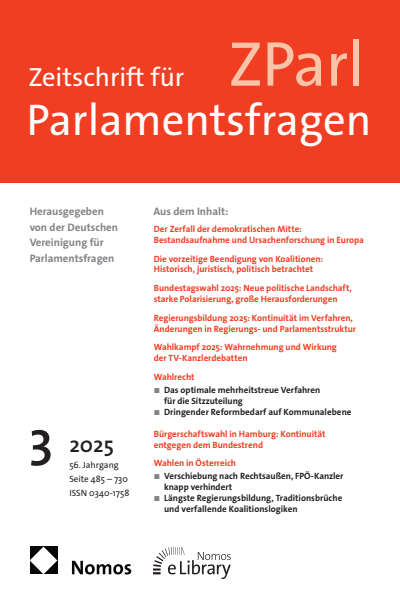
The coalition negotiations following the Austrian National Council elections in 2024 developed into the longest government formation in the Second Republic and led to an oversized three-party coalition of the ÖVP, SPÖ and NEOS for the first time...
Traditional seat apportionment methods focus on proportionality in order to ensure equal suffrage. They may violate a property called majority preservation, though, as we expose on a number of recent elections in Germany. As such, a coalition of...
The federal election on February 23, 2025, was marked by high polarization, which focused mainly on the issue of migration, leading to a record turnout of 82.5 percent. The Union (CDU/CSU) achieved 28.5 percent, but fell short of expectations, while...
The outcome of the Hamburg state election held on March 2, 2025, was principally shaped by city-specific issues, despite the extraordinary context of an early federal election just one week prior, which was triggered by the collapse of the federal...
The Austrian National Council election on September 29, 2024 marks the endpoint of the longest legislative period since the extension of the term of office in 2007. There have been five elections since then, and it was only the second time that it...
After the break-up of the traffic light coalition in November 2025, the question of confidence was used to bring about early general elections. Mathematically and politically, the results allowed only for a coalition between the CDU/CSU and the SPD....
In the last two weeks of the 2025 federal election campaign, the chancellor candidates from the CDU/CSU, SPD, Bündnis 90/Die Grünen, and AfD parties met in three televised debates in various constellations, continuing a tradition of televised...