, to see if you have full access to this publication.
Journal Partial access
ZParl Zeitschrift für Parlamentsfragen
Zeitschrift für Parlamentsfragen
Editors:
Deutsche Vereinigung für Parlamentsfragen | Chefredaktion: Prof. Dr. Suzanne S. Schüttemeyer, Martin-Luther-Universität Halle-Wittenberg | Mitglieder der Redaktion: Prof. Dr. Jörg-Detlef Kühne, Leibniz Universität Hannover; Prof. Dr. Werner J. Patzelt, Technische Universität Dresden; Thomas Hadamek, Ministerialrat, Verwaltung des Deutschen Bundestages, Berlin; Prof. Dr. Sven T. Siefken, Hochschule des Bundes für öffentliche Verwaltung. Beauftragter des Vorstands der DVParl: Prof. Dr. Heinrich Oberreuter, Universität Passau. Gründer der Zeitschrift: Winfried Steffani† und Uwe Thaysen †
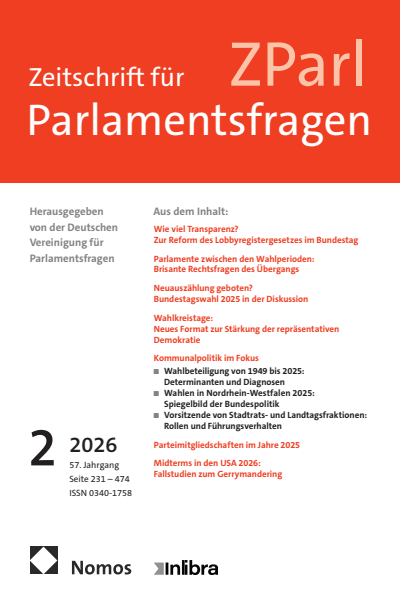
At the 2025 German federal election, the Bündnis Sahra Wagenknecht (BSW) missed the five-percent threshold by just 9,529 votes. Strikingly, in numerous electoral districts the similarly named Bündnis Deutschland – placed next to the BSW on the...
Voter turnout in local elections in Germany’s territorial states has declined significantly since the 1980s. Research mainly attributes this downward trend to the general decrease in political participation and to the horizontal and vertical...
The 2025 local elections in North Rhine-Westphalia signal a structural transformation of the municipal party system. The CDU and SPD recorded their historically weakest results, while the AfD achieved substantial gains and became institutionally...
Can strategically motivated redistricting help large U.S. states counteract the historically recurring seat losses of the president’s party in the midterm elections? Using Texas and California – together accounting for over 20 percent of the...
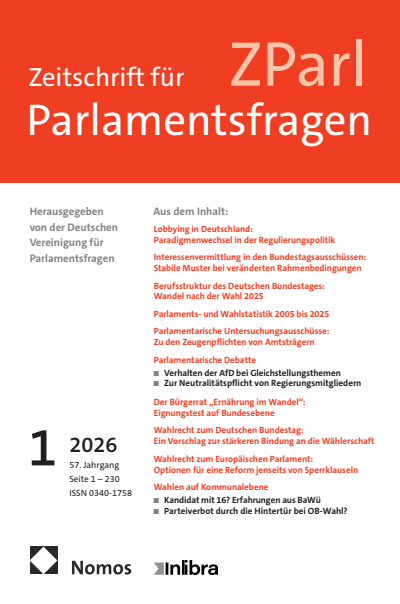
Beginning in the middle of the 2010s in Germany a couple of legal norms were adopted concerning the regulation of lobbying that on the whole can be assessed as a paradigmatic change. The reforms had been made possible by a convergence between the...
Newly elected parliaments establish their institutional capacity to act during their constituent sessions. Normally, these are purely performative debates, but they can escalate into conflicts and legal disputes that put the system’s resilience to...
Between March 2023 and May 2024, 17 so-called Constituency Days were held as part of the project Hallo Bundestag. In this format, 20 to 35 constituents selected through outreach random selection from the civil registers of a constituency discuss a...
What do parliamentary group leaders expect of themselves, what factors influence political leadership, and what tools are used to ensure party discipline? This pilot study explores these questions on the basis of eight structured interviews with...
For elections to the European Parliament in Germany, an electoral system is used that entails four major disadvantages: (1) there is no mechanism to ensure a regionally balanced distribution of representatives; (2) closed party lists prevent a close...
Parliamentary democracy is in crisis, and society’s trust in democratic institutions and their representatives is dwindling. While plebiscites are considered a risky option for alleviating these problems in times of right-wing populism, interest...
How the Bundestag works depends largely on the skills and abilities of its members. The expertise of MPs is determined in particular by their previous professional experience. Building on earlier studies, changes in the parliamentary composition can...
At the center of this mixed methods study is the research question, how the parliamentary communication on gender equality issues has deteriorated since the Alternative for Germany (AfD) has entered the German Bundestag. The analysis is based on a...
In German politics for a long time, issues of lobbying regulation were put on the political agenda only in some periods and with varying subjects. Only at the beginning of the 2000s the isolated rules were recognized by political actors as a...
This article extends previous data collections on interest articulation in the committees of the German Bundestag. The analysis shows a further increase in the relevance of expert participation, without a corresponding expansion in the number of...
So far, the literature on descriptive youth representation in parliaments has mostly focused on the national and occasionally in federal states on the subnational level. We broaden this focus by analyzing the local level that often serves as an...
Public officials play a particularly important role in the work of parliamentary committees of inquiry. Thanks to their official knowledge, they can explain contexts to members of parliament that cannot be gleaned from reading files alone. In...
In the direct election of the mayor of Ludwigshafen in 2025, the candidate of the Alternative for Germany (AfD) party was not allowed to stand for election because of doubts about his loyalty to the constitution. The AfD criticized this as “a...
This article examines the limits of government information and expression activities in the context of parliamentary debates. It explores the extent to which members of the government are subject to a duty of political neutrality when speaking in...