, to see if you have full access to this publication.
Journal Partial access
ZParl Zeitschrift für Parlamentsfragen
Zeitschrift für Parlamentsfragen
Editors:
Deutsche Vereinigung für Parlamentsfragen | Chefredaktion: Prof. Dr. Suzanne S. Schüttemeyer, Martin-Luther-Universität Halle-Wittenberg | Mitglieder der Redaktion: Prof. Dr. Jörg-Detlef Kühne, Leibniz Universität Hannover; Prof. Dr. Werner J. Patzelt, Technische Universität Dresden; Thomas Hadamek, Ministerialrat, Verwaltung des Deutschen Bundestages, Berlin; Prof. Dr. Sven T. Siefken, Hochschule des Bundes für öffentliche Verwaltung. Beauftragter des Vorstands der DVParl: Prof. Dr. Heinrich Oberreuter, Universität Passau. Gründer der Zeitschrift: Winfried Steffani† und Uwe Thaysen †
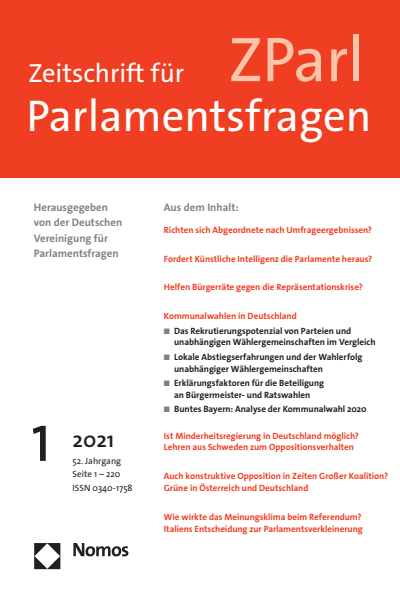
In Germany, Independent Local Lists (UWG) have become an integral part of local politics in recent decades . Despite their growing political importance, the reasons for their electoral rise have hardly been researched . Recent studies argue that...
Since the 1990s, direct democracy has been the favored method to combat the weakness of representative institutions in Germany . In recent years, its proponents-not least the Greens and the SPD-have had a change of heart . Instead of plebiscitary...
The digital transformation is permanently changing the government, administration, and society . This process is being intensified by the much-discussed technologies of artificial intelligence, and poses a variety of challenges for parliaments and...
Despite their crucial role for democratic decision-making, local elections receive little attention from political science research . To overcome this shortcoming, the article analyses the Bavarian local elections of 2020 . Although the CSU...
Voter turnout in German local elections has only been partially examined in comparative analysis . Derived from the state of research, this analysis focuses-on the link between explanatory factors and voter turnout especially in city council and...
In order to analyze which topics are used by the German and Austrian Green parties when proposing bills in times of Grand Coalitions, we use data from a content analysis of all bills these parties proposed from 2007-2008 and 2013-2017 based on the...