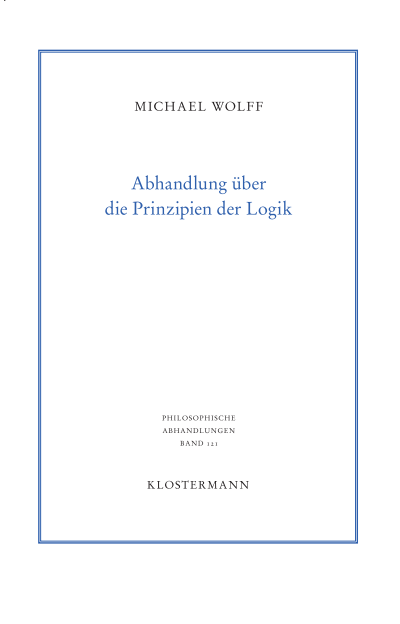
Abhandlung über die Prinzipien der Logik
Eine Verteidigung des logischen Monismus- Authors:
- Series:
- Philosophische Abhandlungen, Volume 121
- Publisher:
- 2023
Summary
The question which of the many divergent modern logic systems contains "the one, correct" logic is readily dismissed by logicians: there is no such logic. In Michael Wolff's book this question is treated differently, namely by applying the method of logical-semantic language analysis to the languages of logic themselves. This analysis shows that the view held by Frege, Hilbert and others that logical vocabulary of syllogistics is replaceable without change of meaning by truth-functional and quantor-logical expressions and by expressions of the class calculus, respectively, is untenable. The logical vocabulary of syllogistics is sufficient to express all valid rules and laws of deductive logic. On the other hand, rules and laws that can be formulated only in the language of one of the modern systems of "classical" and "non-classical" logic turn out not to be generally valid, since their validity is not based exclusively on the meaning of the logical vocabulary used. These systems together implicitly presuppose the validity of syllogistics (as the one, correct logic) and are derivable from it. How this derivation is to be accomplished exactly and without gaps is shown in detail in Wolff's book. It follows a method already developed in the school of Aristotle.
Keywords
Search publication
Bibliographic data
- Copyright Year
- 2023
- ISBN-Print
- 978-3-465-04615-8
- ISBN-Online
- 978-3-465-14615-5
- Publisher
- Klostermann, Frankfurt am Main
- Series
- Philosophische Abhandlungen
- Volume
- 121
- Language
- German
- Pages
- 454
- Product Type
- Monograph
Table of contents
- Titelei/Inhaltsverzeichnis No access Pages I - XII
- VORWORT ZUR DRITTEN AUFLAGE No access Pages XIII - XXII
- EINLEITUNG No access Pages 1 - 4
- § 1. Syllogistische Satzschemata No access
- § 2. Auf der Suche nach einer Universalsprache der deduktiven Logik No access
- § 3. Das logische Vokabular der assertorischen Syllogistik No access
- § 4. Ergänzungen des logischen Vokabulars der assertorischen Syllogistik No access
- § 5. Die kategorische Form No access
- § 6. Das logische Vokabular der modalen Syllogistik No access
- § 7. Die Unentbehrlichkeit des logischen Vokabulars der modalen Syllogistik No access
- § 8. Das Bivalenz-Prinzip No access
- § 9. Das Prinzip des ausgeschlossenen Dritten No access
- § 10. Wahrheitsfunktionale und nicht-wahrheitsfunktionale Verneinung No access
- § 11. Das starke logische Quadrat assertorischer Gegensätze No access
- § 12. Das schwache logische Quadrat assertorischer Gegensätze No access
- § 13. Das logische Quadrat modaler Gegensätze No access
- § 14. Syllogistische und nicht-syllogistische Modalausdrücke No access
- § 15. Sonstige Ausdrücke in der Sprache der elementaren Syllogistik No access
- § 16. Das Vokabular des Klassenkalküls No access
- 17. Das starke logische Quadrat assertorischer Gegensätze in der Sprache des Klassenkalküls No access
- § 18. Das Problem der leeren Klasse No access
- § 19. Alternative Theorien No access
- § 20. Gründe für eine Modifikation des Übersetzungsprogramms No access
- § 21. Nullklasse und leere Begriffsumfänge No access
- § 22. Übersetzung klassenlogischer Satzschemata in die Sprache der Syllogistik No access
- § 23. Zurückführung klassenlogischer Schlußweisen auf syllogistische Schlußweisen No access
- § 24. Vorteile einer Transformation der Sprache des Klassenkalküls in die Sprache des Funktionenkalküls No access
- § 25. Die Wiedergabe von Begriffsausdrücken durch Funktionsausdrücke No access
- § 26. Die Funktionentheorie des Begriffs No access
- § 27. Grammatische und logische Prädikate No access
- § 28. Anmerkungen zur Funktionentheorie des Begriffs No access
- § 29. Subordination von Begriffen in der Sprache des Funktionenkalküls No access
- § 30. Wahrheitsfunktionen und ihre Zurückführung auf nicht-wahrheitsfunktionale Formen No access
- § 31. Eine Erweiterung der Sprache der Syllogistik No access
- § 32. Die kategorische Form in der Sprache des Funktionenkalküls No access
- § 33. Die logische Form singulärer Sätze No access
- § 34. Quantorenregeln und schwaches logisches Quadrat No access
- § 35. Die Voraussetzung nicht-leerer Individuenbereiche No access
- § 36. Eine Formelsprache des nicht-reinen Denkens No access
- § 37. Anschauungsbezug und symbolische Konstruktion No access
- § 38. Das Problem synthetischer Sätze a priori in der Arithmetik No access
- § 39. Nicht-syllogistische Grundregeln in der Sprache der Syllogistik No access
- § 40. Die Entbehrlichkeit eines Ausdrucks für die logische Konjunktion in der syllogistischen Elementarsprache No access
- § 42. Notation No access
- § 43. Definitionen No access
- § 44. Grundregeln No access
- § 45. Aus den Grundregeln abgeleitete Regeln No access
- 1. Vorbemerkung No access
- § 46. Notation No access
- § 47. Definitionen No access
- § 48. Grundregeln No access
- § 49. Abgeleitete Regeln No access
- § 50. Konditionalisierung No access
- 1. Vorbemerkung No access
- § 51. Notation No access
- § 52. Definitionen No access
- § 53. Grundregeln No access
- § 54. Regeln des starken und schwachen logischen Quadrats No access
- § 55. Konversionsregeln No access
- § 56. Kategorische Syllogismen No access
- § 57. Allgemeingültige Satzschemata No access
- 1. Vorbemerkung No access
- § 58. Notation No access
- § 59. Definitionen No access
- § 60. Grundregeln No access
- § 61. Modale Folgerungsregeln No access
- § 62. Modale Konversionsregeln No access
- § 63. Modale Syllogismen No access
- § 64. Notation No access
- § 65. Erläuterungen zur Notation No access
- § 66. Beispiele inhaltlichen syllogistischen Schließens No access
- § 67. Abkürzungsregeln No access
- § 68. Beispiele inhaltlichen syllogistischen Schließens (Fortsetzung) No access
- § 69. Weitere Abkürzungsregeln No access
- § 70. Notation No access
- § 71. Definitionen No access
- § 72. Postulate No access
- § 73. Metalogische Regeln No access
- § 74. Ableitung wahrheitsfunktionaler Regeln No access
- § 75. Ableitung wahrheitsfunktionaler Gesetze No access
- § 76. Inhaltliches Schließen No access
- § 77. Notation No access
- § 78. Ein axiomatisches System des logischen Funktionenkalküls No access
- § 79. Definitionen No access
- § 80. Theoreme des Funktionenkalküls No access
- § 81. Korrektheit und Vollständigkeit No access
- § 82. Prinzipien und Regeln, von denen das vollständige Systemdes Funktionenkalküls abhängt No access
- § 83. Logische Form: Ein Rückblick auf gewonnene Ergebnisse No access
- § 84. Stadien in der Geschichte der Logik No access
- ANHANG 1: ZUR VOLLSTÄNDIGKEIT EINER SYLLOGISTIK OHNE LOGISCHE KONJUNKTION (zu § 40) No access Pages 372 - 377
- ANHANG 2: MATHEMATISCHE INDUKTION OHNE PRÄDIKATENLOGIK HÖHERER STUFE (zu § 28 und § 37) No access Pages 378 - 385
- ANHANG 3: ZURÜCKFÜHRUNG WAHRHEITSFUNKTIONALER AUSDRÜCKE AUF NICHT-WAHRHEITSFUNKTIONALE AUSDRÜCKE (zu § 30) No access Pages 386 - 389
- ANHANG 4: VERTRÄGLICHKEIT UND UNVERTRÄGLICHKEIT (zu § 30) No access Pages 390 - 393
- ANHANG 5: MODERNE NICHT-SYLLOGISTISCHE SYSTEME DER MODALLOGIK IN IHREM VERHÄLTNIS ZUR MODALEN SYLLOGISTIK (zu den §§ 58 bis 63) No access Pages 394 - 408
- ANHANG 6: NICHT-KLASSISCHE LOGIKSYSTEME IN IHREM VERHÄLTNIS ZUM LOGISCHEN FUNKTIONENKALKÜL No access Pages 409 - 414
- ANHANG 7: DIE BARCAN-FORMEL No access Pages 415 - 417
- ANHANG 8: ÜBER BIVALENZ (zu den §§ 6 bis 9) No access Pages 418 - 423
- ANHANG 9: ABSOLUTE LOGISCHE KONSTANTEN No access Pages 424 - 426
- VERZEICHNIS DER VERWENDETEN SYMBOLE No access Pages 427 - 428
- ÜBERSICHT ÜBER DIE IN DEN BEWEISEN DES TEILS II HAUPTSÄCHLICH BENUTZTEN REGELN No access Pages 429 - 430
- VERZEICHNIS METALOGISCHER REGELN, DIE IN DEN BEWEISEN DES TEILS II BENUTZT WERDEN No access Pages 431 - 431
- VERZEICHNIS SYLLOGISTISCHER REGELN, DIE IN DEN GÜLTIGKEITSBEWEISEN ASSERTORISCHER SYLLOGISMEN (IN § 56) UNMITTELBAR BENUTZT WERDEN No access Pages 432 - 432
- VERZEICHNIS MODAL-SYLLOGISTSCHER REGELN, DIE IN DEN GÜLTIGKEITSBEWEISEN MODALER SYLLOGISMEN (IN § 63) UNMITTELBAR BENUTZT WERDEN No access Pages 433 - 434
- VERZEICHNIS DER ZUR ABLEITUNG WAHRHEITSFUNKTIONALER REGELN UND GESETZE (IN § 74 UND § 75) UNMITTELBAR BENUTZTEN LOGISCHEN REGELN No access Pages 435 - 435
- LITERATURVERZEICHNIS No access Pages 436 - 443
- SACHREGISTER No access Pages 444 - 452
- PERSONENREGISTER No access Pages 453 - 454