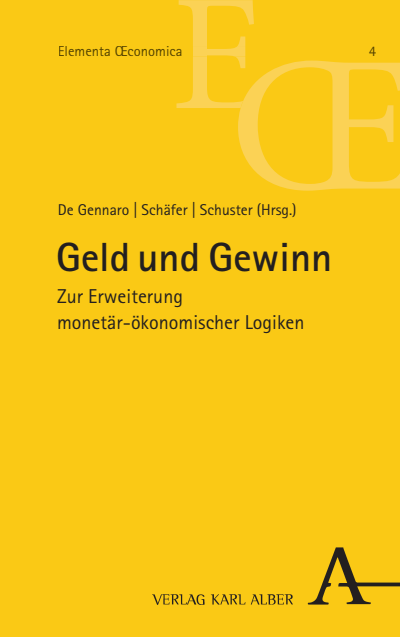
Geld und Gewinn
Zur Erweiterung monetär-ökonomischer Logiken- Editors:
- | |
- Series:
- Elementa Œconomica, Volume 4
- Publisher:
- 2022
Summary
The established economics translate profits of all kinds into monetary rents. At the same time, the application area of this approach is constantly expanding, as exemplarily shown by the integration of care work and environmental economics. However, the reduction of the economic to monetary-economic logics is a very recent – and, considering the history of ideas, controversial – operation. This volume gathers contributions from the philosophy of economics, which identify broader concepts of profit from the political economy of the ancient world, approaches of the gift economy and the economics of the mafia, and thus attempt to provide new ways of understanding the economic and to question the established economic paradigm. With contributions byIrene Colombi, Dr. Marc Frick, Dr. Christian Kremser, PD Dr. Reiner Manstetten, Prof. Dr. Birger P. Priddat, Prof. Masatoshi Sasaki, Georg Schäfer, Prof. Dr. Annika Schlitte, Sören E. Schuster, Dr. Michaël Suurendonk and Dr. Tanja von Egan-Krieger.
Keywords
Search publication
Bibliographic data
- Copyright Year
- 2022
- ISBN-Print
- 978-3-495-99894-6
- ISBN-Online
- 978-3-495-99895-3
- Publisher
- Karl Alber, Baden-Baden
- Series
- Elementa Œconomica
- Volume
- 4
- Language
- German
- Pages
- 286
- Product Type
- Edited Book
Table of contents
- Titelei/Inhaltsverzeichnis No access Pages 1 - 10
- Authors:
- Der Markt als Wahrheits(T)raum für den Maschinen-Menschen No access
- Die Dogmengeschichte als Agententhriller, oder wie man eine betrügerische Gegenwart durch detektivische Beweisführung aus der Vergangenheit aufklärt No access
- Agnotologie, Wille zur Ignoranz, Doppelwahrheit, schlüpfrige Pfade des großen Niemand, und der Verlust dichterischer Weisheit No access
- Wille zu Macht, Nihilismus, Immunologie, Anthropotechnik und Heimatverlust aus Seinsvergessenheit No access
- 2. Die Entscheidung No access
- Glauben-Machen als Einkommensquelle und Herrschaftsgrundlage feiner Leute No access
- Bedeutung von »feine Leute« und »leisure class« auf sprachlicher Ebene No access
- Die Eigentumsordnung als rechtlich abgesichertes Glaubenmachen durch feine Leute No access
- Finanzkapital, Kreditexpansion und Inflation aller Geldwerte: Glaubenmachen durch abwesende Eigentümer (feine Leute) No access
- Legalisiertes Glaubenmachen als abergläubisches Gehirngespinst aus Imponderabilien und Einnahmequelle der feinen Leute No access
- Werbung als Fabrizierung massentauglicher und trügerischer Überzeugungen im System des Glaubenmachens feiner Leute No access
- Wirtlicher Gewinn aus dichterischer Wahrheit No access
- Authors:
- 1. Einleitung No access
- 2. Die unternehmerische Mafia als Gegenstand der Forschung No access
- 3.1 Die ursprüngliche Mafia No access
- 3.2 Von der Subsistenzwirtschaft zu hohen Umsätzen – die Entstehung der unternehmerischen Mafia No access
- 3.3 Die unternehmerische Mafia in der wirtschaftlichen Grauzone No access
- 3.4 Die Organisationsstruktur der unternehmerischen Mafia – zwischen Netzwerken und Zentralisierung No access
- 4. Zum Spannungsfeld »Macht« vs. »monetärer Profit« – ein Ausblick No access
- Authors:
- 1.1 Kritik an ungerechter Verteilung No access
- 1.2 Kommodifizierungskritik und die Frage nach dem guten Leben No access
- 2. Alternative Wirtschaftsakteure und ihre Kritik an den Werten, Normen und »Logiken« der bestehenden Wirtschaft No access
- 3. Die systemischen Wirkungen des Marktes No access
- 4. Ökonomisierung No access
- 5. Fazit: Einbettung und Begrenzung von Märkten No access
- Authors: |
- Vorbemerkung No access
- Einleitung No access
- Der Tausch auf dem Markt No access
- Der Markt, seine Grenzen und ihre Überschreitung No access
- Zur Person Marcel Mauss und zur Intention von Die Gabe No access
- Gabenpraktiken No access
- Potlatsch No access
- Kula-Ring No access
- Die Gabe – Geschenk oder Tauschgegenstand? No access
- Kategorien der Beschreibung des Gabentauschs No access
- Die M.A.U.S.S.-Bewegung No access
- Agape und Gabe bei Paul Ricoeur No access
- Agape und soziale Gerechtigkeit No access
- Würde des Menschen No access
- Authors:
- 1. Einleitung No access
- 2. Ökonomische Utopien in der Geschichte des ökonomischen Denkens No access
- 3.1 Johann Gottlieb Fichte No access
- 3.2 John Stuart Mill No access
- 3.3 Karl Marx No access
- 3.4 Oscar Wilde No access
- 3.5 John Maynard Keynes No access
- 3.6 Bertrand Russell No access
- 4. Die normativen Grundlagen der Wirtschaftstheorie No access
- Authors:
- Ökonomie als Komplexion diverser Allokationsformen No access
- Das wirtschaftliche Feld: der Nexus verschiedener Allokationsformen No access
- Die Allokationsformen im Einzelnen No access
- E-commerce als Gabenökonomie: digitale Ökonomie. Neue Allokationsformate I No access
- Digitale Ökonomie (II) als hybrides Arrangement von Gaben, Märkten und Nicht-Märkten No access
- Multipler Nexus der Allokation: über die sechsfache Verschränkung von Märkten und Nichtmärkten. Neue Allokationsformate II No access
- Ein joint utility-Argument: Ethik der Aggregation No access
- Und fortan? No access
- Authors:
- 1. No access
- 2. No access
- 3. No access
- 4. No access
- 5. No access
- Authors:
- The Anthropocene Mode of Production No access
- From an Inland Sea to the Great American Desert No access
- The First Wave: the Cattle Kingdom, 1865–1886 No access
- The Second Wave: the Sod House Era, 1886–1895 No access
- The Third Wave: the Rise of Factory Farming, 1895–1931 No access
- The Fourth Wave: the Irrigation Empire, 1950s to Present No access
- Conclusion No access
- Authors:
- Der griechische Staat in Nietzsches Frühwerk No access
- Einige Vorbemerkungen: Nietzsches Oncken-Lektüre und die quellenorientierte Analyse No access
- Onckens Aristoteles als Ressource für Nietzsche No access
- Arbeit und Würde im griechischen Staat No access
- Zur Entstehung des Staates No access
- Gewinnkonzeption der Ökonomie und Blüten der Gesellschaft No access
- Der griechische Staat und die »Geldaristokratie« No access
- Ausblick No access
- Authors:
- The Basic Axioms of Economic Thinking No access
- Example 1: The Obliteration of Love No access
- Example 2: The Destruction of Trust No access
- Two Types of Necessity: Causality and Autonomy No access
- The Source and Worth of Dignity No access
- Autorinnen und Autoren No access Pages 283 - 286