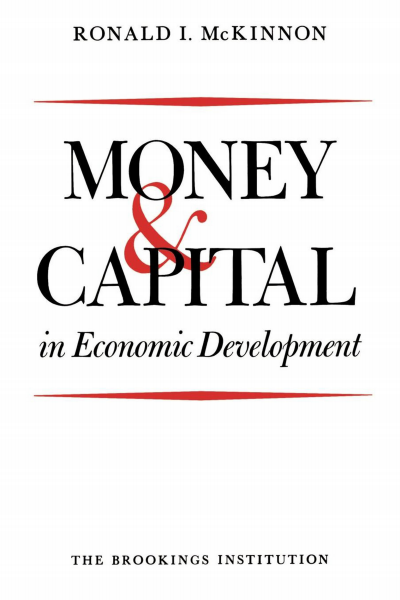
Money and Capital in Economic Development
- Authors:
- Publisher:
- 2010
Summary
This books presents a theory of economic development very different from the "stages of growth" hypothesis or strategies emphasizing foreign aid, trade, or regional association. Leaving these aside, the author breaks new ground by focusing on the use of domestic capital markets to stimulate economic performance. He suggests a "bootstrap" approach in which successful development would depend largely on policy choices made by national authorities in the developing countries themselves.
Central to his theory is the freeing of domestic financial markets to allow interest rates to reflect the true scarcity of capital in a developing economy. His analysis leads to a critique of prevailing monetary theory and to a new view of the relation between money and physical capitala view with policy implications for governments striving to overcome the vicious circle of inflation and stagnation. Examining the performance of South Korea, Taiwan, Brazil, and other countries, the author suggests that their success or failure has depended primarily on steps taken in the monetary sector. He concludes that monetary reform should take precedence over other development measures, such as tariff and tax reform or the encouragement of foreign capital investment. In addition to challenging much of the conventional wisdom of development, the author's revision of accepted monetary theory may be relevant for mature economies that face monetary problems.
Search publication
Bibliographic data
- Edition
- 1/2010
- Copyright Year
- 2010
- ISBN-Print
- 978-0-8157-5613-2
- ISBN-Online
- 978-0-8157-1849-9
- Publisher
- Rowman & Littlefield, Lanham
- Language
- English
- Pages
- 184
- Product Type
- Monograph
Table of contents
- Contents No access
- 1. Introduction No access Pages 1 - 4
- The Fragmented Economy No access
- Liberalization and the Capital Market No access
- Production Opportunities, Wealth, and External Finance: A Fisherian Approach No access
- Indivisible Investments and Technological Innovation No access
- The Importance of High Rates of Interest No access
- Uncertainty and Leverage No access
- Technical Note No access
- Self-Finance and the Distribution of Income No access
- Unemployment and Factor Proportions: Rates of Interest Again No access
- The Tax-Subsidy Solution and the Theory of the Second-Best No access
- 4. Money and the Price Level No access Pages 37 - 41
- Substitution between Money and Physical Capital No access
- The Golden Rule and the Full-Liquidity Rule No access
- Difficulties with the Neoclassical Approach and the Bias toward Inflation No access
- Technical Note No access
- Complementarity between Money and Physical Capital No access
- Optimization within the New Model No access
- Nonmonetary Financing and Complementarity No access
- Policy Implications of the New Approach: A Summary No access
- Banking Restraint and Its Consequences for Traditional Credit Markets No access
- Common Policy Responses to Financial Repression No access
- A Preferred Strategy for Overcoming Repression No access
- How Not to Relieve Financial Repression: Brazil in the Mid-1960s No access
- Orthodox Deflation and the Supply Constraint No access
- Sustained Financial Growth: Germany and Japan from 1953 to 1970 No access
- The Choice of a Price Index for Measuring the Real Return on Money No access
- Monetary Growth, Self-Finance, and Intersectoral Flows of Saving No access
- Notes on Financial Decline in Argentina, Brazil, and Chile No access
- Sensitivity of Time and Savings Deposits No access
- Financial Reform without Tears: Korea, 1964-70 No access
- Monetary Growth in Indonesia with Constraints on Bank Lending No access
- Receding Inflation and Declining Interest Rates in Taiwan No access
- Summary No access
- The Optimum Supply of Monetary Services No access
- Growth and Saving: The Virtuous Circle No access
- Tax Neutrality and the Wellsprings of Export Revival No access
- Indirect Taxation and the Problem of Revenue Inelasticity No access
- From Tariffs to the Value Added Tax No access
- From Tariffs to Consumer Excises No access
- Concluding Comment No access
- Some Unhappy Evidence from Past Reforms No access
- Pitfalls in Partial Liberalization with Foreign Capital: The Alpha Economy No access
- Full Liberalization without Foreign Capital: The Beta Economy No access
- Misaligned Interest Rates and Capital Inflows: Korea Again No access
- Optimal Monetary Policy and a Gliding Foreign Exchange Parity No access
- On Restricting Inflows of Short-Term Capital No access
- Foreign Direct Investment: Were the Japanese Right? No access
- Investment and Credit Guarantees by Wealthy Countries No access
- Unbiased Absorption of International Capital No access
- A No access
- B No access
- C No access
- D No access
- E No access
- F No access
- G No access
- H No access
- I No access
- J No access
- K No access
- L No access
- M No access
- N No access
- O No access
- P No access
- Q No access
- R No access
- S No access
- T No access
- U No access
- V No access
- W No access
- Y No access