Monograph Open Access Full access
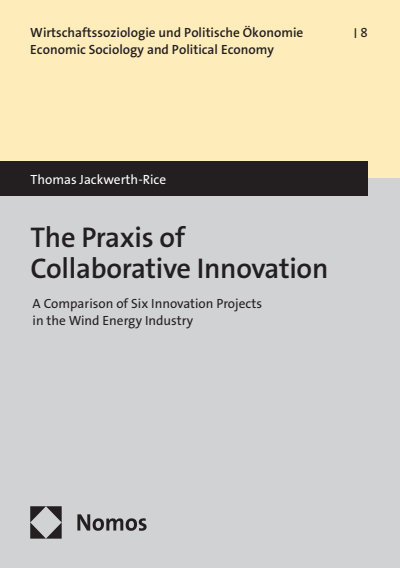
The Praxis of Collaborative Innovation
A Comparison of Six Innovation Projects in the Wind Energy Industry- Authors:
- Series:
- Wirtschaftssoziologie | Economic Sociology, Volume 8
- Publisher:
- 2025
Summary
How do new technologies emerge? This book shows: Not through rigid plans, but through shared social praxis. Using the wind energy sector as an example, the author analyzes how innovation processes are shaped – or blocked – by social norms, standards and power constellations. The book systematically analyzes the institutional barriers to collaborative innovation projects and shows that shared working standards are the silent backbone of any successful technology collaboration. The author provides new food for thought for sociologically based innovation management and the management of open innovation. The book is aimed at practitioners, researchers and policy makers alike.
Keywords
Search publication
Bibliographic data
- Edition
- 1/2025
- Copyright Year
- 2025
- ISBN-Print
- 978-3-7560-0112-5
- ISBN-Online
- 978-3-7489-4722-6
- Publisher
- Nomos, Baden-Baden
- Series
- Wirtschaftssoziologie | Economic Sociology
- Volume
- 8
- Language
- English
- Pages
- 223
- Product Type
- Monograph
Table of contents
ChapterPages
- Titelei/InhaltsverzeichnisPages 1 - 16 Download chapter (PDF)
- 1.1 The research question
- 1.2 The social process of collaborative innovation
- 1.3 A sociological approach to innovation management
- 1.4 The praxis of collaborative innovation
- 1.5 Structure of this book
- 2.1.1 Rules and practices of IP management
- 2.1.2 Preliminary conclusions: Blind spots in the open innovation debate
- 2.2.1 Knowledge boundaries – The cognitive barriers of collaborative innovation
- 2.2.2 Types of barriers to collaborative innovation and knowledge integration
- 3.1 The institutional elements of innovation projects
- 3.2 Standards of technology development
- 3.3.1 Proposition 1: Monitoring technical standards and sanctioning their non-conformity
- 3.3.2 Proposition 2: Establishing a praxis of collaborative problem-solving
- 3.3.3 Proposition 3: Adapting technical standards from adjacent fields
- 4.1 The process of “casing”
- 4.2 The structure of the empirical chapters
- 4.3 Discussing rigor criteria
- 4.4.1 Wind energy technologies
- 4.4.2 Patterns of technological innovation
- 4.4.3 Data collection and problem-centered interviews
- 5.1.1 Case A: An incumbent supplier and market leader
- 5.1.2 Case B: A newcomer and niche product supplier
- 5.2.1 Case A: Highly regulated product development
- 5.2.2 Case B: A new component supply relation
- 5.3.1 Case A: Imposing technical standards
- 5.3.2.1 Central control of component developers
- 5.3.2.2 Working standards that control sub-component suppliers
- 5.3.2.3 Personal inspection and transparent manufacturing
- 5.3.2.4 Homogeneous knowledge on both sides of the partnership
- 5.3.2.5 Preliminary conclusions
- 5.3.3.1 The power to control technology development
- 5.3.3.2 Technical interfaces as a power instrument
- 5.3.3.3 Trying to leave the market niche
- 5.3.3.4 Preliminary conclusions
- 5.4.1 Case A: Loss of innovation capabilities
- 5.4.2 Case B: Remaining trapped in a market niche
- 5.5 Interim conclusions
- 6.1.1.1 An engineering service provider as “boundary spanner”
- 6.1.1.2 The general contractor and project coordinator
- 6.1.2 Case D: A newly established innovation network
- 6.2.1 Case C: Specifying a radical innovation
- 6.2.2 Case D: Establishing an innovation network
- 6.3 Realizing technology development
- 6.4.1.1 Using a boundary object
- 6.4.1.2 No common interest in “knowledge transfer”
- 6.4.1.3 Preliminary conclusions
- 6.4.2.1 A praxis of collaborative material testing
- 6.4.2.2 No power to socially close the approval procedure
- 6.4.2.3 Depending on a small number of experts
- 6.4.2.4 Preliminary conclusions
- 6.5.1 Case C: ‘Blind spots’ of technology development
- 6.5.2 Case D: Institutional concentration of expertise
- 6.6 Interim conclusions
- 7.1.1 New environmental regulations
- 7.1.2 The major players
- 7.1.3 Cases E & F: Two system suppliers, two solutions
- 7.2.1 Case E: Relying on individual creativity and inventiveness
- 7.2.2 Case F: Technology transfer from oil and gas
- 7.3.1.1 Imagining new solutions “in the mind”
- 7.3.1.2 Personal conviction instead of collaborative innovation
- 7.3.1.3 A collaborative approach to technical invention
- 7.3.1.4 Preliminary conclusions
- 7.3.2.1 A unique offshore engineering competence
- 7.3.2.2 A strategic approach to trust-building
- 7.3.2.3 Preliminary conclusions
- 7.4.1 Case E: Lacking trust in system suppliers
- 7.4.2 Case F: Lacking customer cooperation
- 7.5 Interim conclusions
- 8.1 The author’s main argument
- 8.2 Advancing innovation management research
- 8.3.1 Using coercive power to impose technical standards
- 8.3.2 Relying on personal trust to gain some control
- 8.3.3 Individual imagination vs. trial-and-error learning
- 8.4.1 Incremental innovation: Incumbents are bound to existing technical standards
- 8.4.2 Radical innovation: The inability to build coalitions with powerful actors
- 8.4.3 Emerging fields of technology development: The lacking legitimacy of system suppliers
- 8.5 Theoretical relevance
- 8.6 Practical relevance
- 8.7 Limitations and implications for future research
- 9.1 Interview guide
- BibliographyPages 209 - 223 Download chapter (PDF)