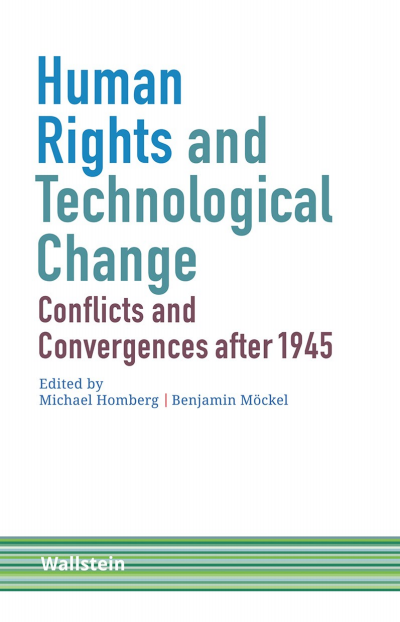
Human Rights and Technological Change
Conflicts and Convergences after 1945- Editors:
- |
- Publisher:
- 2022
Summary
Über das Spannungsverhältnis zwischen Menschenrechten und modernen Technologien für die Zeit seit dem Zweiten Weltkrieg.
Werkzeug der Unterdrückung oder Vehikel der Emanzipation? Moderne Technologien sind zu einem wichtigen Thema der Menschenrechtspolitik geworden. Überwachungstechnik, militärische Drohnen und digitale Datenanalysen stellen die internationale Menschenrechtsbewegung vor neue Herausforderungen. Gleichzeitig eröffnen diese Techniken auch neue Chancen, Menschenrechtsverletzungen zu dokumentieren, anzuprangern und ein zivilgesellschaftliches Engagement zu fördern. In diesem Band wird diese ambivalente Beziehung in historischer Perspektive analysiert.
Gezeigt wird, wie die Verbreitung moderner Technologien die Menschenrechtspolitik herausforderte und unterstützte. Hervorgehoben werden dabei vier Schlüsselbereiche: 1. Entwicklungspolitik, allen voran bei Infrastrukturen und technischen Großprojekten, 2. Bevölkerungspolitik und demographisches Wissen, 3. Medien- und Kommunikationstechnologien und 4. die gesellschaftlichen Auswirkungen der Computerisierung. Indem diese Debatten für die Zeit nach 1945 nachgezeichnet werden, erhalten aktuelle Diskussionen über die Herausforderungen neuer technologischer Entwicklungen eine historische Dimension.
Der Band erscheint vollständig in englischer Sprache.
Keywords
Search publication
Bibliographic data
- Copyright Year
- 2022
- ISBN-Print
- 978-3-8353-5165-3
- ISBN-Online
- 978-3-8353-4842-4
- Publisher
- Wallstein, Göttingen
- Series
- Schriftenreihe Menschenrechte im 20. Jahrhundert
- Language
- English
- Pages
- 392
- Product Type
- Edited Book
Table of contents
- Titelei/Inhaltsverzeichnis No access Pages 1 - 8
- Introduction: Human Rights and Technological Change No access Pages 9 - 34Authors: |
- »Powering Progress, Empowering People«? (Hydro)Electricity and Human Rights in Post/Colonial India,1920s-1990s No access Pages 37 - 62Authors:
- Rationalising the Workplace. The Bengal Jute Industry between the 1920s and the 1950s No access Pages 63 - 97Authors:
- The ILO, Asia, and the Beginnings of Technical Assistance, 1945-1960 No access Pages 98 - 124Authors:
- Reproductive Technologies, Contraceptives, and Human Rights No access Pages 127 - 148Authors:
- Contested Reproductive Rights. Population Technologies and the Quest for Individualism in the 1960s and 1970s No access Pages 149 - 167Authors:
- A Human Right or a Danger to the Future? Debates about Family Planning Between Parental Rights and Duties in 1960s West Germany No access Pages 168 - 186Authors:
- Freedom Fighter. Weapons and Rights in the Cold War No access Pages 189 - 209Authors:
- Innovation, Technology, and Humanitarianism. The Example of the International Committee of the Red Cross No access Pages 210 - 229Authors:
- Image Activists. Building Structures, Arguing with Images, and Cooperating with Media Actors at Amnesty International 1975-1985 No access Pages 230 - 254Authors:
- Origins of a Human Right to Privacy. The United Nations’ Debate on Science and Technology in the Context of the United States’ Domestic Politics No access Pages 257 - 280Authors:
- Computer Power to the People. West German Hackers’ Activism and Online Communication During the Yugoslavian Wars No access Pages 281 - 307Authors:
- Information and Communication Technologies in Human Rights Work in the 1990s No access Pages 308 - 328Authors:
- Into the Open. An Essay on Democratizing Social Media No access Pages 329 - 353Authors:
- Bibliography No access Pages 354 - 384
- Abbreviations and Acronyms No access Pages 385 - 387
- Contributors No access Pages 388 - 389
- Index of Persons No access Pages 390 - 392