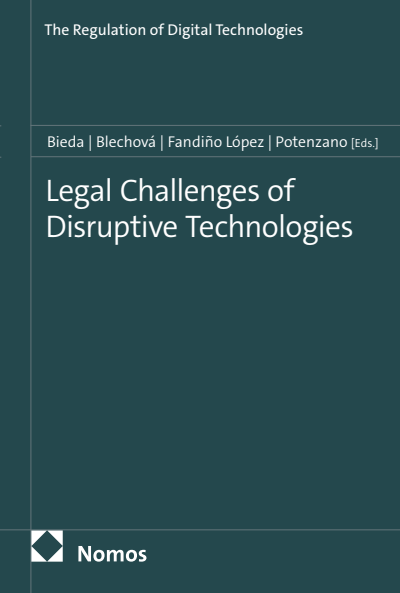
Legal Challenges of Disruptive Technologies
- Editors:
- | | |
- Series:
- The Regulation of Digital Technologies, Volume 2
- Publisher:
- 2025
Summary
The book provides a practical legal analysis of the most pressing challenges posed by emerging technologies, including AI, quantum technologies and cybersecurity. This is one of the first publications in the EU to explore the legal implications of quantum technologies. Major topics include AI and intellectual property law, company law, predictive analytics in criminal justice, data governance, legal tech and artificial intelligence law. At a time of rapid development in these technologies, this book provides essential guidance for all grappling with the issues raised by these technologies. Readers will gain key insights into navigating the complex landscape and understanding the legal frameworks that will shape the future of innovation. With contributions byAnna Blechová | Chiara Comberiati | Michal Czerniawski, PhD | Maria Dymitruk, PhD | Ezlbieta Dziuba | Margarita Maria Fandiño Lopez | Dominik Gabor | Jarosław Greser, PhD | Annachiara Isidori | Michalina Marcia | Sara Michielin | Viktoriia Rekrutiak | Prof. Giovanni Maria Riccio | Anamaria Stoia | Kamil Szpyt, PhD | Anastasia Vidaki
Keywords
Search publication
Bibliographic data
- Edition
- 1/2025
- Copyright Year
- 2025
- ISBN-Print
- 978-3-7560-3170-2
- ISBN-Online
- 978-3-7489-6054-6
- Publisher
- Nomos, Baden-Baden
- Series
- The Regulation of Digital Technologies
- Volume
- 2
- Language
- English
- Pages
- 326
- Product Type
- Edited Book
Table of contents
- Titelei/Inhaltsverzeichnis No access Pages 1 - 10
- Authors:
- A. Introduction No access
- B. Bias in classical AI: Legal standpoint No access
- C. Quantum AI and the risk of bias No access
- D. Addressing bias and framework gaps in quantum AI No access
- E. Conclusions No access
- Bibliography No access
- Authors:
- A. Introduction No access
- I. Hard law No access
- II. Soft law No access
- I. Quantum communication No access
- II. Quantum cybersecurity No access
- I. Justifications for incorporating quantum technologies into new cybersecurity regulations No access
- II. Arguments against incorporating quantum technologies into new cybersecurity regulations No access
- E. Conclusions No access
- Bibliography No access
- Authors:
- A. Introduction No access
- B. Definition and types of PA in policing and criminal proceedings No access
- C. PA and human rights concerns No access
- D. Explainability, right to information and PA No access
- E. Conclusions No access
- Bibliography No access
- Authors:
- A. Introduction No access
- I. Voicing AI – A tool that uses voice No access
- II. Streaming – A tool for capturing base material and disseminating the output of AI No access
- III. Deepfake – The effect of voicing AI No access
- I. The concept of personal right No access
- II. Voice as an element of the human image No access
- III. Voice of the deceased as part of the sanctity of the deceased No access
- 1. Protection under the Polish Civil Code No access
- 2. Protection under Polish copyright law No access
- I. The concept of commercialisation of personal rights No access
- II. Ways of commercialising voice as a personal right No access
- E. Beyond personal rights – A voice in EU law No access
- F. Conclusions No access
- Bibliography No access
- Authors:
- A. Introduction No access
- B. The challenges of data-sharing for governments No access
- C. Potential solutions No access
- D. Conclusions No access
- Bibliography No access
- Authors: |
- A. Introduction No access
- I. The extraterritorial scope of the GDPR: Basics No access
- II. The extraterritorial enforcement of the GDPR: What went wrong No access
- I. General overview No access
- II. Digital sovereignty, the ‘Brussels effect’ and protecting the values-based approach No access
- I. Criminalisation of data protection and AI-related wrongdoing at the EU level: First steps No access
- II. Criminalisation in the field of data protection No access
- III. Criminalising AI-related wrongdoings No access
- I. AI Office – An evolution instead of a revolution No access
- II. Impact of the criminal law regime on the extraterritorial enforcement of the AI Act No access
- III. Criminal law and challenges to the unilateral expansion of jurisdiction No access
- F. Conclusions No access
- Bibliography No access
- Authors:
- A. Introduction No access
- B. Defining AI and AI sex toys No access
- I. General remarks No access
- II. Types and sources of damage caused by AI sex toys No access
- III. Liability regimes for damage caused by AI sex toys No access
- 2. Contractual liability No access
- 3. Tort liability No access
- 4. Liability for damages caused by a dangerous product No access
- D. Conclusions and demands de lege ferenda No access
- E. Conclusions No access
- Bibliography No access
- Authors:
- A. Introduction No access
- B. TDM exception No access
- C. The application of Article 4 of the CDSM to AI systems No access
- D. Transparency obligations in the AI Act No access
- E. What is the future role of CCS? No access
- F. The question of remuneration No access
- G. Conclusions No access
- Bibliography No access
- Authors:
- A. Introduction No access
- B. Workflow of ML and the use of copyright-protected content No access
- I. Reproduction right (Infosoc) No access
- II. Limitations and exceptions (Infosoc) No access
- III. TDM (CDSM) No access
- IV. Limitations and exceptions (CDSM) No access
- D. Conclusions No access
- Bibliography No access
- Authors:
- A. Introduction No access
- B. Overview of the AI landscape No access
- C. Possible divisions of AI-related inventions No access
- D. Patentability requirements No access
- I. United States No access
- II. European Patent Office No access
- III. United Kingdom Intellectual Property Office No access
- I. Inventorship No access
- II. Ownership No access
- III. Person having ordinary skill in the art/person skilled in the art No access
- IV. Transparency No access
- V. Trade secrets No access
- G. Possible scenarios No access
- H. Conclusions No access
- Bibliography No access
- Authors:
- A. Introduction No access
- I. Applications, impacts and limits No access
- II. What about quality? A quick glance at EU quality schemes No access
- I. Blockchain technology for the enforcement of IPRs No access
- II. Towards more effective GI rights No access
- III. Lingering doubts No access
- D. Conclusions No access
- Bibliography No access
- Authors:
- A. Introduction No access
- B. State of the art No access
- I. Using AI systems: Obligation or choice? No access
- II. The choice of AI system: Tech-friendly directors? No access
- III. Using the AI system: Monitoring responsibilities and potential malfunctions No access
- D. Conclusions No access
- Bibliography No access
- Authors:
- A. Introduction No access
- B. The role of AI in the legal professions No access
- C. Use of AI legal tools in the daily practice of law No access
- D. Online legal platforms No access
- E. Potential risks due to the application of AI in the legal professions No access
- F. Conclusions No access
- Bibliography No access
- Authors: |
- A. Introduction No access
- B. What are synthetic data? No access
- C. Data in legal tech applications No access
- D. Data in the Polish Common Courts’ Judgments Portal: A case study No access
- E. Legislative background for synthetic data No access
- F. Are ML-based legal tech applications high-risk systems? No access
- G. Data quality requirements in high-risk case law-based legal tech applications No access
- I. Risk-management system No access
- J. Technical documentation No access
- K. Conclusions No access
- Bibliography No access
- Contributors No access Pages 321 - 324
- Editors No access Pages 325 - 326