, to see if you have full access to this publication.
Monograph No access
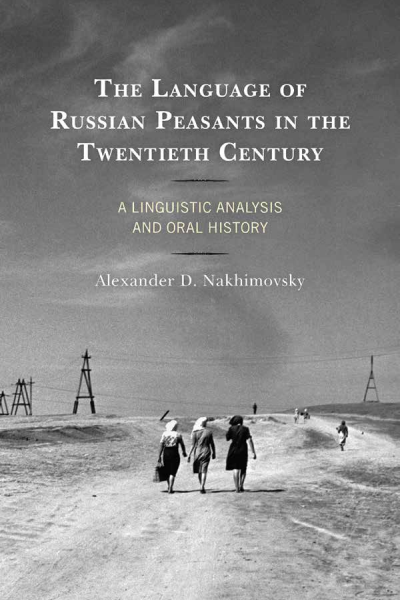
The Language of Russian Peasants in the Twentieth Century
A Linguistic Analysis and Oral History
Authors:
Publisher:
2019
Summary
The Language of Russian Peasants in the Twentieth Century: A Linguistic Analysis and Oral History analyzes the social dialect of Russian peasants in the twentieth century through letters and stories that trace their tragic history. In 1900, there were 100,000,000 peasants in Russia, but by mid-century their language was no longer passed from parents to children, resulting in no speakers of the dialect left today.
In this study, Alexander D. Nakhimovsky argues that for all the variability of local dialects there was an underlying unity in them, which derived from their old shared traditions and oral nature. Their unity is best manifested in word formation, syntax, phraseology, and discourse.
Different social groups followed somewhat different paths through the maze of Soviet history, and peasants' path was one of the most painful. The chronological organization of the book and the analysis of powerful, concise, and simple but expressive language of peasant letters and stories culminate into an oral history of their tragic Soviet experience.
Keywords
Search publication
Bibliographic data
Edition
1/2019
Copyright Year
2019
ISBN-Print
978-1-4985-7503-4
ISBN-Online
978-1-4985-7504-1
Publisher
Lexington, Lanham
Language
English
Pages
214
Product Type
Monograph
Table of contents
ChapterPages
Contents No access
Preface No access
Acknowledgments No access
1.2 Peasant language before 1917 No access
1.3 Examples from Bogoraz, Tenishev No access
1.4 An Initial Generalization: The Peasant Language Profile No access
1.5 A longer story from 1925 No access
Conclusions No access
Notes No access
2.2 Letters to power: long history pre-1905 No access
2.3 The Revolution of 1905 and New Kinds of Letters No access
2.4 Linguistic Background: Phraseology, Formulaic Language No access
2.5 Revolution and civil war, 1917–1921 No access
2.6 Bolshevik Innovations and Peasant Attitudes No access
2.7 Available Peasant Materials, 1917–1921–1928 No access
2.8 Directions of change No access
2.9 Categories and examples No access
Conclusions No access
Notes No access
3.2 Letters to the Army and Peasant “Moods” No access
3.3 Personal Letters as a Genre: Tradition, Structure, and Formal Elements No access
3.4 The Source and the Historical Background No access
3.5 Examples of Letters 1: Three Generations No access
3.6 Examples of Letters 2: Old People No access
3.7 Examples of Letters 3: Recent Peasants and Some Success Stories No access
3.8 The Defining Features of Peasant Letters No access
3.9 On Literacy and Letters from Schoolchildren No access
3.10 Discourse and Pragmatic Features No access
3.11 Overlap and Interpenetration with Other Social Groups No access
3.12 Vocabulary, syntax, phraseology No access
Conclusions No access
Notes No access
4.2 Biographic narratives as historical testimony No access
4.3 Examples, Grouped by History No access
4.4 The Linguistics of Peasant Narratives No access
Conclusions: The Unity of Peasant Language No access