, to see if you have full access to this publication.
Book Titles No access
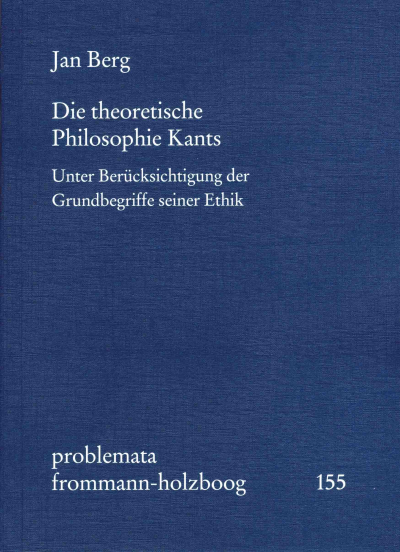
Die theoretische Philosophie Kants
Unter Berücksichtigung der Grundbegriffe seiner Ethik- Authors:
- Series:
- problemata
- Publisher:
- 2014
Keywords
Search publication
Bibliographic data
- Copyright year
- 2014
- ISBN-Print
- 978-3-7728-2671-9
- ISBN-Online
- 978-3-7728-3044-0
- Publisher
- frommann-holzboog, Stuttgart
- Series
- problemata
- Language
- German
- Pages
- 264
- Product type
- Book Titles
Table of contents
ChapterPages
- Titelei/Inhaltsverzeichnis No access Pages 1 - 12
- § 1. Theoretische und praktische Philosophie No access
- A. Kant als Mensch No access
- B. Studium und akademische Laufbahn No access
- C. Verhältnis zur Religion No access
- § 3. Das mechanistische Weltbild No access
- § 4. Der Atomismus No access
- § 5. Determinismus und kritischer Realismus No access
- § 6. Newtons Theorie des absoluten Raumes No access
- § 7. Leibniz’ Raumtheorien No access
- § 8. Kants vorkritische Raumkonzeptionen No access
- § 9. Der Kraftbegriff No access
- § 10. Kants vorkritische Theorien von Kraft und Materie No access
- § 11. Newtons Kosmologie No access
- § 12. Kants Kosmologie No access
- § 13. Kants Kosmogonie No access
- § 14. Nominal- und Realdefinitionen No access
- § 15. Analytische und synthetische Definitionen No access
- § 16. Anschauungen und Begriffe No access
- § 17. Analytische und synthetische Urteile No access
- § 18. Die Urteilstafel No access
- § 19. Die Kategorientafel No access
- § 20. Ein Kriterium der Analytizität von Urteilen No access
- § 21. Das Induktionsproblem No access
- A. Übersicht No access
- B. Die Aristotelische Klassifikationstheorie No access
- C. Kants Begriffstheorie No access
- D. Die Schlußlehre No access
- E. Logische Gültigkeit No access
- § 23. Modallogische Aspekte der Kantischen Erkenntnistheorie No access
- § 24. Die Urteile der Arithmetik No access
- § 25. Transzendentale Beweise No access
- § 26. Die transzendentale Deduktion No access
- A. Erste Analogie No access
- B. Zweite Analogie No access
- C. Dritte Analogie No access
- D. Das Kausalitätsprinzip und die Naturgesetze No access
- § 28. Ist der Raum euklidisch? No access
- A. Kants Verhältnis zu Newton und Leibniz No access
- B. Kants Antinomie des Raumbegriffs No access
- C. Von Kant bis Einstein No access
- A. Die Phänomene und das Ding an sich No access
- B. Die Kategorien No access
- C. Die Materie als beharrende Substanz No access
- D. Das Ding an sich und die Quantenwelt No access
- E. Der neurophysiologische Standpunkt No access
- § 31. Das Ding an sich No access
- A. Metaphysik der Natur No access
- B. Der Bewegungsbegriff No access
- C. Kräftebegriffe No access
- D. Das Gravitationsgesetz No access
- E. Gesetze der Mechanik No access
- F. Referenzsysteme der Phänomenologie No access
- G. Stellung in der Wissenschaftsgeschichte No access
- A. Die Selbstorganisation der Natur No access
- B. Eine Version der Ätherdeduktion No access
- C. Das Ätherfeld No access
- § 34. Die Experimentalphysik No access
- § 35. Normative Ethik und Metaethik No access
- § 36. Utilitaristische Ethik No access
- § 37. Kants Moralpsychologie No access
- § 38. Kants Metaethik No access
- A. Grundlegende Begriffe No access
- B. Einige Beispiele No access
- § 40. Der Begriff des Gegenteils No access
- § 41. Deontische Logik No access
- § 42. Kant und die deontische Logik No access
- § 43. Kants Ethik und die reale Welt No access
- § 44. Kants Freiheitsbegriff No access
- § 45. Kants Gesellschaftsvertrag No access
- § 46. Zum Begriff der Gerechtigkeit No access
- § 47. Abschließende Gedanken No access
- § 48. Belege und Hinweise No access
- Personenregister No access
- Sachregister No access