, to see if you have full access to this publication.
Monograph No access
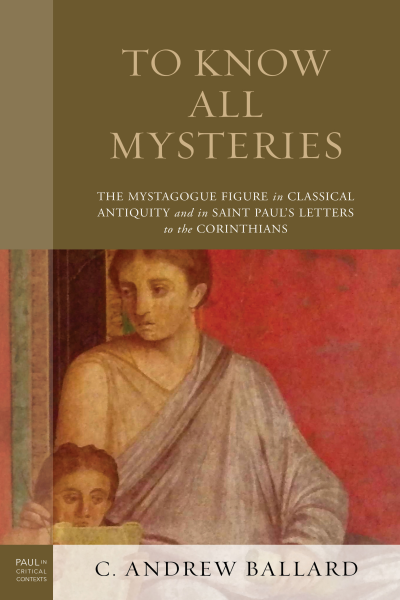
To Know All Mysteries
The Mystagogue Figure in Classical Antiquity and in Saint Paul’s Letters to the Corinthians
Authors:
Publisher:
2022
Summary
This book examines the way that Paul presents himself as a guide into mysteries, a “mystagogue,” in 1–2 Corinthians. By describing himself as a type of mystagogue for the community, Paul was following a precedent in both Jewish and non-Jewish sources for invoking mystagogic language to engage in polemics with a rival. In opposition to the precedent, however, Paul understands the mystagogue to be a bi-partite figure—comprised of both foolishness and wisdom simultaneously. C. Andrew Ballard argues that ancient mystagogues were often described in two disparate ways: figures of power, and figures of weakness and foolishness. Paul synthesizes both aspects of the mystagogue in his self-presentation to the Corinthians. The figure of the mystagogue, as a wise-fool, was useful to Paul because it was descriptive not only of his own experience as a suffering yet authoritative apostle, but also of the experience of his deity, the suffering and glorified Christ. By presenting himself as both a powerful and foolish mystagogue, Paul could argue that he was a more authentic imitator of Christ than his opponents in Corinth, who boasted in self-exaltation instead of self-humility. In this way, Paul used the character of the mystagogue as a strategic rhetorical tool in his communication with the Corinthians.
Keywords
Search publication
Bibliographic data
Edition
1/2022
Copyright Year
2022
ISBN-Print
978-1-9787-1110-5
ISBN-Online
978-1-9787-1111-2
Publisher
Lexington, Lanham
Language
English
Pages
396
Product Type
Monograph
Table of contents
ChapterPages
Contents No access
Acknowledgments No access
Overview of Five Mystery Cults No access
The Mystagogue and Mystery Initiation No access
The History-of-Religion Approach to the Mysteries and Early Christianity No access
Critiques of the History-of-Religion Approach No access
Current Scholarly Approaches to Early Christianity and the Mysteries No access
Taking the Discussion in a New Direction No access
An Outline for the Present Study of the Mystagogue in Antiquity and in Paul No access
Notes No access
Mystagogues of Eleusis in the Homeric Hymn to Demeter No access
The Mystagogue in Menander’s Fragment 714 No access
Mystagogues of Eleusis in Inscription LSS 15 No access
Mystagogues in the Rule of the Andanian Mysteries No access
Mystagogues of Dionysus in Euripides’s Bacchae No access
Mystagogues in Aristophanes’s Frogs and Clouds No access
Dionysiac Initiation in the Villa of the Mysteries at Pompeii No access
Orphic Mystagogues No access
Mystagogues of Private Cults No access
Mystagogues in the Mysteries of Isis No access
Mystagogues in the Mysteries of Mithras No access
Conclusions No access
Notes No access
Metaphorical Mystagogues in Classical Literature No access
Metaphorical Mystagogues in Pagan Literature of the Hellenistic and Early Imperial Periods No access
Notes No access
Erwin Goodenough and the Jewish Mystery Cult Hypothesis No access
Mystery Cults, Jewish Apocalypticism, and Qumran No access
Joseph and Aseneth No access
Wisdom of Solomon No access
Aristobulus and the Pseudo-Orphic Fragments No access
Philo No access
Conclusion No access
Notes No access
The Mystagogue and Power No access
The Mystagogue and Foolishness No access
Conclusion No access
Notes No access
The Mystagogue in 1 Corinthians No access
Conclusion No access
Notes No access
The Mystagogue in 2 Corinthians No access
Conclusion: Paul’s Appropriation and Disruption of the Mystagogue No access
Notes No access
Bibliography No access Pages 343 - 378
Index No access Pages 379 - 394
About the Author No access Pages 395 - 396
Similar publications
from the topics "Religion und Theologie allgemein"