, to see if you have full access to this publication.
Monograph No access
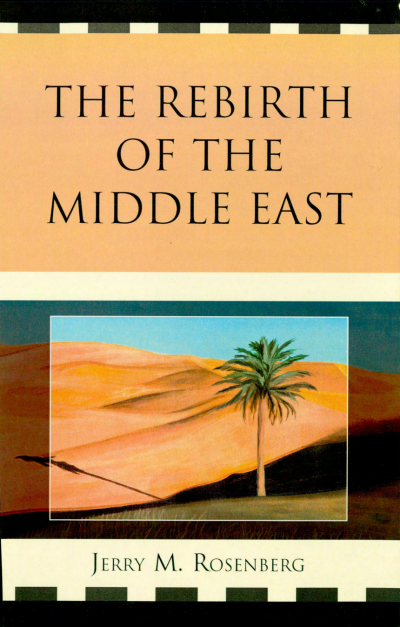
The Rebirth of the Middle East
Authors:
Publisher:
2009
Summary
In The Rebirth of the Middle East,Rosenberg discusses how peace, stability, and prosperity are dependent upon economic and trade relations between Israel and Palestine, as well as other neighboring Arab and Muslim countries. The world is poised to participate in this healing process with funding and training and lacks only the needed conditions to proceed. Rosenberg asserts that this process of stabilization can benefit from a reinvented Marshall Plan, modeled on the 1948 U.S. humanitarian European Recovery Program. In the long run, success will be measured by the creation of a Middle East Economic Community.
As you point out, there is an opportunity to define the future of the Middle East in terms of reconciliation and coexistence rather than confrontation and violence. There are no limits to what can be done if the region's energy and talents can be channeled into creating new opportunities and building a land as bountiful and peaceful as it is holy.
—Bill Clinton, former President of the United States
Praise for Jerry Rosenberg's Nation-Building: A Middle East Recovery Program:
To Jerry M. Rosenberg- With much respect for his attempt to organize a great dream. I believe you have addressed yourself to the very foundations which will lie at the heart of the future of the region and I hope indeed that the day is not far off when the plan will be brought to realization.
—Shimon Peres, former Prime Minster of Israel
[Nation-Building provides] insights into the interplay of underlying variables, encompassing significant regional, global, religious, secular, socio-political, and historical factors, of the permeability of the Middle East.
—el-Sayed el-Aswad, Ph.D., The University of Bahrain, Digest of Middle East Studies
I hope, by drawing on the Marshall Plan, you are able to formulate a blueprint that can succeed in the Middle East. I further hope that you are able to use the Marshall Plan to illustrate to others how such plans have been successful in the past, and how, despite the daunting odds, such a plan could create economic growth, democracy, and peace in our region. I wish you much success in your important work.
—Natan Sharansky, former Deputy Prime Minister of Israel
Search publication
Bibliographic data
Edition
1/2009
Copyright Year
2009
ISBN-Print
978-0-7618-4845-5
ISBN-Online
978-0-7618-4846-2
Publisher
Hamilton Books, Lanham
Language
English
Pages
185
Product Type
Monograph
Table of contents
ChapterPages
CONTENTS No access
PREFACE No access
CHAPTER I INTRODUCTION No access Pages 1 - 12
CHAPTER II CYCLES OF WAR AND POVERTY No access Pages 13 - 50
CHAPTER III THE MARSHALL PLAN No access Pages 51 - 66
CHAPTER IV CONTRASTS AND COMPARISONS No access Pages 67 - 80
CHAPTER V THE MIDDLE EAST RECOVERY PROGRAM No access Pages 81 - 88
CHAPTER VI FORGING ECONOMIC INTEGRATION No access Pages 89 - 110
CHAPTER VII MODELS AND FLOWCHARTS No access Pages 111 - 130
CHAPTER VIII THE END OF THE TUNNEL– A MIDDLE EAST COMMUNITY No access Pages 131 - 146
APPENDIX I THE MIDDLE EAST RECOVERY PROGRAM ACT No access Pages 147 - 158
APPENDIX II ABBREVIATED COMMENTARY No access Pages 159 - 160