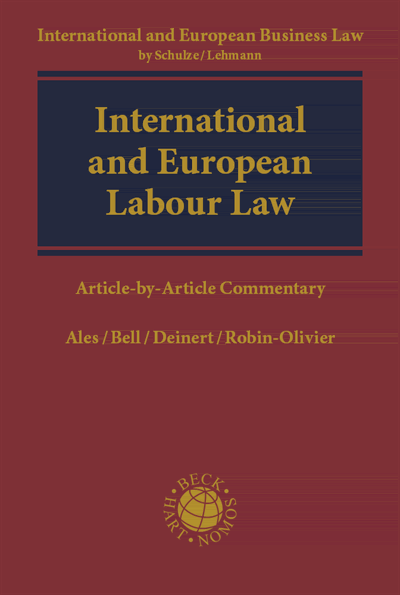
International and European Labour Law
Article-by-Article Commentary- Editors:
- | | |
- Publisher:
- 2018
Summary
This volume includes an article-by-article analysis of key instruments in European and international labour law. It provides an invaluable resource for lawyers and scholars, offering insightful guidance on questions relating to the interpretation of legal texts; the case-law of the relevant international courts and commissions; and international scientific analysis of these legal instruments. The reader will find a quick systematic entry into the discussion thanks to the article-by-article approach. The editors created an international team of more than 70 scientific specialists on international labour law instruments from a wide range of countries, most of them scholars in universities and other research institutes. The book covers the whole field of labour law, i.e. fundamental questions, worker’s mobility, equality law, individual labour law, collective labour law and dispute resolution. Editors and authors have focused on European Union law, including all of the general labour law directives and regulations, as well as instruments with a wider scope insofar as they cover labour law, e.g. in the field of private international law or data protection. Furthermore, the book comprises analysis of the most relevant provisions of the European Convention on Human Rights, the European Social Charter and all the general labour law conventions from the ILO.
Keywords
Search publication
Bibliographic data
- Edition
- 1/2018
- Copyright Year
- 2018
- ISBN-Print
- 978-3-8487-2460-4
- ISBN-Online
- 978-3-8452-6619-0
- Publisher
- Nomos, Baden-Baden
- Series
- Kooperationswerke Beck - Hart – Nomos
- Language
- German
- Pages
- 1678
- Product Type
- Comment
Table of contents
- Titelei/Inhaltsverzeichnis Full access Pages I - XXXII Download chapter (PDF)
- Authors: | | |
- I. Foreword No access
- 1. Basic elements of EU federalism No access
- 2. The role of the Court of Justice in the Development of EU law No access
- 3. Emergence and consecration of a social dimension of the EU No access
- 4. The EU ‘social acquis’: legal basis and methods No access
- 5. The EU ‘social acquis’: substance No access
- 1. The European Social Charter No access
- 2. The European Convention on Human Rights No access
- 1. Conventions and Recommendations No access
- 2. Promoting Compliance with ILO Standards No access
- 3. Core Labour Standards? No access
- V. List of Cases No access
- Authors: |
- I. European Union No access
- II. Council of Europe No access
- III. International Labour Organisation No access
- IV. Conclusion No access
- Authors:
- I. Foreword No access
- 1. The EU strategies on gender equality No access
- 2. European bodies on gender equality No access
- 3. Gender equality in the European semester No access
- 4. Gender equality in the Better Regulation Agenda No access
- 5. Gender budgeting No access
- 6. Gender equality in external actions No access
- 7. Trade agreements No access
- Authors:
- I. Introduction No access
- 1. Sources and legal status of Article 9 TFEU No access
- 2. Application of Article 9 TFEU – mainstreaming social policy No access
- 3. Judicial interpretation of Article 9 TFEU No access
- III. Conclusion No access
- Authors:
- I. Foreword No access
- II. Legal effects No access
- III. List of cases No access
- Authors:
- I. Foreword No access
- II. Relationship with other Treaty provisions No access
- III. Material scope of Article 19 TFEU No access
- IV. The Protected Characteristics No access
- V. List of cases No access
- Authors:
- I. Purpose and relationship with other treaty provisions No access
- 1. The relationship between Article 21 and the previous secondary legislation No access
- 2. Right of residence and access to welfare benefits No access
- 1. The relationship between Article 21 and the Citizens Rights Directive No access
- 2. Right of residence and access to the welfare benefits No access
- IV. A synthesis of the principles on the right to residence and to equal treatment of EU citizens No access
- V. Non-discriminatory barriers to free movement No access
- VI. List of cases No access
- Authors:
- I. Purpose and Relationship with Other Treaty Provisions No access
- II. Effect of Article 45 No access
- III. Territorial scope of Article 45 No access
- 1. Inter-state requirement No access
- 2. Notion of worker No access
- 3. Conditions for retaining the status of worker No access
- 1. Migrant worker’s rights: direct discriminations, covert discriminations and obstacles to free movement No access
- 2. Justifications No access
- 3. Job-seekers rights No access
- VI. Derogation from the principle of free movement (employment in the public service) No access
- VII. List of cases No access
- Article 46 TFEU No access Pages 66 - 68Authors:
- Article 47 TFEU No access Pages 68 - 69Authors:
- Authors:
- I. General remarks on Article 48 TFEU and the implementing secondary legislation No access
- II. Principles on coordination of national social security systems No access
- III. Special non-contributory cash benefits regime No access
- IV. List of cases No access
- Article 56 TFEU No access Pages 76 - 76Authors:
- Article 57 TFEU No access Pages 76 - 76
- Article 58 TFEU No access Pages 76 - 76
- Article 59 TFEU No access Pages 76 - 77
- Article 60 TFEU No access Pages 77 - 77
- Article 61 TFEU No access Pages 77 - 77
- Authors:
- I. From free access to liberalisation of services market No access
- II. Effects on national employment laws No access
- III. Risks of social dumping in the EU internal market No access
- IV. Public policy as the only lawful reason of restriction for free movement of services No access
- V. Searching a new (socially fair) balance between free movement of services and social rights No access
- VI. List of cases No access
- Authors:
- I. Rules on the competition: relationship with other Treaty provisions No access
- II. Premise on the content of the analysis No access
- Authors:
- 1. Competition rules and public social security institutions No access
- 2. Competition rules and natural persons No access
- II. The second question: article 101 TFEU and “labour antitrust exemption” No access
- III. Labour antitrust exemption and “rule of reason” No access
- Authors:
- I. General remarks: “dominant position” and “substantial part of the internal market” No access
- II. Höfner and Elser, Job Centre II and Carra cases No access
- III. Silvano Raso case No access
- Authors:
- I. Paragraph 1 No access
- 1. SGEIs No access
- 2. Public placement offices: SIGs or SGEIs? No access
- III. List of cases No access
- Authors:
- I. Basis and purpose No access
- II. Concept and elements of State Aid No access
- III. Selective advantage favouring certain undertakings or the production of certain goods No access
- IV. Existence of an advantage: The reform of the arrangements for financing the pensions of civil servants working in the Orange SA Case No access
- V. Aid granted by the State or through State resources No access
- VI. Market economy private investor test and making of additional redundancy payments No access
- VII. List of cases No access
- Article 108 TFEU No access Pages 125 - 126Authors:
- Authors:
- I. Basis and purpose No access
- II. The prior control of plans to grant new aid: the roles of Commission and national Courts No access
- III. The relation between obligation to ensure compliance with Article 108(3) TFEU and principle of res judicata No access
- IV. Article 109 TFEU: the enabling regulation No access
- 1. The definition of young people in the Kingdom of Belgium Case and in the GBER No 651/2014 No access
- 2. The criteria for the staff headcount in the Lodato Case and in the GBER No 651/2014 No access
- VI. List of cases No access
- Pre. Articles 145-150 TFEU No access Pages 133 - 134Authors:
- I. Overview No access
- II. Purpose and function No access
- Authors:
- I. Overview No access
- II. Purpose and function No access
- Authors:
- I. Overview No access
- II. Purpose and function No access
- Authors:
- I. Overview No access
- II. Purpose and function No access
- Authors:
- I. Overview No access
- II. Purpose and function No access
- Authors:
- I. Overview No access
- II. Purpose and function No access
- III. List of cases No access
- Authors:
- I. Introduction No access
- 1. Sources and adoption of Article 117 EEC No access
- 2. Article 151 TFEU – fundamental social rights No access
- 3. Balancing economic and social objectives No access
- III. Conclusion No access
- IV. List of cases No access
- Authors:
- Foreword No access
- 1. A legacy of the defunct Treaty establishing a constitution for Europe No access
- 2. The added value of Article 152 No access
- II. The Tripartite Social Summit for growth and employment: a phantom body? No access
- III. List of Cases No access
- Authors:
- I. History of the provision No access
- II. Actors No access
- III. Aim of the provision No access
- IV. Fields of action No access
- V. Exclusions No access
- VI. List of cases No access
- Article 154 TFEU No access Pages 165 - 165Authors:
- Authors:
- Foreword No access
- 1. Voluntary European collective agreements No access
- 2. Commission-induced European collective agreements No access
- 1. The statutory implementation No access
- 2. The autonomous implementation No access
- III. Starting negotiations and implementing agreements: four different ways to combine social partners’ autonomy and Commission’s intervention No access
- IV. List of cases No access
- Authors:
- 1. Gender Equality in the Treaties: from the Treaty of Rome until the Treaty of Lisbon No access
- 2. EU Legislation on gender equality No access
- II. Relationship with other Treaty provisions No access
- III. Material Scope of Article 157 TFEU No access
- IV. Direct effect of Article 157 TFEU No access
- 1. Prohibition of direct and indirect discrimination No access
- 2. Comparison No access
- 3. Burden of proof No access
- 4. Remedies No access
- VI. Positive actions No access
- VII. List of cases No access
- Article 174 TFEU No access Pages 188 - 188Authors:
- Authors:
- I. Social, economic and territorial cohesion in the EU law and strategies No access
- II. Contradictions in the EU approach towards cohesion No access
- III. List of cases No access
- Article 5 CFREU Prohibition of slavery and forced labour No access Pages 195 - 195Authors:
- Article 15 CFREU Freedom to choose an occupation and right to engage in work No access Pages 195 - 195Authors:
- Authors:
- List of cases No access
- Authors:
- I. Foreword No access
- II. Relationship to other provisions of the Charter of Fundamental Rights No access
- III. Scope of application No access
- IV. Judicial interpretation of the principle of equal treatment No access
- V. List of cases No access
- Authors:
- I. Foreword No access
- 1. Relationship to Article 19 TFEU No access
- 2. Relationship to EU anti-discrimination legislation No access
- 3. Relationship to the general principle of equal treatment No access
- 4. Enforcement by private parties No access
- 5. The meaning of non-discrimination No access
- III. Article 21(2) No access
- IV. List of cases No access
- Authors:
- I. Foreword No access
- II. Relationship with other CFREU provisions No access
- III. Material scope and efficacy of Article 23(1) CFREU No access
- IV. Material scope and efficacy of Article 23(2) No access
- V. ECJ Case law on Art. 23 Charter No access
- VI. List of cases No access
- Authors:
- List of cases No access
- Article 28 CFREU Right of collective bargaining and action No access Pages 218 - 218
- Article 29 CFREU Right of access to placement services No access Pages 218 - 219
- Article 30 CFREU Protection in the event of unjustified dismissal No access Pages 219 - 219
- Article 31 CFREU Fair and just working conditions No access Pages 219 - 219
- Authors:
- I. Foreword No access
- II. The European Union and child labour No access
- III. Interrogating some of the presumptions underpinning Article 32 No access
- IV. Conclusion No access
- V. List of cases No access
- Authors:
- I. Foreword No access
- II. Link between reconciliation of professional and family life and gender equality No access
- III. Work life balance and work organisation No access
- IV. A comprehensive approach to reconciliation of professional and family life: The role of care services No access
- V. Material Scope and Efficacy of Article 33(1) No access
- VI. Material Scope and Efficacy of Article 33(2) No access
- VII. ECJ Case law on Art. 33 No access
- VIII. List of cases No access
- Authors:
- I. The field of application of the Charter: the three unsatisfactory categories of principles and rights. No access
- II. Beyond the ‘meaningless’ rights and principles? The margins of the European legal system No access
- III. The margins of the national legal systems. No access
- IV. List of cases No access
- Authors:
- I. Article 52 from a labour law perspective No access
- II. The difference between ‘principles’ and ‘rights’ No access
- III. Moving away from the presumption that Title IV fundamental rights belong to the category of ‘principles’ No access
- IV. The essence of the rights and freedoms No access
- V. Fundamental rights and the constitutional traditions common to the Member States No access
- VI. The explanations as guidance in the interpretation of the Charter No access
- VII. List of Cases No access
- Authors:
- I. Content and purpose No access
- II. The comparison with Art 53 ECHR: a significant difference No access
- III. The relationship between Union law and the legal systems of the Member States: the “primacy” of EU law No access
- IV. List of cases No access
- Authors:
- I. Abuse of rights in the Court of Justice’s case law No access
- II. Art. 54 CFREU: A change of perspective No access
- III. The limits of Article 54: the field of action and scope of application No access
- IV. List of cases No access
- Article 1 RESC The right to work No access Pages 253 - 255Authors:
- Authors: |
- I. Goals and position of Article 2 No access
- II. Effective implementation of Art 2 revESC No access
- III. Personal scope of Art 2 No access
- IV. Art 2 § 1 – Reasonable daily and weekly working hours No access
- V. Art 2 § 2 – Paid public holidays No access
- VI. Art 2 § 3 – Four weeks paid annual holiday No access
- VII. Art 2 § 4 – Protection of workers in inherently dangerous or unhealthy occupations No access
- VIII. Art 2 § 5 – Weekly rest period No access
- IX. Art 2 § 6 – Information of workers on their contract or employment relationship No access
- X. Art 2 § 7 – Protective measures for workers performing night work No access
- Authors:
- I. Foreword No access
- II. Art 3 § 1 No access
- III. Art. 3 § 2 No access
- IV. Art 3 § 3 No access
- V. Art. 3 § 4 No access
- VI. List of cases No access
- Authors:
- I. Foreword No access
- II. The right of workers to a remuneration such allowing a decent standard of living No access
- III. The right of workers to an increased rate of remuneration for overtime work No access
- IV. The right of men and women workers to equal pay for work of equal value No access
- V. The right of all workers to a reasonable period of notice for termination of employment No access
- VI. Deductions from wages only under conditions and to the extent prescribed by national laws or regulations or fixed by collective agreements or arbitration awards No access
- VII. List of cases No access
- Authors:
- I. Foreword No access
- II. Sources No access
- III. Relationship with other provisions on freedom of association No access
- IV. Content No access
- V. Personal scope No access
- VI. Civil servants No access
- 1. Rights of workers and employers No access
- 2. Freedom to form trade unions No access
- 3. Freedom to join and not to join No access
- 4. Trade union activities No access
- 5. Representativeness No access
- VIII. List of cases No access
- Authors:
- I. History No access
- II. International and European context No access
- 1. Objective, structure and systematic context No access
- 2. Personal scope of application No access
- 3. Restrictions No access
- 1. Joint consultations No access
- 2. Collective negotiations No access
- 3. Conciliation and arbitration No access
- 1. Collective action No access
- 2. Strikes No access
- 3. Lockouts No access
- Authors:
- I. Foreword No access
- II. Art 7 § 1 No access
- III. Art. 7 § 2 No access
- IV. Art. 7 § 3 No access
- V. Art. 7 § 4 No access
- VI. Art. 7 § 5 No access
- VII. Art. 7 § 6 No access
- VIII. Art. 7 § 7 No access
- IX. Art. 7 § 8 No access
- X. Art. 7 § 9 No access
- 1. Protection against sexual exploitation No access
- 2. Protection from the misuse of information technology No access
- 3. Protection from other forms of exploitation No access
- Authors:
- Foreword No access
- 1. Material scope No access
- 2. Dismissals No access
- 3. Sufficient time No access
- 4. Paragraphs 4 and 5 No access
- 5. Final remarks No access
- 6. List of cases No access
- Authors:
- I. Foreword No access
- II. Promoting the employment of people with disabilities No access
- III. Non-discrimination and reasonable accommodation No access
- IV. List of cases No access
- Authors:
- Foreword No access
- I. Application of Article 18 No access
- 1. Access to employment No access
- 2. Equal treatment No access
- 3. Loss of employment No access
- III. Limitations No access
- IV. List of cases No access
- Authors:
- Foreword No access
- I. Application No access
- 1. Remuneration and Other Employment and Working Conditions No access
- 2. Membership of Trade Unions and Enjoyment of the benefits of Collective Bargaining No access
- III. List of cases No access
- Authors:
- I. Foreword No access
- II. The Right to Equal Opportunities and Equal Treatment No access
- III. Enforcement No access
- IV. Promoting Gender Equality No access
- V. List of cases No access
- Authors:
- I. Foreword No access
- II. Sources No access
- III. Relationship with other provisions on information and consultation of workers No access
- IV. Content No access
- 1. Undertaking/employer No access
- 2. Workers and workers’ representatives No access
- 3. Majority rule No access
- 1. Information No access
- 2. Consultation No access
- VII. Sanctions No access
- VIII. List of cases No access
- Authors:
- I. Foreword No access
- II. Sources No access
- III. Relationship with Other Charter Provisions No access
- 1. Determination and the improvement of the working conditions, work organisation and working environment No access
- 2. Health and safety within the undertaking No access
- 3. Organisation of social and socio-cultural services and facilities within the undertaking No access
- 4. To the supervision of the observance of regulations on these matters No access
- V. Enforcement/Sanctions on infringements No access
- VI. List of cases No access
- Authors:
- I. Foreword No access
- 1. Reasons related to the personal situation of the worker No access
- 2. Reasons related to the economic situation of the undertaking No access
- 1. The possibility of reinstatement No access
- 2. An adequate compensation No access
- 1. Identity of the competent body No access
- 2. Elements of the proceedings No access
- 3. The burden of proof No access
- V. List of cases No access
- Authors:
- I. Foreword No access
- 1. Insolvency No access
- 2. Workers concerned No access
- 3. Workers’ claims No access
- 1. A guarantee institution? No access
- 2. A prescribed amount No access
- 3. The average term of payment No access
- IV. Conclusion No access
- Authors:
- I. Foreword No access
- 1. Prevention No access
- 2. Liability and remedies No access
- 3. Burden of proof No access
- 4. Damages No access
- III. Art. 26 § 2 No access
- Authors:
- 1. Foreword No access
- 2. Commentary No access
- 3. Final remarks No access
- 4. List of cases No access
- Authors:
- I. Foreword No access
- II. Sources No access
- III. Relationship with Other Charter Provisions No access
- 1. Workers’ representatives No access
- 2. Protection against prejudicial acts No access
- 3. Facilities and limitations No access
- 4. Enforcement No access
- V. List of cases No access
- Authors:
- I. Foreword No access
- II. Sources No access
- III. Relationship with other Charter provisions No access
- 1. ‘Redundancy’ and grounds of dismissal No access
- 2. ‘Collective’: numbers and period No access
- 3. Concept of information and consultation No access
- 4. Definition of workers and workers’ representatives No access
- 5. Cooperation with public authorities No access
- 6. Enforcement No access
- V. List of cases No access
- Authors:
- I. Background and context No access
- 1. Labour is not a commodity No access
- 2. Freedom of expression, of association and collective bargaining No access
- 3. Poverty No access
- 4. War to want and tripartism No access
- 5. Social justice No access
- 6. The broadening of the ILO’s mandate No access
- 7. Full employment, minimum wage and social security No access
- 8. International cooperation and the Declaration’s universality No access
- III. The Declaration’s value nowadays: still an on-going challenge No access
- Authors: |
- 1. Introduction No access
- 2. The definition of employment service No access
- 3. Essential duties and functions of the employment service No access
- 4. Organizational requirements No access
- 5. The public nature of the employment service and its relationship with private agencies on the labour market No access
- 6. The role of social parties No access
- Authors:
- I. Introduction No access
- II. Context and aims No access
- III. Contents No access
- Authors:
- I. Introduction No access
- II. Context and general aims No access
- III. Content No access
- Authors:
- 1. Purpose No access
- 2. Historical background No access
- II. Ratifications No access
- III. Employers’ and workers’ associations No access
- IV. Criteria of representativeness No access
- V. Consultation procedure No access
- VI. Implementation No access
- VII. Free choice of representatives No access
- VIII. Equal representation No access
- 1. Compulsory matters No access
- 2. Recommended matters No access
- 3. Other matters No access
- X. Intervals of consultations No access
- XI. Annual reports on the consultation procedures No access
- XII. ILO standard final provisions for Conventions No access
- Authors: |
- I. Introduction No access
- II. Preamble No access
- a) Labour administration functions: “Activities in the field of national labour policy” (Article 1(a)) No access
- b) System of labour administration: “Public administration bodies” (Article 1(b)) No access
- c) System of labour administration: “The institutional framework for co-ordination, consultation and participation” (Article 1(b) in fine) No access
- 2. Article 2 No access
- 3. Article 3 No access
- a) “Organization and effective operation” No access
- b) “Proper coordination of functions and responsibilities” No access
- a) Modes of involvement of employers and workers No access
- b) Structural arrangements for the involvement of the social partners No access
- c) “Consultation bodies” No access
- d) “Cooperation and negotiation bodies” No access
- e) Negotiation No access
- a) Labour standards No access
- b) Labour relations No access
- c) Employment policy No access
- d) “Preparation and administration of national employment policy” No access
- e) “Coordination and review of national employment policy” No access
- f) Research in labour matters No access
- 7. Article 7 No access
- 8. Article 8 No access
- 9. Article 9 No access
- a) “Qualifications” of labour administration staff No access
- b) “Training” of labour administration staff No access
- c) “Status” of labour administration staff No access
- d) “Independence” of labour administration staff No access
- e) “Financial resources” assigned to labour administration No access
- f) Human resources of the labour administration services No access
- g) “Material means” of the labour administration services No access
- Authors:
- I. Introduction No access
- II. Context and aims No access
- III. Content No access
- Equality: Introduction No access Pages 431 - 433Authors:
- Authors:
- I. Foreword No access
- II. Article 26 within the scheme of the ICCPR No access
- III. Equality before the law and the equal protection of the law No access
- IV. The concept of discrimination in Article 26 No access
- V. The prohibited grounds of discrimination under Article 26 No access
- VI. Application in the context of labour law No access
- VII. List of cases No access
- Authors:
- I. Foreword No access
- II. Article 2 No access
- III. Article 7 No access
- Authors:
- I. Foreword No access
- II. Commentary No access
- III. List of cases No access
- Authors:
- I. Foreword No access
- II. Commentary No access
- Authors:
- I. Foreword No access
- 1. Article 1 No access
- 2. Article 2 No access
- 3. Article 5 No access
- 4. Article 6 No access
- 5. Article 9 No access
- a) Article 27(1) No access
- b) Article 27(2) No access
- III. List of cases No access
- Authors:
- I. Foreword No access
- II. Scope of application No access
- 1. Definition of discrimination No access
- 2. Indirect discrimination No access
- 3. Reasonable accommodation No access
- IV. The protected characteristics No access
- V. List of cases No access
- Authors: |
- Foreword No access
- I. Personal scope: Article 2 No access
- II. Material scope: Article 3(1) No access
- Social security; assistance versus social ‘protection’ No access
- a) Direct discrimination No access
- b) Indirect discrimination No access
- 2. Conditions of treatment No access
- IV. Exclusions from the Principle of Equal Treatment: Article 7(1) No access
- V. Conclusion No access
- VI. List of cases No access
- Authors: |
- I. Foreword No access
- 1. Occupational pensions “may” constitute pay No access
- 2. Occupational pensions: benefits No access
- 3. Access to membership No access
- 4. Occupational pensions and survivor’s benefits No access
- 5. Occupational pensions and public servants: state as employer No access
- 6. Remedying the discrimination No access
- 1. Voluntary Contributions in order to secure additional benefits No access
- 2. Bridging pensions: Method of calculation No access
- IV. Article 9: Examples of discrimination No access
- V. Article 11: Deferrals as regards self-employed persons No access
- VI. Article 12: Retroactive effect – the temporal limitation of the Barber judgment No access
- VII. Conclusion No access
- VIII. List of cases No access
- Authors:
- I. The origin of the Directive No access
- 1. Link with higher ranking norms No access
- 2. Purpose No access
- 3. Protected ground No access
- 1. Overview No access
- 2. Direct discrimination No access
- 3. Indirect discrimination No access
- 4. Harassment No access
- 5. Instructions to discriminate No access
- IV. Personal scope No access
- 1. Overview No access
- 2. Employment No access
- 3. Social protection and social advantages No access
- 4. Education No access
- 5. Access to and supply of goods and services No access
- 1. Overview No access
- 2. Genuine and determining occupational requirements No access
- 3. Positive action No access
- 1. Enforcement procedures No access
- 2. Legal standing No access
- 3. Burden of proof No access
- 4. Victimisation No access
- a) Overview No access
- b) The functions of equality bodies No access
- 6. Sanctions No access
- VIII. List of cases No access
- Authors: |
- 1. Overview No access
- 2. Link with higher ranking norms No access
- 1. Overview No access
- 2. Disability No access
- 1. Overview No access
- 2. Direct discrimination (Article 2(2)(a)) No access
- a) General rule No access
- b) Justification and link to reasonable accommodation No access
- 4. Harassment (Article 2(3)) No access
- 5. Instruction to discriminate (Article 2(4)) No access
- 6. Discrimination by association No access
- 7. Discrimination by Assumption and Perception No access
- 8. The ‘Democratic Society Exceptions’(Article 2(5)) No access
- 1. Overview No access
- a) Definition No access
- b) Sectors of activity No access
- a) Overview No access
- b) Pay No access
- c) Limits to the scope of the Directive No access
- V. Genuine occupational requirement No access
- 1. Overview No access
- 2. Assessment of what is a reasonable accommodation No access
- 3. Disproportionate burden No access
- 4. Consequences of a failure to make a reasonable accommodation No access
- 5. Eligibility for a reasonable accommodation No access
- 1. Overview No access
- 2. Standard of scrutiny No access
- 3. Justification within the context of national law No access
- 4. Social and public nature of the aim pursued No access
- 5. Legitimate aims No access
- 6. Proportionality No access
- 7. Link with other provisions of the Directive No access
- 1. Positive action measures No access
- 2. Positive action measures and disabled persons No access
- 3. Link between reasonable accommodation and positive action measures No access
- 1. Overview No access
- 2. Access to justice No access
- 3. Burden of proof No access
- 4. Victimisation No access
- 5. Compliance and sanctions No access
- X. List of cases No access
- Authors:
- a) Overview No access
- b) Formal or substantive equality No access
- c) Relationship to other provisions No access
- a) Personal scope No access
- b) Material scope No access
- 1. General purpose No access
- a) Direct discrimination No access
- b) Indirect discrimination No access
- c) Harassment No access
- d) Sexual harassment No access
- e) Pay No access
- f) Occupational security schemes No access
- 3. Paragraph 2 No access
- 1. General purpose No access
- a) Overview No access
- b) Scope and limitations No access
- 1. General purpose No access
- a) Overview No access
- b) Same work or work to which equal value is attributed No access
- c) Direct pay discrimination No access
- d) Indirect pay discrimination No access
- e) Job classification schemes No access
- 1. General purpose No access
- a) Overview No access
- b) Access to employment including promotion 14(1)(a) No access
- c) Vocational training 14(1)(b) No access
- d) Working conditions 14(1)(c) No access
- 2. Genuine occupational requirement No access
- 1. General purpose No access
- 2. Scope No access
- VII. Article 16 No access
- a) Overview No access
- b) Relationship with other principles No access
- a) Overview No access
- b) The required procedure No access
- c) Limitations on claim No access
- 1. General purpose No access
- a) Overview No access
- b) Effective compensation No access
- c) Punitive damages No access
- 1. General purpose No access
- a) Overview No access
- b) Facts from which it may be presumed that there has been discrimination No access
- 1. General purpose No access
- 2. Scope No access
- 1. General purpose No access
- 2. Scope No access
- XIII. Article 25 No access
- XIV. Article 26 No access
- XV. Article 27 No access
- 1. General purpose and scope No access
- 2. Implications No access
- XVII. List of cases No access
- Authors:
- 1. Drafting history No access
- 2. Relationship to other Directives No access
- 1. Who is a ‘self-employed worker’? No access
- 2. Self-employed workers, small entrepreneurs and entrepreneurs No access
- III. Article 3: The definition of discrimination and harassment No access
- 1. The Personal scope No access
- 2. The Material scope No access
- 3. The concept of harassment and the intention to discriminate No access
- 1. General remarks No access
- 1. General remarks No access
- 2. Personal scope No access
- 1. General remarks No access
- 2. Interruption in occupational activity and maternity allowance No access
- 3. Personal scope and intersections with Directive 92/85/EEC No access
- 4. Protection against the termination of the contractual relationship No access
- VIII. List of cases No access
- Authors:
- Foreword No access
- 1. Definition of remuneration No access
- 2. Definition of equal remuneration for men and women No access
- 1. Legislation No access
- 2. Legally established or recognised machinery for wage determination No access
- 3. Collective agreements No access
- 4. A combination of these various means No access
- 5. Other means No access
- III. Article 3 No access
- IV. List of cases No access
- Authors:
- Foreword No access
- 1. Definition of discrimination and prohibited grounds No access
- 2. Prohibited grounds No access
- II. Article 2: National conditions and practice No access
- III. Article 3: States’ obligations No access
- IV. Article 4: Measures to protect the security of the State No access
- V. Article 5: Special measures of protection or assistance No access
- VI. Burden of proof No access
- VII. Remedies No access
- VIII. List of cases No access
- Authors:
- I. Foreword No access
- 1. Article 1: Definitions No access
- 2. Article 2: Application to Branches of social security No access
- 3. Articles 3-6: Obligations No access
- 4. Articles 7 and 8: Maintenance schemes No access
- 5. Article 10 No access
- III. List of cases No access
- Authors:
- I. Foreword No access
- 1. Definition and scope No access
- a) Rehabilitation and employment in the open labour market No access
- b) Equality of opportunity and treatment No access
- c) Consultation No access
- a) Services No access
- b) Staff No access
- III. List of cases No access
- Introduction No access Pages 641 - 643Authors:
- Authors:
- I. Foreword No access
- 1. Which undertakings are subject to the PWD? No access
- a) The three ways to post workers according to the PWD No access
- b) What is a “posted worker”? No access
- a) A list of terms and conditions: a floor or a ceiling? No access
- b) How is the nucleus to be applied? No access
- 2. Collective agreement: the “Nordic” case No access
- 3. Extension of the “nucleus” No access
- IV. Articles 4 and 5: cooperation and enforcement No access
- V. Article 6: jurisdiction No access
- Authors:
- Introduction No access
- a) Choice of law No access
- b) Interpretation No access
- c) Comparison between the chosen law and the law applicable in the absence of choice No access
- a) Determining the place of performance of the Contract No access
- b) Place of engagement No access
- 3. Escape clause No access
- 1. Definition No access
- 2. Mandatory rules of the forum No access
- 3. Foreign mandatory rules No access
- Authors:
- Introduction No access
- I. Characterisation No access
- II. Connecting factor No access
- Authors:
- I. Foreword No access
- 1. Abuse of the right of establishment: letterbox company No access
- 2. Abuse of posting: what is “temporary”? No access
- III. Articles 6, 7 and 21: mutual assistance (execution of article 4) No access
- IV. Article 9: authorised controls (execution of article 5) No access
- V. Article 12: subcontracting liability (execution of article 5) No access
- VI. Articles 13-19: cross-border enforcement No access
- Authors:
- Foreword No access
- I. Personal scope of the CRD No access
- 1. Right of exit and entry (Chapter II) No access
- a) Right of residence – Chapter III CRD No access
- b) Right of permanent residence (Chapter IV) No access
- c) Provisions common to the right of residence and the right of permanent residence (Chapter V) No access
- 3. Restrictions on the right of entry and the right of residence on grounds of public policy, public security or public health (Chapter VI) No access
- Authors:
- I. Foreword No access
- 1. Article 1 No access
- 2. Article 2 No access
- 3. Article 3 No access
- a) Article 4 a No access
- b) Article 4 b No access
- c) Article 4 c No access
- d) Article 4 d No access
- e) Article 4 e No access
- f) Article 4 f No access
- 5. Article 5 No access
- 6. Article 6 No access
- 7. Article 7 No access
- 8. Article 8 No access
- 9. Article 9 No access
- 10. Article 10 No access
- 11. Article 11 No access
- 12. Article 12 No access
- 13. Article 13 No access
- 14. Article 14 No access
- 15. Article 15 No access
- 16. Article 16 No access
- 17. Article 17 No access
- 18. Article 18 No access
- 19. Article 19 No access
- 20. Article 20 No access
- III. Recognition on the basis of coordination of minimum training conditions No access
- IV. Doctors of medicine No access
- V. Nurses responsible for general care No access
- VI. Dental practitioners No access
- VII. Veterinary surgeons No access
- VIII. Midwives No access
- IX. Pharmacist No access
- X. Architect No access
- XI. Automatic recognition on the basis of common training principles No access
- XII. Common provisions on establishment No access
- XIII. Rules for pursuing the profession No access
- XIV. Administrative cooperation and responsibility towards citizens for implementation No access
- XV. Other provisions No access
- Authors:
- I. Foreword No access
- II. The mobility rights granted to European workers No access
- III. The attempt to construct a European employment market No access
- IV. Final provisions No access
- Authors:
- I. Foreword No access
- II. Purpose and scope of the Directive No access
- III. A triple strategy aimed at fighting the obstacles to free movement No access
- IV. Implementation No access
- Authors:
- I. Foreword No access
- II. The labour rights of legally residing third-country nationals No access
- I. Rationale for the labour protections in the Directive No access
- II. Application of the Directive No access
- III. Specific labour rights protection No access
- IV. Limitations on labour rights protection No access
- I. Rationale for the labour protections in the Directive No access
- II. Application of the Directive No access
- III. Specific labour rights protection No access
- IV. Limitations on labour rights protections No access
- I. Rationale for the labour protections in the Directive No access
- II. Application of the Directive No access
- III. Specific labour rights protection No access
- IV. Limitations on labour rights protection No access
- I. Rationale for the labour protections in the Directive No access
- II. Application of the Directive No access
- III. Specific labour rights protection No access
- IV. Limitations on labour rights protection No access
- I. Foreword: Rationale for the labour protections in the Directive No access
- II. Application of the Directive No access
- III. Limitations on labour rights protection No access
- I. Rationale for the labour protections in the Directive No access
- II. Application of the Directive No access
- III. Specific labour rights protection No access
- IV. Limitations on Labour Rights Protection No access
- I. Rationale for the labour protections in the Directive No access
- II. Application of the Directive No access
- III. Specific labour rights protection No access
- IV. Limitations on labour rights protection No access
- I. Foreword: Rationale for the labour rights protection in the Directive No access
- II. Application of the Directive No access
- J. List of cases No access
- Authors:
- I. Foreword No access
- II. Links to other regulations No access
- III. Main Provisions of the Convention No access
- IV. List of cases No access
- Authors:
- I. Foreword No access
- 1. Article 6: Equality of treatment of migrant workers in a regular situation No access
- 2. Article 3: Steps against misleading propaganda relating to emigration and immigration No access
- 1. Article 1: Basic human rights of all migrant workers No access
- 2. Article 10: Equality of treatment of migrant workers in a regular situation No access
- 3. Article 12, Convention No. 143: National policy to promote and guarantee equality of opportunity and treatment for migrant workers No access
- 4. Article 14, Convention No. 143: Free choice of employment No access
- a) Article 8 No access
- b) Article 9 No access
- Authors:
- EU Law No access
- Non EU Law No access
- Authors:
- 1. Background No access
- 2. Purpose No access
- 1. Definition of a part-time worker No access
- 2. Existence of an employment relationship No access
- 1. The concept of “working conditions” No access
- 2. The choice of the comparator No access
- 3. Differences of treatment justified: objective reasons and objective grounds No access
- 4. The pro rata temporis rule No access
- 1. Identification and review of obstacles No access
- 2. Transfer from full-time to part-time work No access
- 1. Implementation No access
- 2. Coordination with other EU employment-related instruments No access
- Authors:
- 1. Background No access
- 2. Objectives No access
- 1. Workers covered by the Agreement No access
- 2. Employers covered by the Agreement No access
- 1. Comparability of situations No access
- 2. The notion of “employment conditions” No access
- 3. Objective grounds justifying a difference of treatment No access
- 4. Direct effect of clause 4 of the framework agreement No access
- 1. Measures subject to a limited scope No access
- a) The concept of objective grounds No access
- b) The concept of successive fixed-term contracts No access
- c) Dissuasive and effective measures No access
- 1. Information and employment opportunities No access
- 2. Information and consultation No access
- 1. Non-regression clause No access
- 2. Application to more specific EU provisions No access
- Authors:
- 1. General purpose No access
- 2. Main objectives No access
- 3. Scope No access
- 1. Concept of “worker” No access
- 2. Definition of ‘temporary-work agency’ No access
- 3. Definition of “assignment” No access
- 1. Principles No access
- 2. The AKT case No access
- 1. Meaning of the principle of equal treatment No access
- 2. Derogations to the principle of equal treatment No access
- 3. Access to employment, collective facilities and vocational training No access
- 4. Representation of temporary agency workers No access
- 5. Information of workers’ representatives No access
- 1. Minimum requirements No access
- 2. Penalties No access
- 3. Implementation and entry into force No access
- Authors:
- I. Foreword No access
- 1. Article 1 No access
- 2. Articles 4, 5 and 7 No access
- 3. Article 9 and 10 No access
- Authors:
- I. Foreword No access
- II. Commentary No access
- Authors:
- I. Foreword No access
- II. Commentary No access
- Authors:
- I. Introduction No access
- 1. Article 1 No access
- 2. Article 2 No access
- 3. Article 3 No access
- 4. Article 4 No access
- 5. Article 5 No access
- 6. Article 6 No access
- 7. Article 7 No access
- 8. Article 8 No access
- 9. Article 9 No access
- 10. Article 10 No access
- 11. Article 11 No access
- 12. Article 12 No access
- 13. Article 13 No access
- 14. Article 14 No access
- 15. Article 15 No access
- 16. Article 16 No access
- 17. Article 17 No access
- 18. Article 18 No access
- 19. Article 19 No access
- Introduction: Working Conditions No access Pages 934 - 937Authors:
- Authors:
- I. Foreword No access
- II. Fundamental right to data protection No access
- III. Data protection principles No access
- IV. The scope of protection of personal data No access
- V. List of cases No access
- Authors:
- Foreword No access
- I. The origin and content of Article 30 No access
- II. A limited legal impact of Article 30 No access
- III. List of cases No access
- Authors:
- I. Foreword No access
- 1. Article 1 No access
- 2. Article 2 No access
- 3. Article 3 No access
- 4. Article 4 No access
- 5. Article 5 No access
- 6. Article 6 No access
- 7. Article 7 No access
- 8. Article 8 No access
- 9. Article 9 No access
- Authors:
- I. Foreword No access
- II. Subject-matter an objectives No access
- III. Material scope No access
- IV. Territorial scope No access
- 1. Personal data No access
- 2. Processing No access
- 3. Data controllers and data processors No access
- 1. Lawfulness No access
- 2. Compliance with a legal obligation No access
- 3. The protection of the vital interests of the data subject or of another natural person No access
- 4. The performance of a task carried out in the public interest or in the exercise of official authority vested in the controller No access
- 5. The purposes of the legitimate interests pursued by the controller or by a third party No access
- 6. Fairness and transparency No access
- 7. Purpose limitation No access
- 8. Data minimisation No access
- 9. Accuracy No access
- 10. Storage limitation No access
- 11. Integrity and confidentiality No access
- 12. Accountability No access
- VII. Processing of special categories of data No access
- 1. Foreword No access
- 2. The right to be forgotten No access
- 3. The right of access No access
- 4. The right not to be subject to a decision based solely on automated processing, including profilingArt 22. No access
- IX. Supervisory authority No access
- X. Data protection in the employment context No access
- XI. List of cases No access
- Authors:
- I. Introduction No access
- a) The European definition of ‘worker’ No access
- b) Redundancies and other forms of termination of employment contracts No access
- c) The European definition of ‘establishment’ No access
- 2. The information and consultation procedure No access
- 3. Notification of the collective redundancies to public authorities No access
- 4. Conclusion No access
- Authors:
- a) Nature of the contractual relations given rise to a transfer No access
- b) The Concept of the Transfer of an Undertaking No access
- a) The automatic transfer of the contract of employment No access
- b) Transfer of undertaking and collective agreement applicable No access
- c) Protection against dismissal No access
- d) The transfer of workers’ representatives No access
- 3. Information and consultation of workers’ representatives No access
- 4. Transfers of undertakings in the context of insolvency proceedings No access
- 5. Conclusion No access
- Authors:
- 1. Background No access
- 2. Purpose No access
- 1. Scope No access
- a) Insolvency No access
- b) Employee No access
- 1. Organisation, financing and operation No access
- a) Claims relating to pay No access
- b) Period of protection and ceilings in national law No access
- c) The “Francovich case” No access
- 1. Social security benefits No access
- 2. Old-age benefits No access
- 1. Directive 80/987 No access
- 2. Directive 2002/74 and Directive 2008/94: a new criterion to identify the competent guarantee institution No access
- 3. Another competent institution “in addition to or instead of” No access
- 1. Abuses and options of Member States No access
- 2. Implementation No access
- VII. List of Cases No access
- Authors: |
- 1. Legal basis No access
- 2. Regulatory framework of the Directive No access
- 3. Historical development No access
- 1. Articles 1 to 6 No access
- a) Purpose, clause 1 para 1 No access
- b) Personal scope, clause 1 para 2, 3 No access
- a) Entitled persons, clause 2 para 1 No access
- b) Individual right to parental leave, clause 2 para 1 No access
- c) Duration (clause 2 para 2) and maximum period (clause 2 para 1) No access
- d) Non-transferability, clause 2 para 2 No access
- a) Concrete design of parental leave, clause 3 para 1 subpara a No access
- b) Minimum period of work qualification, clause 3 para 1 subpara b No access
- c) Postponement of parental leave, clause 3 para 1 subpara c No access
- d) Special provisions for small undertakings, clause 3 para 1 subpara d No access
- e) Notice periods, clause 3 para 2 No access
- f) Needs of parents of disabled or long-term ill children, clause 3 para 3 No access
- 5. Annex clause 4, adoption No access
- a) Right to return, clause 5 para 1 No access
- b) Maintenance of rights, clause 5 para 2 No access
- c) Employment status, clause 5 para 3 No access
- d) Protection from discrimination, clause 5 para 4 No access
- e) Protection against dismissal, clause 5 para 4 No access
- f) Matters regarding social security and income, clause 5 para 5 No access
- a) Flexible working conditions, clause 6 para 1 No access
- b) Contact during the period of leave, clause 6 para 2 No access
- 7. Annex clause 7, force majeure No access
- 8. Annex clause 8, final provisions No access
- III. List of cases No access
- Authors:
- I. Situation in 2016 in the world No access
- a) 1930: ILO Convention n°29 – article 1 No access
- b) 1948 – Universal Declaration of Human Rights – article 4 No access
- c) 1957 – ILO n°105 Convention – article 1-2 No access
- d) 1966 – ICESCR article 8 and ECHR article 4 No access
- a) ILO 1998 Declaration on Fundamental Principles and Rights at Work No access
- b) The Decent Work Strategy No access
- c) ILO 1999 Convention on worst forms of child labour (C-182)See ILO 2012 Report on child labour op. cit., p. 210. – article 3 No access
- d) Crimes against humanity No access
- ) UN 2000 Protocol on Human Trafficking“Protocol to prevent, suppress, punish trafficking in persons, especially women and children, supplementing the United Nations convention against transnational o... No access
- f) EU – Charter of Fundamental Right No access
- g) The 2011 Convention on Domestic Workers and the 2014 ILO Protocol to the forced labour Convention (1930) No access
- 1. Elements of forced labour’s definition and Convention n°29 – article 2 No access
- a) 1926 Slavery Convention article 1 No access
- b) The UN 2000 Human Trafficking Protocol (article 3) No access
- c) Discussion No access
- 1. Convention n°29 – article 2-2 No access
- 2. Convention n°29 article 2-2 a – Compulsory military service No access
- 3. Convention n°29 article 2-2 b – Other normal civic obligation No access
- 4. Convention n° 29 article 2-2 c – Compulsory labour of convicted persons No access
- 5. Convention n°29 2-2 d – Imposition of labour for public works or services and other specified purposes No access
- 6. Restrictions on the freedom of workers to terminate employment (Convention N° 29) No access
- 1. Convention n° 105 – article 1 – Imposition of sanctions involving compulsory labour for non-compliance with restrictions on civil rights and political freedoms No access
- 2. Convention 105 – article 1 b – Imposition of forced or compulsory labour for purposes of economic development No access
- 3. Convention n° 105 – article 1 c Forced labour as labour discipline prohibited No access
- 4. Convention n° 105 article 1 d – Punishment for participation in strikes No access
- 5. Convention n° 105 – article 1 e Imposition of forced or compulsory labour as a means of racial, social, national or religious discrimination No access
- 6. UN 2000-Palermo Protocol – article 3 a – Exploitation No access
- 1. Law enforcement – Ratification of Convention n°29, 105, Protocol 2014 No access
- 2. Sanctions – Convention n°29 – article 25 No access
- 1. Protocol 2014 – article 1 No access
- 2. Protocol 2014 – article 2: Prevention No access
- 3. Protocol 2014 – article 3: Protection of victims No access
- 4. Protocol 2014 – article 4: Protection of illegal migrants No access
- 5. Forced Labour (Supplementary Measures) Recommendation, n° 203 (2014) No access
- 1. Example of the French national plan and good practices No access
- 2. Practices of identification for labour inspectors and judges – Evidence of forced labour situations No access
- 1. The role of CRS for fighting against forced labour No access
- 2. Evaluation of the international policy against forced labour in 2016 No access
- Authors: |
- I. Introduction No access
- II. Commentary No access
- No access
- Authors:
- I. Introduction: The Protection of Wages Convention and the Minimum Wage Fixing Convention No access
- 1. Preamble and Article 1 No access
- 2. Article 2 No access
- 3. Article 3 No access
- 4. Article 4 No access
- 5. Article 5 No access
- 6. Article 6 No access
- 7. Article 7 No access
- 8. Article 8 No access
- 9. Article 9 No access
- 10. Article 10 No access
- 11. Article 11 No access
- 12. Article 12 No access
- 13. Article 13 No access
- 14. Articles 14–27 No access
- Authors: |
- I. Introduction No access
- II. Commentary No access
- ILO Convention 131 The Minimum Wage Fixing Convention, 1970 (No. 131) No access Pages 1120 - 1124Authors:
- Authors:
- I. Introduction No access
- 1. Article 1 No access
- 2. Article 2 No access
- 3. Article 3 No access
- 4. Article 4 No access
- 5. Article 5 No access
- 6. Article 6 No access
- 7. Article 7 No access
- 8. Article 8 No access
- 9. Article 9 No access
- Authors:
- I. Foreword: Scope and relation with Human Resources Development Convention No access
- 1. Preamble No access
- 2. Definition, educational purposes and nature of obligations No access
- 3. Sector of activity, categories of worker and discrimination No access
- 4. Safeguards No access
- 5. From Convention 140 to policies of lifelong learning No access
- 6. Obstacles on and potentials of Convention 140 No access
- Authors:
- I. Foreword No access
- II. Relationship with other ILO instruments No access
- III. Impact No access
- IV. Material Scope of the Convention No access
- 1. Articles 1 and 2 No access
- 2. Articles 3 and 4 No access
- 3. Articles 5–8 No access
- 4. Articles 9–19 No access
- 5. Final remarks No access
- Authors:
- 1. Background and methods of implementation No access
- 2. Definition of termination No access
- a) Exclusions in light of the nature of the contract of employment No access
- b) Exclusions in light of the category of workers concerned No access
- a) Reasons connected with the capacity of the worker No access
- b) Reasons connected with conduct of worker No access
- c) Reasons connected with the operational requirements of the undertaking, establishment or service No access
- 5. Prohibited reasons: absolute prohibitions and limited prohibitions No access
- 6. Procedure prior to or at the time of termination for reasons connected with the worker’s conduct or performance No access
- a) Appellate authorities No access
- b) Extent of control No access
- c) Burden of proof No access
- d) Possible time-limit for the worker to appeal No access
- 8. Protections against unjustified termination No access
- a) Period of Notice No access
- b) Compensation in lieu of notice No access
- 10. Workers’ entitlements upon termination No access
- a) Obligation of information and consultation with the workers’ representatives No access
- b) Who are workers’ representatives? No access
- c) Obligation of notification to the competent authority No access
- d) Criteria for selection for termination No access
- Authors:
- I. Introduction No access
- 1. Article 1 No access
- 2. Article 2 No access
- 3. Article 3 No access
- 4. Article 4 No access
- 5. Article 5 No access
- 6. Article 6 No access
- 7. Article 7 No access
- 8. Article 8 No access
- Authors: | |
- 1. The structure of the MLC, 2006 No access
- 2. Requirements for entry into force No access
- 3. The amendment procedures No access
- II. Definition and scope of application No access
- III. Fundamental rights and principles No access
- 1. Seafarers’ Employment Agreements (SEA) No access
- 2. Wages No access
- 3. Hours of work and rest No access
- 4. Entitlement to leave No access
- 5. Repatriation No access
- 6. Seafarer compensation for the ship’s loss or foundering No access
- 7. Manning levels No access
- 8. Career and skill development and opportunities for seafarers’ employment No access
- 9. Accommodation and recreational facilities No access
- 10. Food and catering No access
- 11. Medical care on board ship and ashore No access
- 12. Shipowners’ liability No access
- 13. Health and safety and prevention of accidents No access
- 14. Access to shore-based welfare facilities No access
- 1. Flag States responsibilities No access
- 2. Port state control No access
- 3. Labour-supplying responsibilities No access
- List of cases No access
- Introduction: Occupational Health and Safety No access Pages 1203 - 1207Authors:
- Article 31 CFREU Fair and just working conditions No access Pages 1207 - 1210Authors:
- I. Introduction No access
- 1. Article 1 No access
- 2. Article 2 No access
- 3. Article 3 No access
- 4. Article 4 No access
- 5. Article 5 No access
- 6. Article 6 No access
- 7. Article 7 No access
- a) First aid, fire-fighting and evacuation of workers No access
- b) Situations of serious, imminent and unavoidable danger No access
- 9. Article 9 No access
- 10. Article 10 No access
- 11. Article 11 No access
- 12. Article 12 No access
- 13. Article 13 No access
- 14. Article 14 No access
- 15. Article 15 No access
- a) Adoption of individual Directives No access
- b) Amendments No access
- c) General scope No access
- 17. Article 17 No access
- 18. Article 17 a No access
- Authors:
- I. Introduction No access
- 1. Article 1 No access
- 2. Article 2 No access
- 3. Articles 3 and 7 No access
- 4. Article 4 No access
- 5. Article 5 No access
- 6. Article 6 No access
- 7. Article 8 No access
- 8. Article 9 No access
- 9. Article 10 a No access
- Authors:
- a) General remarks No access
- b) Position within the EU’s framework of safety and health of workers at work (paras 1, 2) No access
- c) Non-regression clause (para 3) No access
- a) General remarks No access
- b) Worker No access
- aa) Pregnant worker No access
- bb) Women who have recently given birth and are breastfeeding No access
- cc) Information of the employer No access
- a) General remarks No access
- b) Obligation of the Commission (para 1) No access
- c) Obligations of the Member States (para 2) No access
- a) Assessment of the risks (para 1) No access
- b) Information of the workers (para 2) No access
- 5. Article 5 No access
- 6. Article 6 No access
- a) Night work No access
- b) Consequences of the equal treatment of men and women No access
- a) General remarks No access
- b) Length of maternity leave and existing rights No access
- c) Entitled persons No access
- 9. Article 9 No access
- a) General remarks No access
- b) Extent of the prohibition No access
- c) Dismissal in exceptional cases No access
- a) General remarks No access
- b) Payment during pregnancy before maternity leave, cases of Art. 5-7 (para 1) No access
- c) Employment rights during maternity leave (paras 2, 3) No access
- 12. Articles 12 to 15 No access
- Authors:
- a) General remarks No access
- b) Prohibition of work by children and minimum working or employment age (para 1) No access
- c) Protection of adolescents (para 2) No access
- d) General aims of the protection of young people at work (para 3) No access
- a) General remarks No access
- b) Personal scope (para 1) No access
- c) Material scope (para 2) No access
- a) General remarks No access
- b) Application of the definitions No access
- a) General remarks No access
- b) Prohibition of work by children (para 1) No access
- c) Derogation from the prohibition of work by children (paras 2 and 3) No access
- a) General remarks No access
- b) Prior authorisation of working conditions, authorisation procedure (paras 1, 2, 4) No access
- c) Authorisation of work of children of at least 13 years of age (para 3) No access
- a) General remarks No access
- b) Measures necessary for protection of young people (para 1) No access
- c) Risk assessment (para 2) No access
- d) Information and involvement (paras 3, 4) No access
- a) General remarks No access
- b) Vulnerability of young people (para 1) No access
- c) Prohibition of work and employment (para 2) No access
- d) Derogation from the prohibition (para 3) No access
- a) General remarks No access
- b) Limitation of working time of children (para 1) No access
- c) Limitations concerning adolescents at work (para 2) No access
- d) Time spent on training (para 3) No access
- e) Employment by more than one employer (para 4) No access
- f) Derogation from working time limitations (para 5) No access
- a) General remarks No access
- b) Prohibition of work by children between 8 p.m. and 6 a.m. (para 1) No access
- c) Derogation for work by adolescents (para 2 and subpara 2) No access
- d) Entitlement of adolescents to a free assessment of their Health and Capacities (para 3) No access
- a) General remarks No access
- b) Daily rest period (para 1) No access
- c) Weekly rest period (para 2) No access
- d) Derogation regarding the rest periods of adolescents (paras 3, 4) No access
- 11. Articles 11-18 No access
- Authors:
- Foreword: The objectives of European Union legislation on the subject of working time No access
- 1. Purpose No access
- 2. Scope No access
- 1. Definitions of ‘working time’ and ‘rest periods’ and their central role in the application of protective measures contained in the Directive. No access
- 2. Other definitions No access
- III. Art. 3: Daily rest No access
- IV. Art. 4: Breaks No access
- 1. Essential content of the right to weekly rest and its accumulation with daily rest No access
- 2. Derogations to the weekly rest period No access
- VI. Art. 6: Maximum (and average) weekly working time – Reference period and derogations to it No access
- VII. Art. 7: Annual holiday No access
- VIII. Art. 8: Length of night work No access
- IX. Art. 9, 10, 11 and 12: Further provisions on night work and shift workers No access
- X. Art, 13: Pattern of work No access
- XI. Art. 14: More specific community provisions No access
- XII. Art. 15: More favourable provisions No access
- 1. General observations No access
- 2. Activities for which the duration of the work is not measured and/or predetermined or can be determined by the workers themselves No access
- 3. Further derogations foreseen in Art. 17 No access
- 1. General observations No access
- 2. Compensatory rest. The protective clause foreseen by arts. 17(2) and 18, subpara 3. No access
- XV. Art. 19: Limitations to derogations from reference periods No access
- XVI. Art. 20: Mobile workers and offshore work No access
- XVII. Art. 21: Workers onboard seagoing fishing vessels No access
- XVIII. Art. 22: Miscellaneous provisions No access
- XIX. Art. 23: Level of Protection No access
- XX. List of cases No access
- Authors:
- I. Introduction No access
- 1. Article 1 No access
- 2. Article 2 No access
- 3. Article 3 No access
- 4. Article 4 No access
- 5. Article 5 No access
- 6. Article 6 No access
- 7. Article 7 No access
- 8. Article 8 No access
- 9. Articles 9–14 No access
- Authors:
- I. Introduction No access
- II. Commentary No access
- Authors:
- I. Introduction No access
- 1. Article 1 No access
- 2. Article 2 No access
- 3. Article 3 No access
- 4. Article 4 No access
- 5. Article 5 No access
- 6. Article 6 No access
- Authors:
- A. Introduction No access
- I. Article 1 No access
- II. Article 2 No access
- III. Article 3 No access
- IV. Article 4 No access
- V. Article 5 No access
- VI. Article 6 No access
- VII. Article 7 No access
- VIII. Article 8 No access
- IX. Article 9 No access
- 1. National laws and regulations No access
- 2. The most representative organisations of employers and workers No access
- 3. The cases of variations No access
- II. Article 2 No access
- Authors:
- A. Introduction No access
- I. Industrial undertakings No access
- II. The definition set by Conventions No. 6 of 1919 No access
- III. The definition set by Conventions No. 6 of 1919 No access
- IV. The general ban on night work and its three exceptions No access
- V. The different provision set by Conventions No. 6 of 1919 No access
- VI. Articles 4–18 No access
- Authors:
- I. Maternity protection in the Conventions of the ILO No access
- 1. Scope No access
- 2. Aspects of maternity protection No access
- 3. Provisions concerning ratification, application and supervision of the convention No access
- 1. Scope No access
- 2. Aspects of maternity protection No access
- 3. Provisions concerning ratification, application and supervision of the convention No access
- 1. Scope No access
- 2. Aspects of maternity protection No access
- 3. Provisions concerning ratification, application and supervision of the convention No access
- Authors:
- I. Introduction No access
- 1. Article 1 No access
- 2. Article 2 No access
- 3. Article 3 No access
- 4. Article 4 No access
- 5. Article 5 No access
- 6. Article 6 No access
- 7. Article 7 No access
- 8. Article 8 No access
- 9. Article 9 No access
- 10. Article 10 No access
- 11. Article 11 No access
- 12. Article 12 No access
- 13. Article 13 No access
- 14. Article 14 No access
- 15. Article 15 No access
- 16. Article 16 No access
- Authors:
- I. Introduction No access
- 1. Article 1 No access
- 2. Article 2 No access
- 3. Article 3 No access
- 4. Article 4 No access
- 5. Article 5 No access
- 6. Article 6 No access
- 7. Article 7 No access
- 8. Article 8 No access
- 9. Article 9 No access
- 10. Article 10 No access
- 11. Article 11 No access
- 12. Article 12 No access
- 13. Article 13 No access
- Authors:
- I. Introduction No access
- 1. Article 1 No access
- 2. Article 2 No access
- a) Temporary agency workers No access
- b) Domestic workers No access
- c) Pregnant or breastfeeding workers No access
- d) Minimum Age Convention No access
- e) Handicapped workers No access
- f) Workplace No access
- g) Regulations No access
- 4. Article 4 No access
- 5. Article 5 No access
- 6. Article 6 No access
- 7. Article 7 No access
- 8. Article 8 No access
- 9. Article 9 No access
- 10. Article 10 No access
- 11. Article 11 No access
- 12. Article 12 No access
- 13. Article 13 No access
- 14. Article 14 No access
- 15. Article 15 No access
- 16. Article 16 No access
- 17. Article 17 No access
- 18. Article 18 No access
- 19. Article 19 No access
- 20. Article 20 No access
- 21. Article 21 No access
- Authors:
- I. Introduction No access
- 1. Article 1 No access
- 2. Articles 2, 3, 4 and 16 No access
- a) The surveillance of the working environment No access
- b) The surveillance of workers’ health No access
- c) Information, education, training, advice No access
- d) First aid, treatment and health programmes No access
- e) Other functions No access
- 4. Article 6 No access
- 5. Articles 7, 8 and 10 No access
- 6. Article 9 and 11 No access
- 7. Article 12 No access
- 8. Article 13 No access
- 9. Article 14 No access
- 10. Article 15 No access
- Authors:
- I. Introduction No access
- a) Night work No access
- b) Night worker No access
- 2. Article 2 No access
- 3. Article 3 No access
- 4. Article 4 No access
- 5. Article 5 No access
- 6. Article 6 No access
- 7. Article 7 No access
- 8. Article 8–19 No access
- Authors:
- Introduction No access
- I. Definitions No access
- II. Objective No access
- III. National policy No access
- IV. National system No access
- V. National programme No access
- Introduction: Collective Organisation and Action No access Pages 1454 - 1457Authors:
- Authors:
- 1. Introduction No access
- 2. Historical background of adoption No access
- 3. International sources No access
- 4. Legal nature No access
- 1. General No access
- 2. Horizontal effect? No access
- 1. Individual workers and employers No access
- a) Organizations of independent workers? No access
- b) Coalitions (only)? No access
- a) Definition of collective agreement No access
- b) Levels of collective bargaining: autonomy to choose appropriate level or ‘in accordance with community law and national laws and practices’? No access
- c) Scope of collective agreement: business decision and political mandate of trade unions No access
- d) Right to refrain from collective bargaining No access
- aa) The Viking case No access
- bb) The Laval case No access
- b) ‘In cases of conflict of interest’: Conflict of interests/Purpose of strike? No access
- c) Levels of collective action No access
- d) Types of action No access
- a) Protection against regulation from the EU?Dissent: Krebber § 2 Arbeitsrechtsspezifische Grundrechte (n 33), para 82. No access
- b) Protection of collective bargaining as procedure No access
- 1. Restrictions on the right of collective bargaining and action No access
- 2. Justification of restrictions No access
- aa) Freedom to provide services No access
- bb) Freedom of establishment No access
- cc) Freedom of movement of workers No access
- b) Other fundamental freedoms No access
- aa) Collective labour agreement between employers and employees No access
- bb) Social-policy objectives No access
- c) Secondary Law No access
- VI. List of cases No access
- Authors:
- I. Background to ILO Conventions Nos. 87, 98 and 154 No access
- II. Sources No access
- III. Relationship with other provisions on freedom of association and collective bargaining No access
- B. Commentary on Convention 87 – Freedom of Association and Protection of the Right to Organise Convention, 1948 (No. 87) No access
- C. Commentary on Convention 98 – Right to Organise and Collective Bargaining Convention, 1949 (No. 98) No access
- D. Commentary on Convention 154 – Collective Bargaining Convention, 1981 (No. 154) No access
- Authors:
- . ForewordJudgments and decisions of the European Court of Human Rights (ECtHR) and the former European Commission of Human Rights (EComHR) are cited according to HUDOC, the Court’s case law online da... No access
- II. Personal scope No access
- 1. The right to form or to join a trade union No access
- a) Employees No access
- b) Employers No access
- 1. Legal recognition No access
- 2. Trade union autonomy No access
- 3. Indispensable rights of trade unions No access
- a) Collective bargaining No access
- b) Collective action No access
- 1. General requirements No access
- 2. Members of the armed forces, the police and the administration of the State No access
- VI. List of cases No access
- Introduction: Workers’ Involvement No access Pages 1534 - 1535Authors:
- Authors:
- A. Foreword No access
- 1. Purpose and function No access
- 2. Creation of the SNB No access
- 3. Tasks and rights of the SNB No access
- 1. Purpose and function No access
- 2. Content of the agreement No access
- 3. Special rules regarding SE established by means of transformation No access
- 1. Purpose and function No access
- 2. Content of the standard rules No access
- 1. Confidence clause No access
- 2. Right to retention of information No access
- V. Article 9 No access
- Authors:
- I. Foreword No access
- 1. Practical arrangements and subsidiarity No access
- 2. Spirit of cooperation No access
- III. Definitions No access
- 1. Undertaking or establishment No access
- 2. Calculating the threshold No access
- 1. Content of information and consultation No access
- 2. Process of information and consultation No access
- VI. Information and consultation from an agreement No access
- 1. Partial disclosure of information No access
- 2. Withdrawal of information and consultation No access
- 3. Legal challenge No access
- VIII. Employee representatives’ protection No access
- 1. Procedures to enforce the Directive No access
- 2. Adequate sanctions No access
- 1. Directive 2002/14 and other European information and consultation provisions No access
- 2. Directive 2002/14 and national law on information and consultation No access
- XI. Delayed transposition No access
- XII. Transposition No access
- XIII. Review and reforms No access
- XIV. List of cases No access
- Authors:
- I. Foreword No access
- II. Objective No access
- III. Definitions No access
- 1. Purpose and functions No access
- 2. The formation of the SNB No access
- 3. The decision-making rules No access
- 1. Purpose and functions No access
- 2. Negotiation in a spirit of cooperation. No access
- 3. Autonomy of the parties and the limitations thereof No access
- 1. Purpose and functions No access
- 2. Cases in which standard rules apply No access
- 3. Content of standard rules No access
- VII. The peculiar features of the cooperative: exemption from negotiations related to nature and dimension of SCE No access
- VIII. The peculiar features of the cooperative: participation in the general meeting No access
- IX. Reservation and confidentiality No access
- X. Misuse of procedures No access
- Authors:
- I. Overview No access
- 1. Rationale No access
- 2. Safeguards for participation rights: general rule and alternative cases No access
- 3. Negotiated participation regimes No access
- III. Structural changes and prevention of misuses No access
- IV. List of cases No access
- Authors:
- I. Foreword No access
- 1. Purpose and functions No access
- 2. The transnational scope of EWCs (matters of competence) No access
- 1. Purpose and functions No access
- 2. The transnational scope of EWCs (actors) No access
- 3. The definitions of information and consultation No access
- 1. Purpose and functions No access
- 2. Subjective scope No access
- 3. Contents of the responsibility: The duty to provide information on the structure of the undertaking No access
- 1. Purpose and functions No access
- 2. The formation of the SNB and the rules on decision-making No access
- 3. The procedural and substantive obligations of the negotiating parties No access
- 1. Purpose and functions No access
- 2. The select committee No access
- VII. Subsidiary requirements No access
- VIII. Confidential information No access
- 1. Purpose and functions No access
- 2. The means to represent collectively the employees No access
- 3. The duty to report back to the local representatives No access
- X. Compliance No access
- XI. Relationship with other Community and national provisions No access
- XII. Adaptation No access
- XIII. Agreements in force No access
- XIV. List of cases No access
- Introduction: Dispute Resolution No access Pages 1636 - 1637Authors:
- Authors:
- I. Foreword No access
- 1. Scope of application: civil procedure No access
- 2. Fair hearing No access
- III. Presumption of Innocence No access
- IV. List of cases No access
- Authors:
- I. Foreword No access
- 1. Geographical scope No access
- 2. Material scope No access
- a) The place where or from where the employee habitually carries out his work or the last place where he did so No access
- b) The place where the business which engaged the employee is or was situated No access
- a) Principle No access
- b) Counter-claim No access
- a) Unenforceability of the agreement No access
- b) Exceptions No access
- c) Formal requirements No access
- Authors: |
- I. Introduction No access
- 1. Background No access
- a) Access to justice No access
- b) Amicable settlement of disputes No access
- a) Cross-border and internal disputes No access
- aa) Individual labour law and workplace conflicts No access
- bb) Collective labour law No access
- c) Limitation of scope to disposable rights No access
- d) Areas of required regulation No access
- a) No third-party decision No access
- b) Consensus orientation No access
- c) Voluntariness No access
- 2. Structure of the mediation process No access
- 3. Intervention methods No access
- IV. Enforceability No access
- V. Confidentiality No access
- VI. Limitation No access
- 1. Power asymmetry No access
- 2. Limited voluntariness No access
- 3. Avoidance of precedents No access
- 4. Cross-border conflicts No access
- VIII. Outlook No access