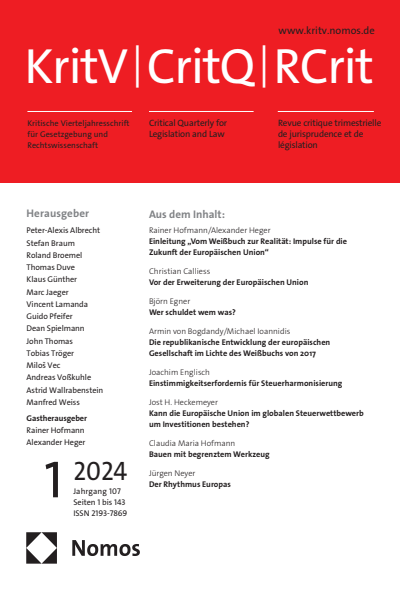
The CritQ provides a forum for open, interdisciplinary-oriented, intradisciplinary-informed critical jurisprudence grounded in the theory-praxis dialogue. As a European law journal the CritQ reflects the required legal adjustments towards societal, political, and systemic directives in Europe. The list of editors that counts the law schools of the University of Luxembourg and Goethe-University Frankfurt am Main among them, has been prominently enhanced with pioneers of European jurisdiction (Marc Jaeger, Vincent Lamanda, Dean Spielmann, Sir John Thomas, Andreas Voßkuhle). The European public is conveyed by language, thus the CritQ presents articles in German, English, and French.
Enlargement is back on the European agenda. But without a reform of the European Union (EU) it may lead to an ‘overstretch’ and as a consequence to disintegration. Nonetheless, tackling the ongoing European ‘polycrisis’ by adequate reforms...
The article focuses on expectations of citizens towards their fellow European citizens, other EU member states and the EU institutions concerning solidarity. The article is based on empirical analysis of 27 focus groups with citizens from 9 Euro...
In 2017, the European Commission published its White Paper on the Future of Europe. It presents five different scenarios for the development of the EU, but aims for further federalisation. This contribution shows that the integration since 2017 has...
Since the Single European Act of 1986, the requirement of a unanimous Council decision for Union legislative acts has been successively replaced by qualified majority voting. However, the harmonization of national tax legislation still remains a...
In recent years, the European Union has dedicated itself with great vehemence to the fight against international tax avoidance. The result of this policy is the restriction of tax structuring leeway while at the same time significantly increasing...
In view of the discussions surrounding the enlargement of the European Union's member states, institutional reforms, the further development of the single market and the strengthening of European competitiveness, social policy issues appear to be...
The article analyses Europe's social challenges and describes them as a function of dysfunctional political structures. The EU lacks institutional mechanisms that continuously mediate between the demand for redistributive mechanisms and its...