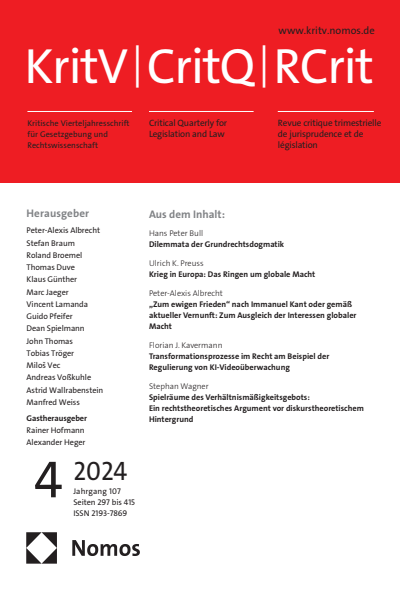
The CritQ provides a forum for open, interdisciplinary-oriented, intradisciplinary-informed critical jurisprudence grounded in the theory-praxis dialogue. As a European law journal the CritQ reflects the required legal adjustments towards societal, political, and systemic directives in Europe. The list of editors that counts the law schools of the University of Luxembourg and Goethe-University Frankfurt am Main among them, has been prominently enhanced with pioneers of European jurisdiction (Marc Jaeger, Vincent Lamanda, Dean Spielmann, Sir John Thomas, Andreas Voßkuhle). The European public is conveyed by language, thus the CritQ presents articles in German, English, and French.
The prospect of enlargement and the geopolitical challenges of the „Zeitenwende“ (watershed) make reforms in the EU indispensable. Enlargement and reforms must take place in parallel. While the European Parliament, the European Council and the...
Productivity growth in the US has been higher than in Europe for many years, leading to ever-widening differences in per capita income between the two countries. This article documents that lower firm dynamics, i.e. fewer firms entering and leaving...
The responsibility of the euro member states for their respective independent economic and fiscal policies leads to heterogeneity in the economic fundamentals of the euro member states, which has an impact on the risk premiums for government bonds,...
The White Paper on the Future of Europe presented by then Commission President Jean-Claude Juncker in 2017 outlined five possible scenarios for the development of the European Union up to 2025. Against the background of these scenarios, this article...