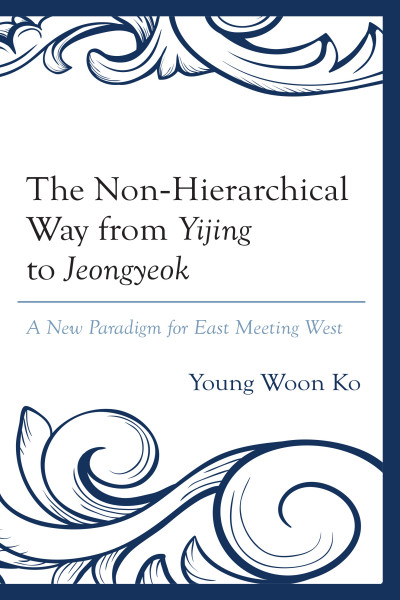
The Non-Hierarchical Way from Yijing to Jeongyeok
A New Paradigm for East Meeting West- Authors:
- Publisher:
- 2023
Summary
The Non-Hierarchical Way from Yijing to Jeongyeok: A New Paradigm for East Meeting West examines the paradoxical structure of Yijing known as the Book of Changes—a structure that promotes in a non-hierarchical way the harmony and transformation of opposites. Because the non-hierarchical model is not limited to the East Asian tradition, it is considered in relation to ideas developed in the West, including Carl Jung’s archetypal psychology, Georg Cantor’s Diagonal Theorem, Rene Girard’s mimetic desire, and Alfred North Whitehead’s process thought. By critically reviewing the numerical and symbolic structures of Yijing, Young Woon Ko introduces Kim Ilbu’s Jeongyeok (the Book of Right Changes) and demonstrates that it intensifies the correlation between opposites to overcome any hierarchical system implied by the Yijing. Both the Yijing and the Jeongyeok are useful textual sources for kindling a discussion about the Divine, which is conceived in Eastern and Western philosophical theological traditions quite differently. While the nontheistic aspects of the Ultimate feature prominently in Yijing, Jeongyeok extends them to a theistic issue by introducing the notion of Sangjae, the Supreme Lord, which can lead to a fruitful dialogue for understanding the dipolar characteristics of the divine reality—personal and impersonal. Ko considers their contrast, which has divided Eastern and Western religious belief systems, to be transformational and open to a wider perspective of the divine conception in the process of change.
Keywords
Search publication
Bibliographic data
- Edition
- 1/2023
- Copyright Year
- 2023
- ISBN-Print
- 978-1-4985-7392-4
- ISBN-Online
- 978-1-4985-7393-1
- Publisher
- Lexington, Lanham
- Language
- English
- Pages
- 226
- Product Type
- Monograph
Table of contents
- Contents No access
- List of Figures No access
- List of Tables No access
- Notes No access
- The Historical Formation and Authorship of the Yijing No access
- The Structure of the Yijing No access
- Notes No access
- Wang Bi’s Idea of Non-Being in the Yijing No access
- Cheng Yi’s Concept of Principle in the Yin-Yang Force No access
- Neo-Confucian Interpretation of the Yijing and Zhu Xi No access
- Zhu Xi’s Interpretation of the Yijing in Li-Qi Theory No access
- Zhu Xi’s Interpretation of the Mind and Self-Cultivation in the Yijing No access
- Whitehead’s Process Model of the Yijing and Creativity in Time No access
- Notes No access
- The Problem of Paradox in the Yin-Yang Relationship No access
- The Sagehood of the Yijing in the Correlative Pattern of Culture and Nature No access
- The Yijing Language and Correlative Thinking No access
- Notes No access
- The Collective Unconscious, Instinct and Archetype, and Archetypal Images for the Theory of Synchronicity No access
- Philosophy of Science in Jung and the Yijing No access
- The Difference between Jung and the Yijing from Jung’s Etic Points of View No access
- The Connection of Differences between Jung and Yijing No access
- The Encounter of Jung and the Yijing in the Pluralist Contexts of the Self No access
- The Religious Significance of the Yijing in Jung’s Interpretation of the Divine Experience No access
- The Significance of Jung’s Synchronistic Principle from the Yijing View of Time No access
- Notes No access
- Sang Yil Kim’s Discussion of Shao Yong’s Square Diagram and Cantor’s Diagonal Theorem No access
- Shao Yong’s Circular Diagram and the Yijing Cosmology No access
- Notes No access
- Seoncheon and Hoocheon No access
- The Three Types of Ultimate: Taegeuk, Hwanggeuk, and Mugeuk No access
- Do-Saeng-Yeok-Sung and Yeok-Saeng-Do-Sung No access
- The Charts of Ha Do-Fu Xi, Nak Seo-King Wen, and Ilbu’s Jeongyeok No access
- The Topological Development of the Triple Charts No access
- Notes No access
- Sooji-sangsu in Jeongyeok No access
- Yearly Cycle in the Jeongyeok No access
- Geumhwa Gyoyeok: The Metal-Fire Reciprocity No access
- Joyang-Yuleum: Regulating Yang and Reinforcing Yin No access
- Notes No access
- Directionality in Girard’s Theory of Mimetic Desire No access
- The Problem of Directionality No access
- Multidirectionality in a Religiously Pluralistic Society No access
- Notes No access
- Su-un’s Divine Paradox and Ilbu’s Jeongyeok No access
- Whitehead and Ilbu’s Jeongyeok No access
- The Jeongyeok and Deep Pluralism No access
- Notes No access
- Note No access
- Selected Bibliography No access Pages 211 - 218
- Index No access Pages 219 - 224
- About the Author No access Pages 225 - 226