, to see if you have full access to this publication.
Monograph No access
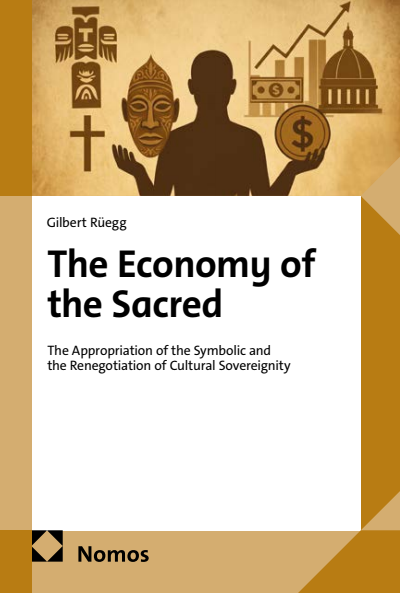
The Economy of the Sacred
The Appropriation of the Symbolic and the Renegotiation of Cultural Sovereignity- Authors:
- Publisher:
- 2026
Summary
In response to postcolonial critique, Dr Gilbert Rüegg analyses the mechanisms of symbolic appropriation in a globally networked world. The work develops a triadic analytical framework of semantics, performativity, and power to critically examine the commodification of the sacred. From the Benin Bronzes to spiritual wellness industries, Rüegg demonstrates how colonial continuities undermine the epistemic sovereignty of indigenous communities. The book provides a sophisticated typology of appropriation and outlines normative perspectives for a decolonial practice. It is a vital contribution to the debate on restitution, cultural integrity, and the ethical responsibility of scholarship within asymmetrical power relations.
Search publication
Bibliographic data
- Edition
- 1/2026
- Copyright Year
- 2026
- ISBN-Print
- 978-3-7560-2192-5
- ISBN-Online
- 978-3-7489-5740-9
- Publisher
- Nomos, Baden-Baden
- Language
- English
- Pages
- 257
- Product Type
- Monograph
Table of contents
ChapterPages
- Introduction—Symbolic Power in a Globalized World No access
- Subject, Context, and Relevance of the Topic No access
- Aesthetic and Symbolic Appropriation No access
- Ritual and Performative Appropriation No access
- Epistemic and Material Forms of Appropriation No access
- Signs, Power, and Coloniality: An Analytical Framework No access
- Research Gap, Problem Statement, and Objectives of the Study No access
- Methodological Approach: Symbolic, Semiotic, and Decolonial Perspectives No access
- Structure and Argumentative Framework of the Book No access
- 1.1 Symbolic Order as the Foundation of Cultural Practice No access
- 1.2.1 Culture as a Semiotic System No access
- 1.2.2 Thick Description as a Methodological Principle No access
- 1.2.3 Relevance for the Book No access
- 1.3.1 The Multilayered Symbol No access
- 1.3.2 Ritual Performative Practice No access
- 1.3.3 Social Dramas No access
- 1.3.4 Relevance for the Book No access
- 1.4.1 Symbolic Power as an Invisible Principle of Domination No access
- 1.4.2 Habitus and Cultural Disposition No access
- 1.4.3 Fields: Art, Religion, Market, and Science No access
- 1.4.4 Relevance for the Book No access
- 1.5.1 Mircea Eliade: The Structure of the Sacred No access
- 1.5.2 Sacrality in the Political Economy No access
- 1.5.3 Sacredness in the Colonial Context No access
- 1.5.4 Relevance for the Book No access
- 1.6.1 Colonial Genealogies of Symbolic Control No access
- 1.6.2 Epistemic Violence No access
- 1.6.3 The Coloniality of the Sign No access
- 1.7.1 Symbolic Appropriation and Epistemic Control No access
- 1.7.2 Symbolic Vulnerability and Cultural Integrity No access
- 1.8.1 Integrating Geertz, Turner, and Bourdieu No access
- 1.8.2 The Necessity of the Geertz–Turner–Bourdieu Triad No access
- 1.8.3 Methodological Implications No access
- 1.9 Conclusion: Symbolic Order and Appropriation No access
- 2.1.1 Epistemic Boundaries and Power Asymmetries No access
- 2.1.2 Identity Formation, Vulnerability, and Normative Implications No access
- 2.2.1 Contextual Embeddedness No access
- 2.2.2 Power Asymmetries and Positionality No access
- 2.2.3 Intention and Function No access
- 2.2.4 Relationality between the ‘Appropriators’ and the ‘Appropriated’ No access
- 2.3.1 Aesthetic Appropriation No access
- 2.3.2 Ritual Appropriation No access
- 2.3.3 Religious–Spiritual Appropriation No access
- 2.3.4 Epistemic Appropriation No access
- 2.3.5 Performative Appropriation No access
- 2.3.6 Economic and Commercial Appropriation No access
- 2.4.1 Aesthetic–Spiritual Hybridization No access
- 2.4.2 Economic–Ritual Dual Codings No access
- 2.4.3 Epistemic–Economic Extraction No access
- 2.4.4 The Shangri-La Case as a Paradigmatic Hybrid Form No access
- 2.5.1 Hegemonic Interpretive Authority and Cultural Power No access
- 2.5.2 Cultural Control and its Dissolution No access
- 2.5.3 Recognition, Consent, and Authorization No access
- 2.5.4 Conflicts over Access to Sacred or Ritual Resources No access
- 2.6.1 The Symbolic Order as a Framework No access
- 2.6.2 The Dynamics of Cultural Transformation No access
- 2.6.3 Appropriation as the Capitalization of Meaning No access
- 2.6.4 Outlook: Zones of Conflict over Recognition No access
- 3.1.1 Sacredness as a Cultural Category: Boundaries and Set-Apart Structures No access
- 3.1.2 Aura and Authenticity: Benjamin, Taylor, and the Question of Presence No access
- 3.1.3 Sacredness as Intangible Capital: Bourdieu and Symbolic Orders No access
- 3.1.4 Global Mobility of Sacred Meanings: Appadurai and Logics of Circulation No access
- 3.2.1 Religious Value versus Market Value: Historical and Systematic Distinctions No access
- 3.2.2 The Economized Aura: Sacredness as a Source of Surplus Value No access
- 3.2.3 Sacred Authenticity as a Market Argument: Staging and Legitimation No access
- 3.2.4 Postcolonial Challenges: Power, Claims to Interpretation, and Hierarchization No access
- 3.2.5 Symbolic Appropriation: Pagan Cycles and Christian Festive Culture No access
- 3.3.1 Souvenirization: Miniatures, Replicas, and 'Take-Away Holiness' No access
- 3.3.2 Sacredness Marketing: Branding, Storytelling, and Visual Coding No access
- 3.3.3 Medially Staged Sacredness: Documentaries and Digital Pilgrimage No access
- 3.3.4 Luxury Industries and Lifestyle Spirituality: Retreats and Designer Rituals No access
- 3.4.1 Commercialized Retreat Formats: Yoga, Meditation, and Detox No access
- 3.4.2 Spiritual Tourism: Authenticity and Transformation as Products No access
- 3.4.3 Economies of Emotion: Care, Healing, and Affect Economies No access
- 3.4.4 The Logic of the Transformational: Self-Optimization as Spiritual Capital No access
- 3.5.1 Religious Artefacts, Talismans, and Devotional Items in Modern Markets No access
- 3.5.2 Problematical Circulations: Colonial Objects, Looted Goods, and Replicas No access
- 3.5.3 Ownership and Moral Economy: Restitution and Community Rights No access
- 3.5.4 Museum Economies: Aura Management and Value Production No access
- 3.6.1 Indigenous Intellectual Property: Cultural Brands and Collective Identity No access
- 3.6.2 Trademarking of Rituals and Symbols: Cases and Conflicts No access
- 3.6.3 Economic Safeguards: Certificates and Provenance Labels No access
- 3.6.4 Risks of Commodification: Essentialization, Fixation, and Authenticity No access
- 3.7.1 De-commodification and Resistance: Re-sacralization and Re-embedding No access
- 3.7.2 Sacredness as a Political Argument: Indigenous Movements and Land Rights No access
- 3.7.3 Sacredness as an Identity‑Forming Resource: Diaspora and Politics of Memory No access
- 3.7.4 Ambivalent Effects: Accessibility, Overuse, and Symbolic Exhaustion No access
- 3.8.1 Interconnections between Economic, Symbolic, and Political Dimensions No access
- 3.8.2 Connection to Chapter 2: Hybridization, Legitimation, and Power Asymmetries No access
- 3.8.3 Outlook for Part III: Conflicts, Looting, Restitution, and Regulation No access
- 4.1.1 From Colonial Seizure to Modern Legal Discourse No access
- 4.1.2 Delimitation: Plunder, Theft, Restitution No access
- 4.1.3 Cultural Theft and Epistemic Power No access
- 4.2.1 Appropriation as Control over Cultural Knowledge No access
- 4.2.2 Colonial Archival Regimes No access
- 4.2.3 Museum-Based Exclusion and Epistemic Distortion No access
- 4.2.4 Loss of Cultural Self-Description No access
- 4.3.1 Symbolic and Material Capitalization No access
- 4.3.2 The Global Art Market as a Power Apparatus No access
- 4.3.3 International Legal Norms and Their Asymmetries No access
- 4.3.4 Restitution, Legal Asymmetries, and the Politics of Return No access
- 4.4.1 Object Loss and Identity Disruption No access
- 4.4.2 Ritual Emptiness: Removed Objects, Depleted Contexts of Meaning No access
- 4.4.3 Generational Memory and Postcolonial Burdens No access
- 4.5.1 Restitution Claims and Political Negotiations No access
- 4.5.2 Re-contextualization and Re-ritualization No access
- 4.5.3 Cases of Successful Epistemic Reconstruction No access
- 5.1.1 Selection Criteria No access
- 5.1.2 Case Studies as Epistemic Reconstruction No access
- 5.1.3 Limits of Case-Analytic Methods No access
- 5.2.1 The Parthenon Frieze (Elgin Marbles): UNESCO and Restitution Debates No access
- 5.2.2 Nefertiti Bust No access
- 5.2.3 Rosetta Stone / Pergamon Altar No access
- 5.3.1 Benin Bronzes No access
- 5.3.2 The Maqdala Treasures from Abyssinia (Ethiopia) No access
- 5.3.3 Moctezuma’s Feather Headdress (Aztec Artefacts) No access
- 5.3.4 Māori Waka and Moko Mokai No access
- 5.3.5 Ashanti Treasures and South Sea Objects of the German Colonial Period No access
- 5.3.6 Tibetan Cultural Treasures No access
- 5.4.1 Yuanmingyuan, Beijing No access
- 5.4.2 The Benjamin’s Collection from Alaska and the Northwest Coast No access
- 5.4.3 Indigenous Human Remains and Sacred Objects from North America No access
- 5.5.1 The Rothschild and Gurlitt Collections: Klimt’s Adele Bloch-Bauer No access
- 5.5.2 Eastern European Archives and Manuscripts during the Second World War No access
- 5.6.1 Koh-i-Noor-Diamant & Hope Diamond No access
- 5.6.2 ’Great Star of Africa’ No access
- 5.7.1 Ethiopian Manuscripts from Maqdala No access
- 5.7.2 Timbuktu Manuscripts / Sanskrit Manuscripts No access
- 5.8.1 The de Clercq Collection, Louvre, and Berlin Collections from Syria and Iraq No access
- 5.8.2 Objects of the Moai Cult (Rapa Nui) No access
- 6.1.1 Relation to Symbolic Order and Dynamics of Appropriation No access
- 6.1.2 Epistemic Violation and Normative Challenges No access
- 6.2.1 Integrity as a Relational and Processual Condition No access
- 6.2.2 Culture, Vulnerability and the Limits of Essentialism No access
- 6.2.3 Integrity between Collective Autonomy and Global Interdependence No access
- 6.3.1 Principle of Respect and Context: Recognition and Embedding No access
- 6.3.2 Principle of Participation: Decision-Making Rights of Source Communities No access
- 6.3.3 Principle of Institutional Responsibility: Museums, States, and Markets No access
- 6.4.1 Restitution and Repatriation: Criteria, Limits, Misunderstandings No access
- 6.4.2 Co-Curation and Shared Sovereignty No access
- 6.4.3 Temporary Repatriations and Circular Cultural Property Policies No access
- 6.4.4 Digital Rights, Representation, and Epistemic Co-Authorship No access
- 6.5.1 Decolonial Ethics Beyond Moral Dichotomies No access
- 6.5.2 Enabling Cultural Agency in the Twenty-First Century No access
- Review of the Line of Argument No access
- Insight gained from the work as a whole No access
- Outlook and Open Questions No access
- Concluding Reflection No access
- 1 Iconographic Origin Scene: The ‘Cigar Store Indian’ No access
- 2 Pueblo: The Commercialization of Indigenous Architecture No access
- 3 Contemporary Condensation: ‘American Spirit’ as a Globalized Icon No access
- 4 Philosophical Reflection: Symbolic Appropriation as a Structural Principle No access
- 5 Concluding Movement: Responsibility and the Presence of Cultural Signs No access
- References No access Pages 241 - 256