Figurines as Cultural Identifiers in Space and Time
On the Nature of Human Interactions with Images- Authors:
- Series:
- Studien zur Kunstgeschichte, Volume 227
- Publisher:
- 2026
Summary
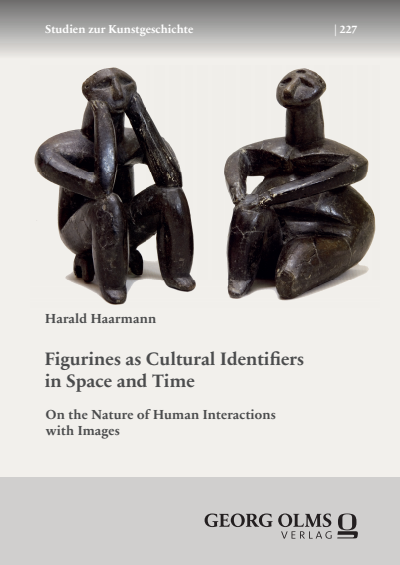
Ever since humans moved into Eurasia, they have fashioned figurines from stone, clay, wood, metal, wax and even butter. These sculpted figurines must be understood within the context of the cultures in which they were fashioned. In this fascinating examination of contemporary scholarship on the study of figurines, Harald Haarmann draws on millennia of human activity from the Stone Age through the works of twentieth-century artists such as Constantin Brancusi and Henry Moore whose sculptures glow with their veneration of human culture. In his richly illustrated book, Haarmann draws on the disciplines of archaeology, ethnology, mythology, and history of religion, showing direction how modern scholars and other interested investigators can see beyond the boundaries our culture sets on us so that we can immerse into other spheres.
Search publication
Bibliographic data
- Edition
- 1/2026
- Copyright Year
- 2026
- ISBN-Print
- 978-3-487-17059-6
- ISBN-Online
- 978-3-487-42517-7
- Publisher
- Georg Olms Verlag, Baden-Baden
- Series
- Studien zur Kunstgeschichte
- Volume
- 227
- Language
- English
- Pages
- 234
- Product Type
- Monograph
Table of contents
- Preface No access Pages 1 - 8
- Introduction: Figurines as a visual lingua franca No access Pages 9 - 16
- Anthropomorphic figurines No access
- Zoomorphic figurines No access
- Figurines with hybrid (anthropomorphic-zoomorphic) features No access
- On the nature of figurines as agents in culture‑construction No access
- Figurines as artifacts with profane functions No access
- Figurines with symbolic functions No access
- The relativism of aesthetic corporeality No access
- The dimension of spirited worlds in prehistoric thought No access
- Materials and their selection for the production of figurines No access
- Durable materials for sculpting figurines No access
- Soft materials for sculpting figurines No access
- Asking questions about figurines No access
- “Embodied” scholarship: A metaphor for interdisciplinary research on figurines No access
- Symbol-making, myth-making and mythopoetic categorizations of the living-space No access
- The prominence of mythopoetic worldviews for assessing the function of ancient imagery No access
- Approaches to replace the Goddess by a bull god No access
- Approaches to replace the Goddess by a bear No access
- Variations of figurine prototypes in the horizon of cultural evolution No access
- Hybridization of forms (1): The interchange of features of human beings and animals No access
- Hybridization of forms (2): The combination of features of living things and items of material culture No access
- A typology of visible forms in the Neolithic of southeastern Europe No access
- Stylistic variations in space and time No access
- Photometric methods for analyzing figurines No access
- Visualization in process: How visible forms relate to the web of cultural memory No access
- Viewing figurines as dolls No access
- Figurines as dolls to play with No access
- Among the Bering Sea Eskimo, the playing with dolls underlies certain restrictive rules: No access
- Broken figurines – broken toys? No access
- Figurines as dolls not to play with No access
- Intrinsic relationships: Tactile impressions and visual perception No access
- The interplay of light and darkness/shadow No access
- Figurines in the context of Palaeolithic imagery No access
- Figurines as diagnostic items for the identification of the Early Neolithic in western Asia No access
- Microcontext as the relationship between artifacts in the same cultural horizon No access
- Female statuettes as expressions of beliefs in the Female Principle of the life cycle No access
- The bear as a mythical animal No access
- Birds as helper spirits No access
- Microcontext as the relationship of figurines with a cultural key concept: The hearth in focus No access
- Assessing the role of figurines as items in the cultural space for the living and the dead No access
- Servant figures No access
- Shawabtis (Shabtis) No access
- Figurines and their semiotic networks No access
- Inscribed figurines and utensils for weaving No access
- The female body as cultural identifier and memorial space – Anthropological insights from a living matrilinear society No access
- The status of women and their lineages in African matrilinear society No access
- The female body as a canvas for cultural symbolism No access
- Analogy 1: Female sculptures as mirrors of memorial landscapes No access
- Analogy 2: Ornamented pots considered, like scarified female bodies, as containers of spiritual vitality No access
- Ornamentation of the living body and ornamentation of material items No access
- Parallelism of motifs on the human body and on figurines No access
- Parallelism of motifs on figurines and on artifacts with non-practical functions No access
- Parallelism of motifs throughout the spectrum of templates which bear cultural symbols (i.e. the human body, figurines, pottery, utensils and requisites) No access
- Verbal metaphors No access
- Visual metaphors No access
- Motivation and the infrastructure of metaphors No access
- Conclusiveness and the value of circumstantial evidence for the identification of metaphorical meaning No access
- The type with prominent bottom (kallipygeous) No access
- The geometric-volumetric type (stile geometrico-volumetrico) No access
- The smooth geometrical type (stile geometrico planare) No access
- Modern art and the aesthetic appeal of the Neolithic spirit No access
- Constantin Brancusi in focus No access
- The relationship of modern art and natural forms No access
- Henry Moore in focus No access
- Barbara Hepworth in focus No access
- What have literary historiography and art history in common? No access
- Conditions of altered states of consciousness No access
- Stage 1 No access
- Stage 2 No access
- Stage 3 No access
- Speaking a figurine’s lingua franca No access
- Epilogue: Will figurines remain a leitmotif of human culture? No access Pages 211 - 212
- Bibliography No access Pages 213 - 228
- List of Figures No access Pages 229 - 232
- List of Maps No access Pages 233 - 233