, to see if you have full access to this publication.
Edited Book No access
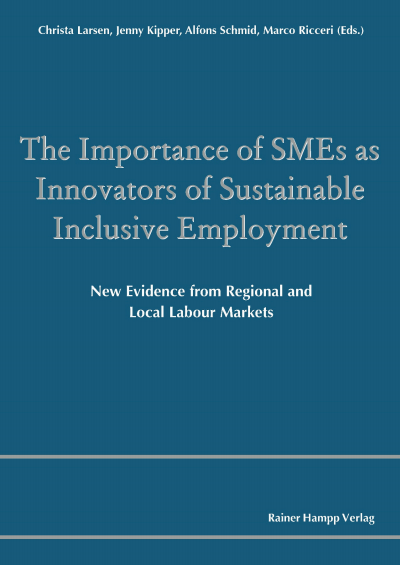
The Importance of SMEs as Innovators of Sustainable Inclusive Employment
New Evidence from Regional and Local Labour Markets
Editors:
| | |
Publisher:
2020
Summary
SMEs are the backbone of the European economy, but in regional and local labour market monitoring approaches their specificities are not yet well considered. As SMEs have to compete with larger companies for human resources, they develop creative strategies for recruiting and retaining employees. This overall flexible approach proves to be a good tactic for staying in business, e.g. during a pandemic. This publication delivers insights on the statistical relevance of SMEs and their importance for the functioning of regional and local labour markets. Additionally, it offers an organisational perspective on specific conditions for human resource management within European, national, regional and local policy frameworks. Most of the contributions in this anthology show insights drawn from the current COVID-19 pandemic. This perspective leads to further discussions on how these insights can be used to develop new concepts for regional and local labour market monitoring beyond the pandemic.
Search publication
Bibliographic data
Edition
1/2020
Copyright Year
2020
ISBN-Print
978-3-95710-280-5
ISBN-Online
978-3-95710-380-2
Publisher
Hampp, Baden-Baden
Language
English
Pages
358
Product Type
Edited Book
Table of contents
ChapterPages
Titelei/Inhaltsverzeichnis No access Pages 1 - 20
The Importance of SMEs as Innovators of Sustainable Inclusive Employment: New Evidence from Regional and Local Labour Markets No access Pages 21 - 32
Authors: |
The Importance of SMEs as Innovators of Sustainable Inclusive Employment: Some Issues Resulting from Shocks to the Economy Imposed by the COVID-19 Pandemic No access Pages 33 - 46
Authors: |
What Is New in SMEs? Innovation and Employment Sustainability in the Context of Italian Start-Ups No access Pages 47 - 78
Authors: | |
SMEs in Hungary and in Poland: A Comparative Analysis of Legal and Labour Relations19 No access Pages 79 - 102
Authors: | | |
Regional Public Policy on the Use of ICT to Support Innovation and Growth: How Can Micro-Businesses and SMEs Be Supported Through Collaborative Initiatives in Clusters? No access Pages 103 - 128
Authors: | |
Employment in SMEs in the Context of Digitalisation: Opportunities and Threats. On the Examples of Russia and China No access Pages 129 - 140
Authors: | |
Decent Work in the Basque Country No access Pages 141 - 158
Authors:
SMEs in the Economy of Russia: Regional and Industry Aspects No access Pages 159 - 178
Authors:
Contributions of SMEs to Employment in Romania No access Pages 179 - 190
Authors: |
SMEs in Brandenburg – Job Creation Motor, Adaptation Machine, Low Wages? No access Pages 191 - 214
Authors:
Continuing Vocational Training and SMEs: Specificities, Practices, and Potentials No access Pages 215 - 230
Authors:
Skills for Smart Specialisation: Fostering SME Innovation Through New Training and Learning Pathways, Technological Transfer, and Skills Upgrading No access Pages 231 - 246
Authors: |
SMEs and the Retrospective Acquirement of Vocational Qualification by Semi-Skilled and Unskilled Workers in the Federal State of Hesse No access Pages 247 - 262
Authors: |
How Do SMEs Contribute to Sustainable Employability in Times of Crisis? An Explorative Study in Northern Italy No access Pages 263 - 280
Authors: |
Innovation and Sustainable Inclusive Employment: Evidence from the „Regio Insubria“ During the COVID-19 Outbreak No access Pages 281 - 294
Authors:
Recruiting and Retention in SMEs in Hesse – Qualitative Insights No access Pages 295 - 310
Authors:
SMEs – Labour and the Challenge of Competitive Sustainability No access
Authors:
Afterword No access Pages 337 - 340
INFORMATION ON THE AUTHORS No access Pages 341 - 358
Similar publications
from the topics "Umweltökonomie & Umweltmanagement & Energiewirtschaft"