, to see if you have full access to this publication.
Monograph No access
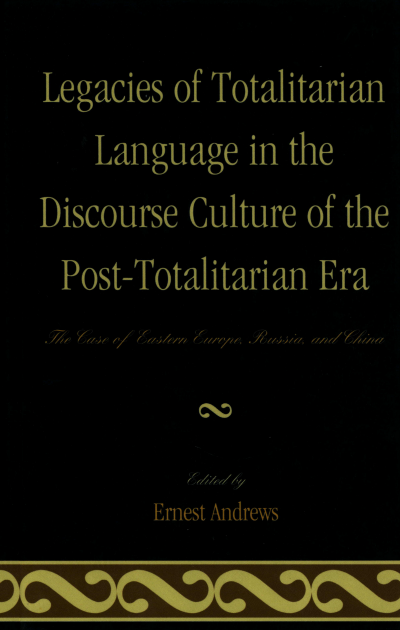
Legacies of Totalitarian Language in the Discourse Culture of the Post-Totalitarian Era
The Case of Eastern Europe, Russia, and China
Authors:
Publisher:
2011
Summary
This book is unique in its kind. It is the first scholarly work to attempt a comprehensive and fairly detailed look into the lingering legacies of the communist totalitarian modes of thought and expression in the new discourse forms of the post-totalitarian era. The book gives also new and interesting insights into the ways the new, presumably democratically-minded political elites in post-totalitarian Eastern Europe, Russia, and China manipulate language to serve their own political and economic agendas. The book consists of ten discrete discussions, nine case-studies or 'chapters' and an 'introduction.' Chapter 1 discusses patterns of continuity and change in the conceptual apparatus and linguistic habits of political science and sociology practiced in the Czech Republic before and after 1989. Chapter 2 analyzes lingering effects of communist propaganda language in the political discourse and behavior in post-communist Poland. Chapter 3 analyzes the legacy of Soviet semantics in post-Soviet Moldovan politics through the prism of such politically contested words as 'democracy,' 'democratization,' and 'people.' Chapters 4 and 5 discuss the way in which communist patterns of thought and expression manifest themselves in the new political discourse in Romania and Bulgaria, respectively. Chapter 6 examines phenomena of change and continuity in the socio-linguistic and socio-political scene of post-Soviet Latvia. Chapter 7 analyzes the extent to which the language of the post-communist Romanian media differs from the official language of the communist era. Chapter 8 examines the evolution of Russian official discourse since the late eighties with a view of showing 'whether or not new phenomena in the evolution of post-Soviet discourse represent new development or just a mutation of the value-orientations of the old Soviet ideological apparatus.' Chapter 9 gives a detailed and lucid account of the evolution of both official and non-official discourse in China since the end of the Mao era.
Keywords
Search publication
Bibliographic data
Edition
1/2011
Copyright Year
2011
ISBN-Print
978-0-7391-6465-5
ISBN-Online
978-0-7391-6467-9
Publisher
Lexington, Lanham
Language
English
Pages
2
Product Type
Monograph
Table of contents
ChapterPages
Contents No access
Introduction No access Pages 1 - 14
Chapter 1 The Absent Past: The Language of Czech Sociology Before and After 1989 No access Pages 15 - 38
Chapter 2 The Linguistic Legacy of the Communist Propaganda in Post-Communist Thought Patterns: The Case of Poland No access Pages 39 - 54
Chapter 3 What Does Democracy Mean in Moldova?: Political Discourse Around Contested Words in the Disputed Elections of 2009 No access Pages 55 - 76
Chapter 4 The Language of Romanian Post-Communist Politics Twenty Years After: Linguistic Memories of a Communist Past No access Pages 77 - 98
Chapter 5 Newspeak in the Language of Politics in the Post-Totalitarian Era: The Case of Bulgaria No access Pages 99 - 120
Chapter 6 Intertwining Legacies: Language and Socio-Cultural Change in Post-Soviet Latvia No access Pages 121 - 140
Chapter 7 The Language of the Media in Post-Communist Romania: Changes and Continuities No access Pages 141 - 154
Chapter 8 Official Ideological Discourse in Pre-Transition and Post-Communist Russia: What Has Really Changed since the Communist Period? No access Pages 155 - 182
Chapter 9 Language, State, and Society in Post-Mao China: Continuity and Change No access Pages 183 - 208