, to see if you have full access to this publication.
Edited Book No access
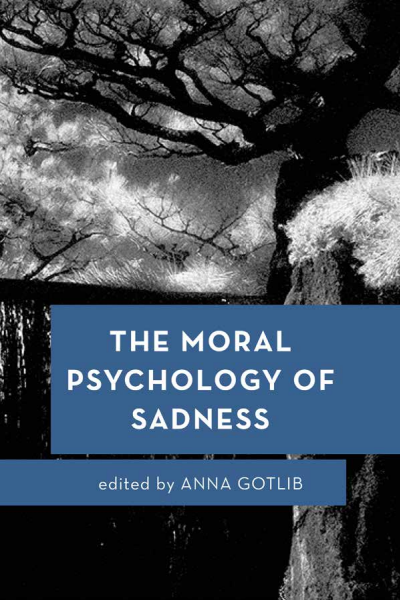
The Moral Psychology of Sadness
Editors:
Publisher:
2017
Summary
What does it mean to be sad? What difference does it make whether, how, and why we experience our own, and other people’s, sadness? Is sadness always appropriate and can it be a way of seeing more clearly into ourselves and others?
In this volume, a multi-disciplinary team of scholars - from fields including philosophy, women’s and gender studies, bioethics and public health, and neuroscience - addresses these and other questions related to this nearly-universal emotion that all of us experience, and that some of us dread. Somewhat surprisingly, sadness has been largely ignored by philosophers and others within the humanities, or else under-theorized as a subject worthy of serious and careful attention. This volume reverses this trend, presenting sadness as not merely a feeling or affect, but an emotion of great moral significance that in important ways underwrites how we understand ourselves and each other.
Keywords
Search publication
Bibliographic data
Edition
1/2017
Copyright Year
2017
ISBN-Print
978-1-78348-861-2
ISBN-Online
978-1-78348-862-9
Publisher
Rowman & Littlefield, Lanham
Language
English
Pages
216
Product Type
Edited Book
Table of contents
ChapterPages
Contents No access
Acknowledgments No access
The Topographies of Sadness No access Pages 1 - 18
Chapter 1 Untold Sorrow No access
Chapter 2 Should We Feel Sad about Scheffler’s Doomsday Scenario? No access
Chapter 3 Sadness, Sense, and Sensibility No access
Chapter 4 Sadness, Intersubjectivity, and the Lesson of No access
Chapter 5 Grief and Recovery No access
Chapter 6 Forgiveness and the Moral Psychology of Sadness1 No access
Chapter 7 Nostalgia and Mental Simulation1 No access