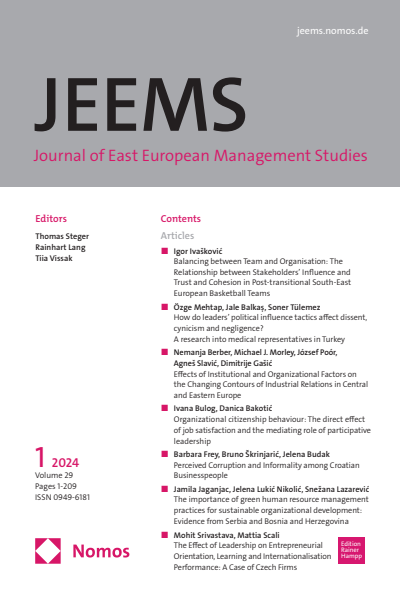
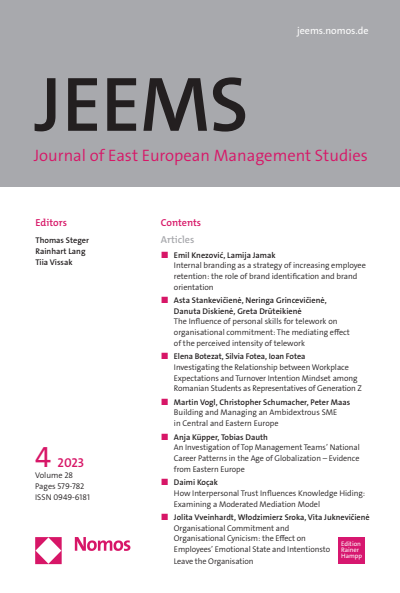
The Journal of East European Management Studies aims to promote dialogue and cooperation among scholars seeking to examine,explore and explain the behaviour and practices of management within the transforming societies of Central and Eastern Europe.The theoretical interests of the journal areorganisational and management change,Central and East European societies (including those on the fringes of Europe) undergoing processes of transition or transformation, andscientific issues of business, management and organisation that arise in such contexts.The JEEMS aims to attract social scientific contributions from scholars of any nation and region, but particularly wishes to encourageauthors from those countries directly experiencing transformational change. Its potential readership is international, comprising academicsand practitioners with an involvement or interest in the management of change in transforming societies in Central and Eastern Europe.
Inconsistent findings from the literature suggest that the relationship between innovativeness and performance is more complex than it might be presumed. By drawing on the resource-advantage theory, in this study we investigate: 1) the moderating...
Investing in Human Resource Management (HRM), particularly in employee development through Further Education and Training (FET) at workplaces is a priority for most organisations. Our paper investigates how the participants perceive the...
The limiting factors of foreign direct investment (FDI) are of considerable significance to managers, governments, and scholars, as these factors directly influence the profitability of a foreign subsidiary and its parent multinational company. The...
To tackle undeclared work in Central and East Europe, the conventional bureaucratic public sector management approach has used the hard-direct controls of penalties and increasing the risk of detection. Recently, an alternative post-bureaucratic...
Drawing on the findings from a serial moderated mediation model, this study aims to expand prior research by investigating the interaction between paternalist leadership and employee task performance. Study also aims to test the indirect effects of...
This paper analyses the relation between organisational justice in its three aspects: distributive, procedural and interactional, and employees’ subjective perception of remuneration justice using the case studies of Poland and Lithuania....
This article analyzes implementation of English as a lingua franca, and the way it induces the power relations within a company, through the example of a Hungarian multinational. Specifically, the article contributes to the field of cross-cultural...