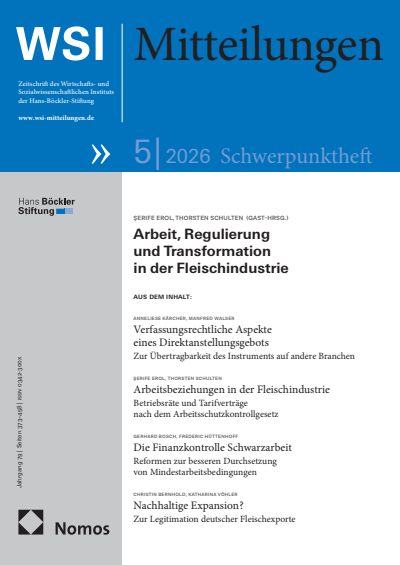
This paper examines the “direct employment obligation”, which was introduced in the meat industry in 2020 by the German Occupational Safety and Health Inspection Act (Arbeitsschutzkontrollgesetz). It first outlines the key elements of the act...
The Occupational Safety and Health Inspection Act (ASKG) strengthened the institutional power resources of workers in the German meat industry by integrating previously outsourced workers directly into company structures. This improved conditions...
What do informal forms of work organisation mean for the collective organisation of workers in the meat industry? The answer to this question is of crucial importance, not only for the concrete formulation of labour policies aimed at improving...
This article traces the development of labour and production in the German meat industry and highlights the sector’s dependence on cheap labour from Eastern Europe, which has grown over time. Romania plays a particularly important role as a source...
The introduction of the statutory minimum wage and other laws such as the German Meat Industry Act (GSA Fleisch)) has multiplied the tasks of the Financial Control of Illegal Employment (FKS). At the same time, violations of the law have become...
Actors in the German meat industry actively advocate expanding meat exports. Against this backdrop, the article critically examines the framing of these exports as a sustainable practice. The authors show that industry representatives justify...
This article analyses tensions in socio-ecological transformation in the case of the Danish pig-meat industry. In Germany, Denmark is celebrated as a climate policy model: The 2024 Green Tripartite Agreement introduced the world’s first CO₂...