"Law and Politics in Africa, Asia and Latin America" analyses legal and constitutional developments in all states or regions outside of Europe as well as their regional and international integration. Founded in 1968 and inspired by decolonization and the idea of a cooperative new beginning, the Journal also promotes a special interest in contributions on 'Law and development'. The journal aims to provide a forum for a variety of perspectives on these fields of interest, be they focused on one country or comparative, theoretical or methodological in nature. Next to extensive articles, the journal publishes shorter reports about current events or conferences as well as book reviews. As a special service, each issue of "Law and Politics in Africa, Asia and Latin America" contains an international bibliography of relevant publications from around the world. This is compiled in cooperation with the Leibniz-Institute for Global and Regional Studies in Hamburg (GIGA). "Law and Politics" addresses authors and readers on all continents and aims to serve as a forum of mutual exchange. The journal is open for contributions from legal and social sciences as well as for analyses from practitioners. The journal is published quarterly and welcomes contributions in German, English, Spanish and French. Website: www.vrue.nomos.de
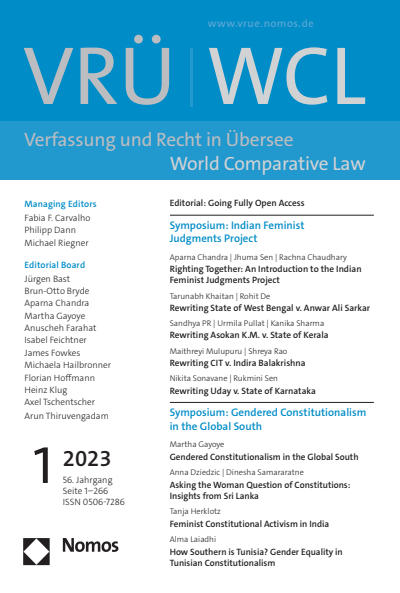
The case of Anwar Ali Sarkar has been a founding precedent for equality jurisprudence in India and elsewhere. The case is most cited for the two-step reasonable classification test. Yet over the years, it has become increasingly clear that there...
In Asokan K.M. v. State of Kerala (2017) at the behest of a disgruntled Hindu father whose daughter had converted to Islam and married a man of her choice, the Kerala High Court (HC) cast the daughter, Hadiya, as a ‘vulnerable’ woman before...
Since income tax is levied on a progressive basis (depending on the income of each taxpayer), how we define the taxpayer or “tax unit” is of critical importance. In the 1960 ruling of Commissioner of Income Tax v. Indira Balakrishna, the Supreme...
This commentary is on one ‘promise to marry’ judgment and its feminist re-writing. Promise to marry cases involve a woman agreeing to sexual intercourse with a partner relying on his promise to marry her subsequently. In inter-caste...
What do we learn when we ask ‘the woman question’ of constitutions of the Global South? Constitutions worldwide are increasingly the subject of gender analysis, which rests on ‘asking the woman question’ to uncover the gendered implications...
This paper assesses feminist constitutional activism in India, i.e. feminist engagements with the Constitution with the aim of broadening women's rights. To this end, the paper looks at several generations of feminist activists. It shows how...
Tunisia can be considered as a recent example for gendered constitutionalism in the Global South. In 2014, the country adopted a new constitution in the context of the so-called Arab Spring and enshrined far-reaching women's rights in it. With the...
This paper situates itself within existing feminist constitutionalism analyses by noting that constitutions and constitutional processes are gendered and that constitutional norms may have different consequences for different genders. However, it...
This paper makes the case for a theorising of gendered constitutionalism in postcolonial Africa on its own terms, rather than as an appendage or often afterthought to hegemonic and universalising impulses of Western liberal thought. More...