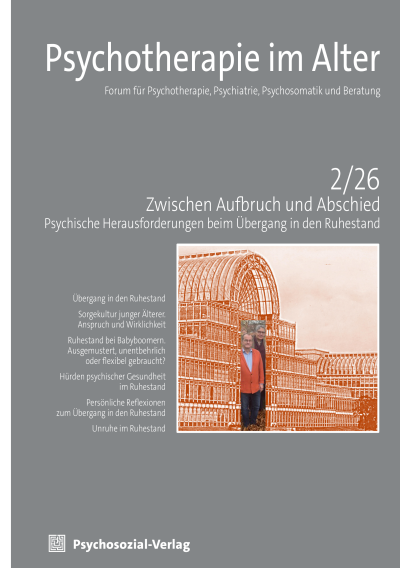
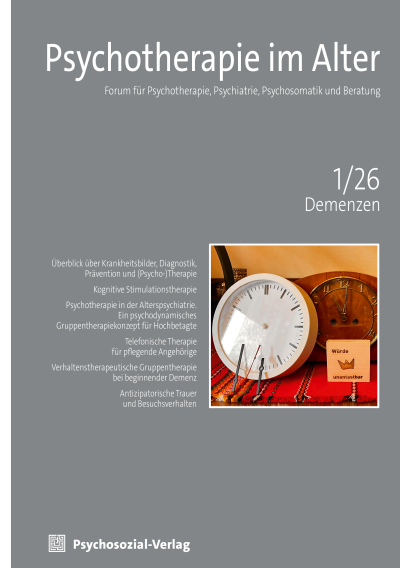
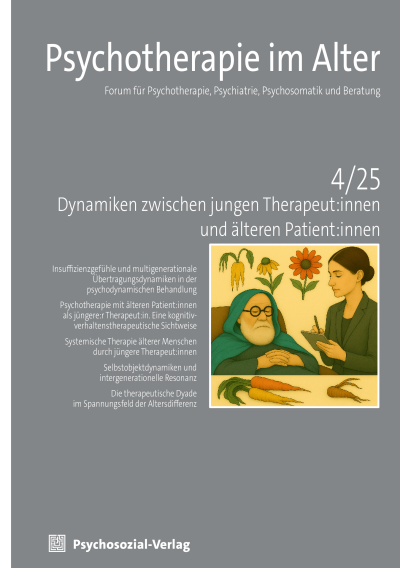
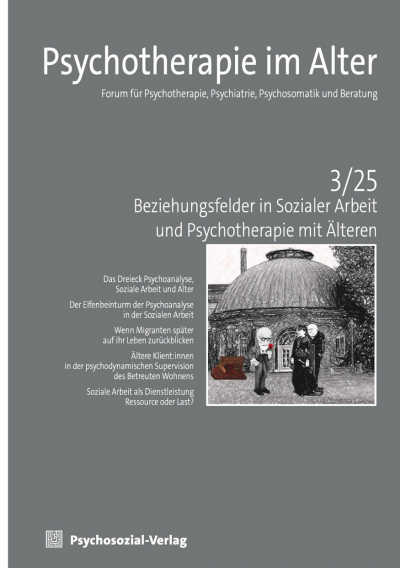
For a long time, the transition to retirement was considered a negative critical life event. Today, empirical research paints a different picture: for the majority, the gains outweigh the losses. There is hardly any evidence of a decline in health...
Psychosozial-Verlag, Gießen 2026
Authors:
Article
No access
Page 165 - 181
This article understands young old age as a phase of potential late freedom. It is based on psychological concepts of transitional phases and developmental tasks. Retirement from work is interpreted as a transitional phase characterized by a high...
Psychosozial-Verlag, Gießen 2026
Authors:
Article
No access
Page 183 - 196
The transition to post-working life is one of the most significant experiences of early old age. Although it is visible in therapeutic practice as a particularly crisis-prone phase, it is difficult to scientifically assess how people experience and...
Psychosozial-Verlag, Gießen 2026
Authors:
Article
No access
Page 197 - 212
How do older people experience retirement? What particular mental health risks do they associate with this stage of life? These questions are the focus of this article. From the perspective of the age group concerned, three categories that are...
Psychosozial-Verlag, Gießen 2026
Authors:
Article
No access
Page 213 - 226
For those working in the medical-psychosocial field, the transition to retirement represents a complex biographical turning point that extends far beyond the end of gainful employment. The personal reflections provided by psychotherapists,...
Psychosozial-Verlag, Gießen 2026
Authors: | | | |
Article
No access
Page 227 - 240
This paper describes and reflects on several experiences in retirement after decades of psychoanalytic and psychotherapeutic work, especially in the context of the simultaneous dynamics of aging. The central psychodynamic hypotheses are based on...
Psychosozial-Verlag, Gießen 2026
Authors:
Article
No access
Page 241 - 244
Psychosozial-Verlag, Gießen 2026
Authors:
Article
No access
Page 245 - 256
Medical advances have led to a longer life expectancy for patients with advanced cancer. Patients and their caregivers are thus confronted with the existential tension between hope and uncertainty. Patients often experience existential fears of...