, to see if you have full access to this publication.
Monograph No access
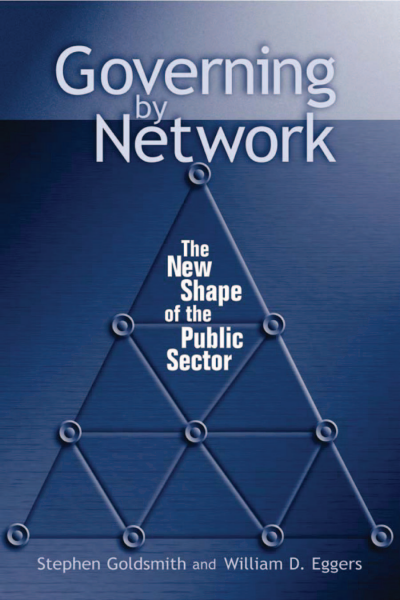
Governing by Network
The New Shape of the Public Sector
Authors:
|
Publisher:
2005
Summary
A fundamental, but mostly hidden, transformation is happening in the way public services are being delivered, and in the way local and national governments fulfill their policy goals. Government executives are redefining their core responsibilities away from managing workers and providing services directly to orchestrating networks of public, private, and nonprofit organizations to deliver the services that government once did itself. Authors Stephen Goldsmith and William D. Eggers call this new model “governing by network” and maintain that the new approach is a dramatically different type of endeavor that simply managing divisions of employees.
Like any changes of such magnitude, it poses major challenges for those in charge. Faced by a web of relationships and partnerships that increasingly make up modern governance, public managers must grapple with skill-set issues (managing a contract to capture value); technology issues (incompatible information systems); communications issues (one partner in the network, for example, might possess more information than another); and cultural issues (how interplay among varied public, private, and nonprofit sector cultures can create unproductive dissonance).
Governing by Network examines for the first time how managers on both sides of the aisle, public and private, are coping with the changes. Drawing from dozens of case studies, as well as established best practices, the authors tell us what works and what doesn’t. Here is a clear roadmap for actually governing the networked state for elected officials, business executives, and the broader public.
Search publication
Bibliographic data
Edition
1/2005
Copyright Year
2005
ISBN-Print
978-0-8157-3129-0
ISBN-Online
978-0-8157-9752-4
Publisher
Rowman & Littlefield, Lanham
Language
English
Pages
225
Product Type
Monograph
Table of contents
ChapterPages
Contents No access
Foreword No access
Chapter 1. The New Shape of Government No access
Chapter 2. Advantages of the Network Model No access
Chapter 3. Challenges of the Network Model No access
Chapter 4. Designing the Network No access
Chapter 5. Ties That Bind No access
Chapter 6. Networks and the Accountability Dilemma No access
Chapter 7. Building the Capacity for Network Governance No access