, to see if you have full access to this publication.
Monograph No access
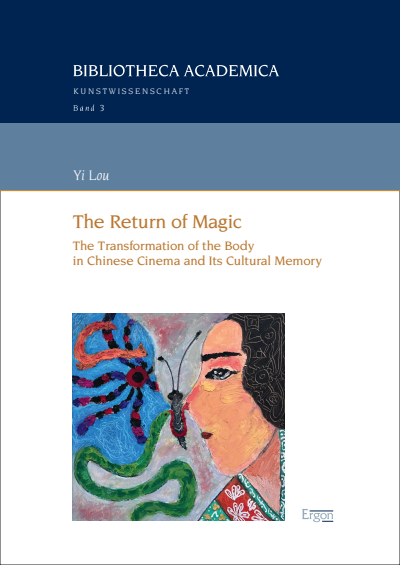
The Return of Magic
The Transformation of the Body in Chinese Cinema and Its Cultural Memory- Authors:
- Series:
- Bibliotheca Academica - Reihe Kunst- und Altertumswissenschaft, Volume 3
- Publisher:
- 2023
Summary
Body — a fragile, limited, but powerful object. The phenomenon of bodily transformation has occurred in Chinese cinema from the early phase of the twentieth century until today. The recurrence of transforming bodies reifies the shifting boundaries between normality and abnormality, beauty and ugliness, good and evil, remembering and forgetting that are mapped in social discourse. At the core of this research lies the question of how films concerning transforming bodies could be treated as a dispositif to shape and evoke the cultural memory of China.
Keywords
Search publication
Bibliographic data
- Copyright Year
- 2023
- ISBN-Print
- 978-3-98740-038-4
- ISBN-Online
- 978-3-98740-039-1
- Publisher
- Ergon, Baden-Baden
- Series
- Bibliotheca Academica - Reihe Kunst- und Altertumswissenschaft
- Volume
- 3
- Language
- English
- Pages
- 269
- Product Type
- Monograph
Table of contents
ChapterPages
- Titelei/Inhaltsverzeichnis No access Pages 1 - 20
- Aspects of the Bodily Transformation No access
- An Interdisciplinary Approach No access
- Outline of the Dissertation No access
- 1.1 The Body Speaks Louder: Corporeality in Film Theory No access
- 1.2 Portraying the Strange: A Chinese Narrative Tradition No access
- Disguise: Achilles’ Armor and His Heel No access
- Seduction: A Game of Appearance No access
- Impossible Love: The Distribution of the Sensible No access
- Revisiting the Mythical Past No access
- Memory Figures and the Self-Image in Power Relations No access
- Film as Mnemonic Device No access
- The Mechanisms of Memory in Ancient China No access
- The Destruction of Memory Activates Remembering No access
- Canonized Memory Formulates the Overriding Voice No access
- The Makeover of Memory Leads to Forget No access
- The Narrative of the Strange as a Result of Collective Memory No access
- The Film as a Discourse of Popular Memory No access
- The Transforming Body as a Practice of Counter-Memory No access
- A Journey to the West and Its Way Home No access
- The Transformation of the Body as Ugliness No access
- The Transformation of the Body as Comical No access
- The Transformation of the Body as Metaphors of Desire No access
- Retelling of the Legend No access
- The Making of Seductive Bodies: Animality and Erotic Attributes No access
- Transgression in Erotic Encounters: Challenging the Overriding Discourse No access
- Skin as the Boundary of the Body No access
- Horror Produced by the Transformation of the Body No access
- The Painted Skin in Softcore Pornography No access
- Empathy in the Bodily Transformation and a Cross-Border Phenomenon No access
- 4.1 The False Memory Evoked by the Gender Disguise No access
- Chinese Opera Film and National Discourse No access
- Cross-Dressing in the Opera Films and Its Attraction No access
- Double Sex-Role Reversals and the Covered (Homo)Sexuality No access
- Repairing the Dislocation of Gender No access
- Refocusing the Revolutionary Attribute Inherent in the Melancholic Love No access
- The Butterfly Lovers as the False Memory in Reality No access
- The Body as a Site of Illusion in David Henry Hwang’s M. Butterfly (Play) No access
- The Butterfly Paradox in the Film M. Butterfly (1993) No access
- Humiliation No access
- Torture No access
- Abandoning the Flesh No access
- The Negation of Magic No access
- So Long, the Magic from the Soil No access
- Fear Eats the Soul No access
- Conclusion: The Pathos of Transforming Bodies No access Pages 239 - 246
- Bibliography No access Pages 247 - 269
Bibliography (450 entries)
No match found. Try another term.
- A. Rosenstone, Robert. “History in Images/History in Words: Reflections on the Possibility of Really Putting History onto Film.” The American Historical Review, vol. 93, no. 5, 1988. Open Google Scholar DOI: 10.5771/9783987400391
- Abramson, Jeffrey B. Minerva’s Owl: The Tradition of Western Political Thought. Harvard University Press, 2021. Open Google Scholar DOI: 10.5771/9783987400391
- Adorno, Theodor W. Aesthetic Theory. Translated by Robert Hullot-Kentor, London: Continuum, 2002. Open Google Scholar DOI: 10.5771/9783987400391
- Adorno, Theodor W. and Max Horkheimer. Dialektik der Aufklärung: Philosophische Fragmente. Fischer Taschenbuch Verlag, 2006. Open Google Scholar DOI: 10.5771/9783987400391
- Agamben, Giorgio. “Aby Warburg and the Nameless Science.” Potentialities, Collected Essays in Philosophy, Stanford University Press, 1999. Open Google Scholar DOI: 10.5771/9783987400391
- Agamben, Giorgio. “Difference and Repetition: On Guy Debord’s Films.” Guy Debord and the Situationist International. Translated by Brian Holmes, edited by Tom McDonough, Cambridge: The MIT Press, 2002. Open Google Scholar DOI: 10.5771/9783987400391
- Agamben, Giorgio. “What is an Apparatus?” What is an Apparatus? And Other Essays. Translated by David Kishik, Stefan Pedatella, Stanford University Press, 2009. Open Google Scholar DOI: 10.5771/9783987400391
- Agamben, Giorgio. Nymphs. Translated by Amanda Minervini, University of Chicago Press, 2013. Open Google Scholar DOI: 10.5771/9783987400391
- Allen, Robert C., and Douglas Gomery. Film History: Theory and Practice. New York: McGraw-Hill, 1993. Open Google Scholar DOI: 10.5771/9783987400391
- Anckarman, Tina K. “Presentation Edderkoppene, Pan Si Dong.” Pan Si Dong 1927, edited by China Film Archive, Beijing: Beijing World Publishing Cooperation, 2014. Open Google Scholar DOI: 10.5771/9783987400391
- Anhui Research Institute of Arts. An Introduction of Huangmei Opera (Huangmei Xi Tong Lun). Hefei: Anhui People Press, 2000. Open Google Scholar DOI: 10.5771/9783987400391
- Arnheim, Rudolf. Film als Kunst. Frankfurt am Main: Fischer Taschenbuch Verlag, 1979. Open Google Scholar DOI: 10.5771/9783987400391
- Asker, D.B.D.. Aspects of Metamorphosis: Fictional Representations of the Becoming Human. Leiden: Brill, 2021. Open Google Scholar DOI: 10.5771/9783987400391
- Assmann, Aleida. “Canon and Archive.” Cultural Memory Studies: An International and Interdisciplinary Handbook, edited by Astrid Erll and Ansgar Nünning, Berlin: De Gruyter, 2008. Open Google Scholar DOI: 10.5771/9783987400391
- Assmann, Aleida. “From Collective Violence to a Common Future: Four Models for Dealing with a Traumatic Past.” Justice and Memory: Confronting Traumatic Pasts: An International Comparison, edited by Ruth Wodak and G. A. Borea, Wien: Passagen Verlag, 2009. Open Google Scholar DOI: 10.5771/9783987400391
- Assmann, Aleida. Der lange Schatten der Vergangenheit, Erinnerungskultur und Geschichtspolitik. München: C.H Beck, 2006. Open Google Scholar DOI: 10.5771/9783987400391
- Assmann, Aleida. Erinnerungsräume: Formen und Wandlungen des kulturellen Gedächtnisses. München: C.H. Beck, 2018. Open Google Scholar DOI: 10.5771/9783987400391
- Assmann, Aleida. Introduction to Cultural Studies: Topics, Concepts, Issues. Germany, Erich Schmidt, 2012. Open Google Scholar DOI: 10.5771/9783987400391
- Assmann, Jan. “Collective Memory and Cultural Identity.” New German Critique, no. 65, 1995. Open Google Scholar DOI: 10.5771/9783987400391
- Assmann, Jan. “Communicative and Cultural Memory.” The Theoretical Foundations of Hungarian 'lieux de mémoire' studies (Loci Memoriae Hungaricae 1), edited by Pál S. Varga, Karl Katschthaler, Donald E. Morse, Miklós Takács, Debrecen, 2013. Open Google Scholar DOI: 10.5771/9783987400391
- Assmann, Jan. “Tradition, Writing and Canonisation: Structural Changes of Cultural Memory.” The Formative Past and the Formation of the Future. Collective Remembering and Identity Formation, edited by Terje Stordalen, Saphinaz-Amal Naguib, Oslo: Novus Press 2015. Open Google Scholar DOI: 10.5771/9783987400391
- Assmann, Jan. Cultural Memory and Early Civilization: Writing, Remembrance, and Political Imagination. New York: Cambridge University Press, 2011. Open Google Scholar DOI: 10.5771/9783987400391
- Auerbach, Jonathan. Body Shots: Early Cinema's Incarnations. Los Angeles: University of California Press, 2007. Open Google Scholar DOI: 10.5771/9783987400391
- Badiou, Alain. “Cinema as a Philosophical Experiment.” Cinema. Translated by Susan Spitzer, Cambridge: Polity Press, 2013. Open Google Scholar DOI: 10.5771/9783987400391
- Badiou, Alain. Handbook of Inaesthetics, Translated by Alberto Toscano, Stanford University Press, 2005. Open Google Scholar DOI: 10.5771/9783987400391
- Badmington, Neil. “Introduction: Approaching Posthumanism.” Posthumanism, edited by Neil Badmington, London: Bloomsbury Publishing, 2000. Open Google Scholar DOI: 10.5771/9783987400391
- Balázs, Béla. Early Film Theory: Visible Man and The Spirit of Film. New York: Berghahn Books, 2010. Open Google Scholar DOI: 10.5771/9783987400391
- Bangwei, Zhang. “Marriage (Part 2): Marriage of Ethnic People Living in the Territories of Liao, Western Xia, Jin and Dali, and Ethnic Settlement under the Jurisdiction of Song.” A Social History of Medieval China. Translated by Bang Qian Zhu, Cambridge University Press, 2016. Open Google Scholar DOI: 10.5771/9783987400391
- Bao, Gan. In Search of the Supernatural: The Written Record. Translated by Kenneth J. DeWoskin and James Irving Crump, Stanford University Press, 1996. Open Google Scholar DOI: 10.5771/9783987400391
- Bao, Huai. Cross-Gender China: Across Yin-Yang, Across Cultures, and Beyond Jingju. London: Routledge, 2017. Open Google Scholar DOI: 10.5771/9783987400391
- Baolin, Duan. Introduction to Chinese Folk Literature (Zhongguo Minjian Wenxue Gaiyao), Beijing: Peking University Press, 2002. Open Google Scholar DOI: 10.5771/9783987400391
- Baoshan, Jin. “The First Movie in Color Since New China: Liang Shanbo and Zhu Yingtai (Xin Zhongguo Diyibu Caise Dianying).” Wen Shi Chun Qiu, no.12, 2005. Open Google Scholar DOI: 10.5771/9783987400391
- Barasch, Moshe. Theories of Art: From Plato to Winckelmann. New York: Routledge, 2000. Open Google Scholar DOI: 10.5771/9783987400391
- Barker, Jennifer M.. The Tactile Eye: Touch and the Cinematic Experience. University of California Press, 2009. Open Google Scholar DOI: 10.5771/9783987400391
- Bataille, Georges. Erotism: Death and Sensuality. San Francisco: City Lights Publishers, 1986. Open Google Scholar DOI: 10.5771/9783987400391
- Baudrillard, Jean. Seduction. Translated by Brian Singer, Montreal: New World Perspectives, 1990. Open Google Scholar DOI: 10.5771/9783987400391
- Baudrillard, Jean. Symbolic Exchange and Death (Theory, Culture & Society). New York: SAGE Publications, 1993. Open Google Scholar DOI: 10.5771/9783987400391
- Baudry, Jean-Louis. “Ideological Effects of the Basic Cinematographic Apparatus.” Film Quarterly, vol. 28, no. 2, 1974. Open Google Scholar DOI: 10.5771/9783987400391
- Baudry, Jean-Louis. “The Apparatus: Metapsychological Approaches to the Impression of Reality in Cinema (1975).” Narrative, Apparatus, Ideology: A Film Theory Reader, edited by Philip Rosen, New York: Columbia University Press, 1986. Open Google Scholar DOI: 10.5771/9783987400391
- Bauman, Zygmunt. “Industrialism, Consumerism and Power.” Theory, Culture & Society, vol. 1, no. 3, 1983. Open Google Scholar DOI: 10.5771/9783987400391
- Bell, Clive. “Art.” Art and Its Significance: An Anthology of Aesthetic Theory, edited by Stephen David Ross. Albany: State University of New York Press, 1984. Open Google Scholar DOI: 10.5771/9783987400391
- Bentley, Arthur F. “The Human Skin: Philosophy's Last Line of Defense.” Philosophy of Science, vol. 8, no. 1, 1941. Open Google Scholar DOI: 10.5771/9783987400391
- Bentley, Eric. The Life of the Drama. London: Methuen & Co, 1965. Open Google Scholar DOI: 10.5771/9783987400391
- Benshoff, Harry M. and Sean Griffin. Queer Images: A History of Gay and Lesbian Film in America. Rowman & Littlefield, 2006. Open Google Scholar DOI: 10.5771/9783987400391
- Berger, Sandra, and Julia Schütze. Film und kulturelle Erinnerung: Plurimediale Konstellationen. De Gruyter, 2008. Open Google Scholar DOI: 10.5771/9783987400391
- Bergson, Henri. Laughter: An Essay on the Meaning of Comic. Translated by Cloudesley Brereton, Fred Rothwell, Mineola: Dover Publications, 2013. Open Google Scholar DOI: 10.5771/9783987400391
- Berry, Chris. “Cave of the Silken Web: Rediscovered Treasure of Chinese Cinema.” Tencent Entertainment, 24.10.2013, https://ent.qq.com/a/20131024/000998_1.htm. Accessed on 28.05.2021. Open Google Scholar DOI: 10.5771/9783987400391
- Bhattacharyya, N. N.. History of the Tantric Religion. Second Revised Edition. Manohar: New Delhi, 1999. Open Google Scholar DOI: 10.5771/9783987400391
- Biltereyst, Daniel. “Film History, Cultural Memory, and the Experience of Cinema: A Conversation with Annette Kuhn.” The Routledge Companion to New Cinema History. London: Routledge, 2019. Open Google Scholar DOI: 10.5771/9783987400391
- Bordwell, David. Poetics of Cinema. Routledge, 2012. Open Google Scholar DOI: 10.5771/9783987400391
- Braidotti, Rosi. “Discontinuous Becomings. Deleuze on the Becoming-Woman of Philosophy.” Journal of the British Society for Phenomenology, vol. 24, no. 1, 1993. Open Google Scholar DOI: 10.5771/9783987400391
- Braidotti, Rosi. The Posthuman. Cambridge: Polity Press, 2013. Open Google Scholar DOI: 10.5771/9783987400391
- Brittnacher, Hans Richard. Ästhetik des Horrors. Gespenster, Vampire, Monster, Teufel und künstliche Menschen in der phantastischen Literatur. Frankfurt am Main: Suhrkamp, 1994. Open Google Scholar DOI: 10.5771/9783987400391
- Braidotti, Rosi. The Posthuman. New York: Wiley, 2013. Open Google Scholar DOI: 10.5771/9783987400391
- Browne, Nick. “Society and Subjectivity on the Political Economy of Chinese Melodrama.” New Chinese Cinemas: Forms, Identities, Politics. Cambridge University Press, 1994. Open Google Scholar DOI: 10.5771/9783987400391
- Bruno, Giuliana. Surface: Matters of Aesthetics, Materiality, and Media. University of Chicago Press, 2014. Open Google Scholar DOI: 10.5771/9783987400391
- Busche, Andreas. “Der richtige Film gewinnt den Goldenen Bären.” Der Tagesspiegel, 17.02.2019. https://www.tagesspiegel.de/berlin/bilanz-der-berlinale-2019-der-richtige-film-gewinnt-den-goldenen-baeren/24004410.html. Accessed on 05.04.2022. Open Google Scholar DOI: 10.5771/9783987400391
- Butler, Judith. Subjects of Desire: Hegelian Reflections in Twentieth-Century France. New York: Columbia University Press, 1987. Open Google Scholar DOI: 10.5771/9783987400391
- Campany, Robert Ford. Strange Writing: Anomaly Accounts in Early Medieval China. Albany: State University of New York Press, 1996. Open Google Scholar DOI: 10.5771/9783987400391
- Carbonell, Curtis D., Hauskeller, Michael and Thomas D. Philbeck. The Palgrave Handbook of Posthumanism in Film and Television. London: Palgrave Macmillan, 2016. Open Google Scholar DOI: 10.5771/9783987400391
- Carroll, Noel. The Philosophy of Horror: Or, Paradoxes of the Heart. Routledge, 2003. Open Google Scholar DOI: 10.5771/9783987400391
- Cassidy, R. Michael. “Zoosex and other relationships with animals.” Transgressive Sex: Subversion and Control in Erotic Encounters, edited by Fiona Magowan, Hastings Donnan, Berghahn Books, 2012. Open Google Scholar DOI: 10.5771/9783987400391
- Chan, Gordan. “Gordan Chan’s Painted Skin.” Interview by Ma Rongrong, Sanlian Life Week, 20.10.2008, http://www.lifeweek.com.cn/2008/1020/22879.shtml. Accessed on 23.09.2021. Open Google Scholar DOI: 10.5771/9783987400391
- Chang, Chu-shu, and Shelley Hsueh-lun Chang. Redefining History: Ghosts, Spirits and Human Society in P’u Sung-ling’s World, 1640–1715. Ann Arbor: University of Michigan Press, 1998. Open Google Scholar DOI: 10.5771/9783987400391
- Chen, Edwin W. (Chen Weizhi). I Love Huangmei Diao: Research on the Huangmei Diao Film in Hong Kong and Taiwan (Wo’ai Huangmei Diao). Taipei: Mucun Publication Company, 2005. Open Google Scholar DOI: 10.5771/9783987400391
- Chen, Yeong-Rury. “An Investigation of the Huangmei Opera Film Genre: The Audience’s Perception of Ling Po’s Male Impersonation.” (En)Gendering Taiwan: The Rise of Taiwanese Feminism, edited by Ya-chen Chen, Springer, 2018. Open Google Scholar DOI: 10.5771/9783987400391
- Cherno, Melvin. “Feuerbach’s ‘Man Is What He Eats’: A Rectification.” Journal of the History of Ideas, vol. 24, no. 3, 1963. Open Google Scholar DOI: 10.5771/9783987400391
- Cheung, Esther M. K. “In Love with Music: Melody, Identity and Music in Hong Kong’s Diasporic Films.” At Home in the Chinese Diaspora: Memories, Identities and Belongings, edited by Kuah-Pearce Khun Eng and Andrew P. Davidsion, New York: Palgrave Macmillan, 2008. Open Google Scholar DOI: 10.5771/9783987400391
- Cheung, King-Kok. Chinese American Literature Without Borders: Gender, Genre, and Form. Los Angeles: Palgrave Macmillan, 2017. Open Google Scholar DOI: 10.5771/9783987400391
- Chiao, Peggy (Chiao Hsiung-ping). “The Female Consciousness: The World of Signification and Safe Extramarital Affairs: A 40th Year Tribute to The Love Eterne.” The Shaw Screen: A Preliminary Study, edited by Wong Ain-ling, Hong Kong: Hong Kong Film Archive, 2003. Open Google Scholar DOI: 10.5771/9783987400391
- Ching, Yau. “Li Han-hsiang’s Porn Power and Hong Kong Obscenity (Fenghuaxueyue de Yanse yu Liren).” Taking Pornography Seriously, edited by Josephine Ho and Yin-Bin Ning, Taiwan: Sexuality Studies, National Central University, 2008. Open Google Scholar DOI: 10.5771/9783987400391
- Ching, Yau. “Porn Power: Sexual and Gender Politics in Li Han-hsiang’s Fengyue Films.” As Normal as Possible: Negotiating Sexuality and Gender in Mainland China and Hong Kong, Hong Kong University Press, 2010. Open Google Scholar DOI: 10.5771/9783987400391
- Chiu, Angie. “Between Gain and Loss.” Interview by Zhu Jun. The Life of Art, 17.11.2004, https://www.bilibili.com/video/BV1Th411Z78f?p=14. Accessed on 11.09.202. Open Google Scholar DOI: 10.5771/9783987400391
- Chow, Rey. “The Dream of a Butterfly.” The Rey Chow Reader, edited by Paul Bowman. Columbia University Press, 2010. Open Google Scholar DOI: 10.5771/9783987400391
- Chris Rodley, Cronenberg On Cronenberg. London: Faber & Faber, 1994. Open Google Scholar DOI: 10.5771/9783987400391
- Chuang, Tzu (Zhuang Zi). Chuang Tzu. Translated by Herbert A. Giles, London: Routledge, 2013. Open Google Scholar DOI: 10.5771/9783987400391
- Confino, Alon. “Collective Memory and Cultural History: Problems of Method.” The American Historical Review, vol. 102, no. 5, 1997. Open Google Scholar DOI: 10.5771/9783987400391
- Cornelißen, Christoph. “Erinnerungskulturen (Version 2).” Docupedia-Zeitgeschichte, 22.10.2012. Open Google Scholar DOI: 10.5771/9783987400391
- Creed, Barbara. The Monstrous-Feminine: Film, Feminism, Psychoanalysis. London: Routledge, 2015. Open Google Scholar DOI: 10.5771/9783987400391
- Csef, Herbert. “Der Femme fatale-Mythos und seine moderne Inszenierung in „Lulu“ von Frank Wedekind.” Internationale Zeitschrift Für Philosophie und Psychosomatik, Ausgabe 1, 2019. Open Google Scholar DOI: 10.5771/9783987400391
- Dafeng, Zhong. “The Historical Origin of Shadow Play Theory (Yingxi Lilun Lishi Suyuan).” Contemporary Cinema, no. 3, 1986. Open Google Scholar DOI: 10.5771/9783987400391
- Dafeng, Zhong. “The Investigation for the Origins of the Theory of ‘Shadow Play (‘Yingxi’ lilun lishi suyuan)’.” Contemporary Film (Dangdai dianying), no. 3, 1986. Open Google Scholar DOI: 10.5771/9783987400391
- Dake, Zhu. “Misunderstanding and Correction of The Butterfly Lovers (Liangzhu Gushi de Wudu yu Qiaozheng).” Shanghai Theater, no. 2, 1993. Open Google Scholar DOI: 10.5771/9783987400391
- Dan, Sha. “Journey to the East: The Significance of Film Acquisition.” Pan Si Dong 1927, edited by China Film Archive, Beijing: Beijing World Publishing Cooperation, 2014. Open Google Scholar DOI: 10.5771/9783987400391
- Daoxin, Li. “Early Chinese Musical Film as a Genre (Zuowei Leixing de Zhongguo Zaoqi Gechangpian).” Modern Cinema, no. 6, 2000. Open Google Scholar DOI: 10.5771/9783987400391
- Daoxin, Li. “The Beauty and Historical Significance of Dan Duyu’ Film.” Pan Si Dong 1927, edited by China Film Archive, Beijing: Beijing World Publishing Cooperation, 2014. Open Google Scholar DOI: 10.5771/9783987400391
- Daoxin, Li. History of Chinese Film Culture: 1905-2004 (Zhongguo Dianying Wenhuashi). Beijing: Peking University Press, 2005. Open Google Scholar DOI: 10.5771/9783987400391
- David Cárdenas, Juan. “Cinema as a Foucauldian Dispositif: An Anachronistic and Materialistic Approach.” Palabra Clave, vol. 20, no. 1, 2017. Open Google Scholar DOI: 10.5771/9783987400391
- Deleuze, Gill. “What is Dispositif?.” Michel Foucault Philosopher, edited by T.J. Armstrong, Hemel Hempstead: Harvester Wheatsheaf, 1992. Open Google Scholar DOI: 10.5771/9783987400391
- Deutscher, Penelope. “Three Touches to the Skin and One Look, Sartre and Beauvoir on Desire and Embodiment.” Thinking Through the Skin, edited by Jackie Stacey, Sara Ahmed, London: Routledge, 2003. Open Google Scholar DOI: 10.5771/9783987400391
- Didi-Huberman, Georges. “The Surviving Image: Aby Warburg and Tylorian Anthropology.” Oxford Art Journal, vol. 25, no. 1, 2002. Open Google Scholar DOI: 10.5771/9783987400391
- Ding, Yi. “The Birth of Female Yue Opera and the Initiator, Jin Rongshui.” The Historical Materials of Xiju in Shanghai, 06, 1990. Open Google Scholar DOI: 10.5771/9783987400391
- Do, Myha T. “Concubines and Chameleons: Deconstruction and Consumption in Pu Songling’s and Gordon Chan’s Painted Skin.” Animal Horror Cinema: Genre, History and Criticism. Basingstoke: Palgrave Macmillan, 2016. Open Google Scholar DOI: 10.5771/9783987400391
- Domenig, Roland. “Vital flesh: the Mysterious World of Pink Eiga.” Internet Archive: Wayback Machine, 2002, https://web.archive.org/web/20041118094603/http://194.21.179.166/cecudine/fe_2002/eng/PinkEiga2002.htm. Accessed on 30.08.2021. Open Google Scholar DOI: 10.5771/9783987400391
- Douglas, Mary. Purity and Danger: An Analysis of Concepts of Pollution and Taboo. London: Routledge, 2013. Open Google Scholar DOI: 10.5771/9783987400391
- Duanrong, Xu. Research on the Story of Butterfly Lovers (Liangzhu Gushi Yanjiu), Taiwan Xiu Wei Publication, 2007. Open Google Scholar DOI: 10.5771/9783987400391
- Duara, Prasenjit. “Knowledge and Power in the Discourse of Modernity: The Campaigns Against Popular Religion in Early Twentieth-Century China.” The Journal of Asian Studies, vol. 50, no. 1, 1991. Open Google Scholar DOI: 10.5771/9783987400391
- Duara, Prasenjit. Rescuing History from the Nation: Questioning Narratives of Modern China. University of Chicago Press, 1995. Open Google Scholar DOI: 10.5771/9783987400391
- Dziemidok, Bohdan. The Comical: A Philosophical Analysis. Springer Netherlands, 2012. Open Google Scholar DOI: 10.5771/9783987400391
- Ebrey, Patricia. Women and the Family in Chinese History. London: Routledge, 2003. Open Google Scholar DOI: 10.5771/9783987400391
- Eco, Umberto. On Ugliness. New York: Rizzoli, 2007. Open Google Scholar DOI: 10.5771/9783987400391
- Eco, Umberto. On Literature. Translated by Martin McLaughlin, Harcourt, 2005. Open Google Scholar DOI: 10.5771/9783987400391
- Eileraas, Karina. Between Image and Identity: Transnational Fantasy, Symbolic Violence, and Feminist Misrecognition. Lexington Books, 2007. Open Google Scholar DOI: 10.5771/9783987400391
- Erll, Astrid. Memory in Culture. Translated by Sara B. Young, London: Palgrave Macmillan, 2011. Open Google Scholar DOI: 10.5771/9783987400391
- Erll, Astrid. Wodianka, Stephanie. “Einleitung: Phänomenologie und Methodologie des Erinnerungsfilms.” Film und Kulturelle Erinnerung: Plurimediale Konstellationen, edited by Astrid Erll and Stephanie Wodianka, Berlin: De Gruyter, 2008. Open Google Scholar DOI: 10.5771/9783987400391
- Exhibition Archiv of the Mnemosyne Atlas, Zentrum für Kunst und Medien Karlsruhe, https://zkm.de/en/event/2016/09/aby-warburg-mnemosyne-bilderatlas/the-mnemosyne-bilderatlas. Accessed on 31.08.2020. Open Google Scholar DOI: 10.5771/9783987400391
- Falksen, G. D. “Steampunk 101.” Tor.com, October, 2009. Open Google Scholar DOI: 10.5771/9783987400391
- Fei, Xiaotong. From the Soil: The Foundations of Chinese Society. University of California Press, 1992. Open Google Scholar DOI: 10.5771/9783987400391
- Fend, Mechthild. Fleshing Out Surfaces: Skin in French Art and Medicine, 1650-1850. Manchester University Press, 2017. Open Google Scholar DOI: 10.5771/9783987400391
- Feuerbach, Ludwig. ”Das Geheimnis des Opfers oder Der Mensch ist, was er ißt.” BAND 11 Kleinere Schriften IV (1851-1866), Berlin: Akademie Verlag, 2016. Open Google Scholar DOI: 10.5771/9783987400391
- Fiskesjö, Magnus. “Rescuing the Empire: Chinese Nation-Building in the Twentieth Century.” European Journal of East Asian Studies, vol. 5, no.1, 2006. Open Google Scholar DOI: 10.5771/9783987400391
- Fluck, Winfried. “Film and Memory.” Sites of Memory in American Literatures and Cultures, edited by Udo J. Hebel, Universitätsverlag Winter, 2003. Open Google Scholar DOI: 10.5771/9783987400391
- Foster, Hal. “Obscene, Abject, Traumatic.” October, vol. 78, 1996. Open Google Scholar DOI: 10.5771/9783987400391
- Foucault, Michel. “Film, History, and Popular Memory.” Foucault at the Movies. Translated and edited by Clare O’ Farrell, New York: Columbia University, 2018. Open Google Scholar DOI: 10.5771/9783987400391
- Foucault, Michel. “The Confession of the Flesh.” Power/Knowledge, edited by Colin Gordon, New York: Pantheon Books, 1980. Open Google Scholar DOI: 10.5771/9783987400391
- Foucault, Michel. Abnormal. Lectures at the College de France 1974-75. Translated by Graham Burchell, London: Verso, 2003. Open Google Scholar DOI: 10.5771/9783987400391
- Foucault, Michel. Discipline and Punish: The Birth of the Prison. Translated by Alan Sheridan, New York: Vintage Books, 1995. Open Google Scholar DOI: 10.5771/9783987400391
- Foucault, Michel. Foucault at the Movies. Translated and edited by Clare O’ Farrell, New York: Columbia University, 2018. Open Google Scholar DOI: 10.5771/9783987400391
- Foucault, Michel. Language, Counter-Memory, Practice. Translated by Donald F. Bouchard, Connell University Press, 1980. Open Google Scholar DOI: 10.5771/9783987400391
- Foucault, Michel. The History of Sexuality: Volume 1: An Introduction. Translated by R. Hurley, New York: Vintage Books, 1978. Open Google Scholar DOI: 10.5771/9783987400391
- Franzer, James George. The Golden Bough (The Third Edition, Vol. 4 The Dying God). New York: Cambridge University Press, 2012. Open Google Scholar DOI: 10.5771/9783987400391
- Frater, Patrick. “Banned in Berlin: Why China Said No Go to Zhang Yimou.” Variety, 11.02.2019. https://variety.com/2019/film/asia/banned-in-berlin-why-china-no-go-zhang-yimou-1203135788/amp/. Accessed on 05.04.2022. Open Google Scholar DOI: 10.5771/9783987400391
- Freud, Sigmund. “The Uncanny (First published in Imago, Bd. V., 1919).” The Standard Edition of the Complete Psychological Works of Sigmund Freud. Translated and edited by James Strachey, Alix Strachey, Anna Freud and Alan Tyson, London: The Hogarth Press, 2001. Open Google Scholar DOI: 10.5771/9783987400391
- Fu, Poshek. “The Shaw Brothers and Diasporic Cinema.” China Forever: The Shaw Brothers and Diasporic Cinema, Urbana and Chicago: University of Illinois Press, 2008. Open Google Scholar DOI: 10.5771/9783987400391
- Kuhn, Gustav, Hugo A. Caffaratti, Robert Teszka and Ronald. A. Rensink. “A Psychologically-based Taxonomy of Misdirection.” Frontiers in Psychology, vol. 5, 2014. Open Google Scholar DOI: 10.5771/9783987400391
- Gadamer, Hans-Georg. Truth and Method. Translated by Joel Weinscheimer and Donald G. Marshall, London: Continuum, 2004. Open Google Scholar DOI: 10.5771/9783987400391
- Hershatter, Gail. The Gender of Memory: Rural Women and China’s Collective Past, University of California Press, 2011. Open Google Scholar DOI: 10.5771/9783987400391
- Gallagher, David. Metamorphosis: Transformations of the Body and the Influence of Ovid's Metamorphoses on Germanic Literature of the Nineteenth and Twentieth Centuries. Amsterdam: Rodopi, 2009. Open Google Scholar DOI: 10.5771/9783987400391
- Gao, Jie. “Promoting ‘Low Culture’: The Origins of the Modern Chinese Folklore Movement.” Canadian Journal of History, vol. 50, no. 1, 2005. Open Google Scholar DOI: 10.5771/9783987400391
- Gao, Long. “Vanished Nanjing Massacre (Ceng Xiaoshi de Nanjing Datusha).” Nanfang Dushi Newspaper, 18.12.2013, http://news.sina.com.cn/c/2013-12-18/063229013426.shtml. Accessed on 29.09.2020. Open Google Scholar DOI: 10.5771/9783987400391
- Gengkui, Yao. “The Process of Making Journey to the West (Xiyouji Shezhi Jingguo Tan).” Special Edition of Pan Si Dong, The Journey to the West, Shanghai, no. 4, 1927. Open Google Scholar DOI: 10.5771/9783987400391
- Gillman, Susan. Dark Twins: Imposture and Identity in Mark Twain's America. University of Chicago Press, 1989. Open Google Scholar DOI: 10.5771/9783987400391
- Gloys, Boris. Unter Verdacht: eine Phänomenologie der Medien. München: Hanser, 2000. Open Google Scholar DOI: 10.5771/9783987400391
- Gorton, K.. Theorizing Desire: From Freud to Feminism to Film. London: Palgrave Macmillan, 2008. Open Google Scholar DOI: 10.5771/9783987400391
- Gradinari, Irina. Kinematografie der Erinnerung: Band 1: Filme als kollektives Gedächtnis verstehen. Wiesbaden: Springer Fachmedien, 2020. Open Google Scholar DOI: 10.5771/9783987400391
- Great Learning & The Mean-in-action: Newly Translated from the Chinese, with an Introductory Essay on the History of Chinese Philosophy. Translated by Hughes, Ernest Richard, Dutton, 1943. Open Google Scholar DOI: 10.5771/9783987400391
- Green, Marcus E. “Rethinking the Subaltern and the Question of Censorship in Gramsci's Prison Notebooks.” Postcolonial Studies, vol. 14, no. 4, 2011. Open Google Scholar DOI: 10.5771/9783987400391
- Groys, Boris. On the New. Translated by G. M. Goshgarian, London: Verso, 2014. Open Google Scholar DOI: 10.5771/9783987400391
- Groys, Boris. Under Suspicion: A Phenomenology of Media. Translated by Carsten Strathausen, New York: Columbia University Press, 2012. Open Google Scholar DOI: 10.5771/9783987400391
- Gombrich, E. H. Aby Warburg. An Intellectual Biography. Chicago University Press, 1986. Open Google Scholar DOI: 10.5771/9783987400391
- Gu, Ban. “Ru Lin Zhuan.” Han Shu (汉书·儒林传), Chinese Text Project, https://ctext.org/han-shu/ru-lin-zhuan/ens. Accessed on 15.01.2021. Open Google Scholar DOI: 10.5771/9783987400391
- Gugutzer, Robert. Body Turn: Perspektiven der Soziologie des Körpers und des Sports. Bielefeld: Transcript, 2006. Open Google Scholar DOI: 10.5771/9783987400391
- Gunning, Tom. “Chaplin and the Body of Modernity.” Early Popular Visual Culture, vol. 8, no. 3, 2010. Open Google Scholar DOI: 10.5771/9783987400391
- Gunning, Tom. “The Cinema of Attractions: Early Film, Its Spectator and the Avant-Garde.” Wide Angle, vol. 8, no. 3 & 4, 1986. Open Google Scholar DOI: 10.5771/9783987400391
- Gunning, Tom. “The Impossible Bodies of Early Film.” Corporeality in Early Cinema: Viscera, Skin, and Physical Form. Bloomington: Indiana University Press, 2018. Open Google Scholar DOI: 10.5771/9783987400391
- Gustafsson, Karl. “Chinese Collective Memory on the Internet: Remembering the Great Famine in Online Encyclopaedias.” Memory Studies, vol. 12, no. 2, 2019. Open Google Scholar DOI: 10.5771/9783987400391
- H. Hutton, Patrick. History as an Art of Memory. University Press of New England, 1993. Open Google Scholar DOI: 10.5771/9783987400391
- Haiyan, Zhou. The Politics of Memory (Jiyi de Zhengzhi). Beijing: China Development Publishing House, 2013. Open Google Scholar DOI: 10.5771/9783987400391
- Halbwachs, Maurice. On Collective Memory. Translated by Lewis A. Coser, University of Chicago Press, 1992. Open Google Scholar DOI: 10.5771/9783987400391
- Hansen, Lydia. “Where is the Strong Woman in Netflix’s Adaptation of ‘Good Hunting’?.” Popmatters, 06.05.2020, https://www.popmatters.com/wheres-the-strong-woman-in-netflixs-good-hunting-2645933544.html. Accessed on 07.11.2021. Open Google Scholar DOI: 10.5771/9783987400391
- Hansen, Miriam. “The Mass Production of the Senses: Classical Cinema as Vernacular Modernism.” Modernism/modernity, vol. 6 no. 2, 1999. Open Google Scholar DOI: 10.5771/9783987400391
- Hao, Zhai. “Liang Shanbo Visits His Friend (Liang Shanbo Fangyou).” Tong Su Bian (通俗编), vol. 37, Chinese Text Project, https://ctext.org/wiki.pl?if=en&chapter=529050&remap=gb. Accessed on 18.06.2022. Open Google Scholar DOI: 10.5771/9783987400391
- Haraway, Donna Jeanne. “A Cyborg Manifesto: Science, Technology, and Socialist-Feminism in the Late Twentieth Century.” Simians, Cyborgs and Women: The Reinvention of Nature, New York: Routledge, 1991. Open Google Scholar DOI: 10.5771/9783987400391
- Hawthorne, Malanie C.. “Du Du That Voodoo: M. Venus and M. Butterfly.” L’Esprit Cerateur, vol. 37, no. 4, 1997. Open Google Scholar DOI: 10.5771/9783987400391
- Hayles, H. Katherine. How We Became Posthuman?. University of Chicago Press, 1999. Open Google Scholar DOI: 10.5771/9783987400391
- Hayward, Susan. Cinema Studies: The Key Concepts. London: Routledge, 2002. Open Google Scholar DOI: 10.5771/9783987400391
- Hegel, G.W.F. Aesthetics Lectures on Fine Art Volume 1. Translated by T. M. Knox, Oxford: Clarendon Press, 1988. Open Google Scholar DOI: 10.5771/9783987400391
- Hegel, G.W.F. Grundlinien der Philosophie des Rechts. Frankfurt am Main: Suhrkamp, 1972. Open Google Scholar DOI: 10.5771/9783987400391
- Hobsbawm, Eric. “Introduction: Inventing Traditions.” The Invention of Tradition, edited by T. Ranger and Eric Hobsbawm, Cambridge: Cambridge University Press, 2012. Open Google Scholar DOI: 10.5771/9783987400391
- Hockley, Luke. Somatic Cinema: The Relationship Between Body and Screen - a Jungian Perspective. London: Routledge, 2013. Open Google Scholar DOI: 10.5771/9783987400391
- Hongtao, Li, and Huang Shunming. The Texture of Memory: Media, Trauma and the Nanjing Massacre (Jiyi de Wengli). Beijing: China Renmin University Press, 2017. Open Google Scholar DOI: 10.5771/9783987400391
- Hristova, Marije, et al. “Memory Worlds: Reframing Time and the Past – An Introduction.” Memory Studies, vol. 13, no. 5, 2020. Open Google Scholar DOI: 10.5771/9783987400391
- Hsun, Lu. A Brief History of Chinese Fiction, translated by Yang Hsien-Yi and Gladys Yang, Beijing: Foreign Language Press, 1964. Open Google Scholar DOI: 10.5771/9783987400391
- Hu Shih, An Archeological Study on the Journey to the West (Xiyouji Kaozheng). Wikesource, https://zh.m.wikisource.org/zh/《西遊記》考證. Accessed on 06.04.2021. Open Google Scholar DOI: 10.5771/9783987400391
- Huang, Martin W.. Desire and Fictional Narrative in Late Imperial China. Brill, 2020. Open Google Scholar DOI: 10.5771/9783987400391
- Hui, Shi. “Director’s Notes of Tian Xian Pei (Tian Xian Pei Daoyan Shouji).” Movie (Dianying), no. 8, 2015. Open Google Scholar DOI: 10.5771/9783987400391
- Huimei, Liu, and Yao Yuanyuan. “Writing, Space and Identity: A Review of Cultural Memory Studies in the Past Two Decades in China (Shuxie, Changyu you Rentong: Zhongguo Jin Ershinian Wenhua Jiyi Yanjiu Zongshu).” Journal of Zhejiang University (Humanities and Social Sciences), vol. 48, no. 4, 2018. Open Google Scholar DOI: 10.5771/9783987400391
- Huntington, Rania. Alien Kind: Foxes and Late Imperial Chinese Narrative. Harvard University Asia Center, 2003. Open Google Scholar DOI: 10.5771/9783987400391
- Huntington, Rania. Alien Kind: Foxes and Late Imperial Chinese Narrative. Brill, 2020. Open Google Scholar DOI: 10.5771/9783987400391
- Hutchings, Peter. The Horror Film. Pearson Education, 2004. Open Google Scholar DOI: 10.5771/9783987400391
- Hutton, Ronald. The Witch: A History of Fear, from Ancient Times to the Present. Yale University Press, 2017. Open Google Scholar DOI: 10.5771/9783987400391
- Huyssen, Andreas. “The Vamp and the Machine: Technology and Sexuality in Fritz Lang’s Metropolis.” New German Critique, no. 24/25, Duke University Press, 1981. Open Google Scholar DOI: 10.5771/9783987400391
- Huyssen, Andreas. Twilight Memories: Marking Time in a Culture of Amnesia. New York: Routledge, 1995. Open Google Scholar DOI: 10.5771/9783987400391
- Hwang, David Henry. M. Butterfly. New York: Penguin Books, 1993. Open Google Scholar DOI: 10.5771/9783987400391
- Idema, Wilt L. “Old Tales for New Times: Some Comments on the Cultural Translation of China's Four Great Folktales in the Twentieth Century.” Taiwan Journal of East Asian Studies 9, vol. 1, no. 17, 2012. Open Google Scholar DOI: 10.5771/9783987400391
- Idema, Wilt L. The Butterfly Lovers: The Legend of Liang Shanbo and Zhu Yingtai: Four Versions, with Related Texts, Hackett Publishing Company, Inc., 2010. Open Google Scholar DOI: 10.5771/9783987400391
- J. Geary, Patrick. “Geschichte als Erinnerung?.” Kontinuität und Wandel. Geschichtsbilder in verschiedenen Fächern und Kulturen, hrsg. v. Evelyn Schulz und Wolfgang Sonne, Hochschulverlag AG an der ETH Zürich, 1999. Open Google Scholar DOI: 10.5771/9783987400391
- Jäger, Siegfried. “Diskurs und Wissen.” Handbuch Sozialwissenschaftliche Diskursanalyse, edited by Keller R., Hirseland A., Schneider W., Viehöver W., Wiesbaden: VS Verlag für Sozialwissenschaften, 2000. Open Google Scholar DOI: 10.5771/9783987400391
- Jiang, Jin, Women Playing Men: Yue Opera and Social Change in Twentieth-Century Shanghai. University of Washington Press, 2011. Open Google Scholar DOI: 10.5771/9783987400391
- Jianxin, Zhao and Chen Zhi. A Brief History of Chinese Opera Theory and Critic (Zhongguo Xiqu Lilun Piping Jianshi). Beijing: China Sociological Press, 2014. https://books.google.de/books?id=3YRVDwAAQBAJ&printsec=frontcover&hl=de&source=gbs_ge_summary_r&cad=0#v=onepage&q&f=false. Accessed 03.03.2020. Open Google Scholar DOI: 10.5771/9783987400391
- Jianyu, Zhou. “Seduction: Rereading of ‘Madam White is Kept under the Leifeng Pagoda Forever’ (Seyou: Chongdu ‘Bainiangzi Yongzhen Leifengta’ ).” 21st Century, no.12, 2000. Open Google Scholar DOI: 10.5771/9783987400391
- Jie, Shen. “The Anti-Superstition Discourse and Its Modern Origin (Fan Mixin Huayu jiqi Xiandai Qiyuan).” Shi Lin, no. 02, 2006. Open Google Scholar DOI: 10.5771/9783987400391
- Jihua, Cheng. The History of the Development of Chinese Cinema (Zhongguo Dianying Fazhanshi). Beijing: China Film Press, 1981. Open Google Scholar DOI: 10.5771/9783987400391
- Jing, Jun. The Temple of Memories: History, Power, and Morality in a Chinese Village. Stanford University Press, 1998. Open Google Scholar DOI: 10.5771/9783987400391
- Jing, Shi. “100 Years of Yue Opera (Bainian Yueju: Cangsang Lijing Tu Fenfang).” Zhejiang Huabao, no. 8, 2007. Open Google Scholar DOI: 10.5771/9783987400391
- Jingshen, Zhao. “An Overview on The Tradition of The Classic Comedy in China (Zhongguo Gudian Xiju Chuantong Gaishu).” Shanghai Xiju, vol. 1, 1961. Open Google Scholar DOI: 10.5771/9783987400391
- Jingshu, Zhou. “The Development and Research of Centurial Liang-Zhu Culture (Bainian Liangzhu Wenhua de Fazhan yu Yanjiu).” Journal of Ningbo University, no. 3, 2000. Open Google Scholar DOI: 10.5771/9783987400391
- Jingshu, Zhou. Culture of Liang and Zhu: Volume of Theatre and Film (Liangzhu Wenhua Daguan). Beijing: Zhonghua Publication, 1992. Open Google Scholar DOI: 10.5771/9783987400391
- Jingshu, Zhou. Culture of Liang and Zhu: Volume of Academic Paper (Liangzhu Wenhua Daguan). Beijing: Zhonghua Publication, 1999. Open Google Scholar DOI: 10.5771/9783987400391
- Jinhua, Dai. “In the Current Gender Imagination, there is a Profound ‘Polygamy’ Ghost.” Interview by Hong Fan, The Paper, 15.12.2015, https://www.thepaper.cn/newsDetail_forward_1409159. Accessed on 25.09.2021. Open Google Scholar DOI: 10.5771/9783987400391
- Jinhua, Dai. “The Shift of People’s Image in Chinese Cinema After 1949 (1949 nian Zhihou Zhongguo Dianying zhizhong de ‘Renmin’ Xingxiang Bianqian).” Sohu Culture, 11.01.2016. http://cul.sohu.com/20160111/n434132807.shtml. Accessed on 31.03.2022. Open Google Scholar DOI: 10.5771/9783987400391
- Johnson, Kay Ann. Women, the Family, and Peasant Revolution in China. University of Chicago Press, 2009. Open Google Scholar DOI: 10.5771/9783987400391
- Josephson, Jason Ānanda, and Storm, Jason Ananda Josephson. The Myth of Disenchantment: Magic, Modernity, and the Birth of the Human Sciences. University of Chicago Press, 2017. Open Google Scholar DOI: 10.5771/9783987400391
- Kaesler, Dirk, and Weber, Max. Die protestantische Ethik und der Geist des Kapitalismus: Vollständige Ausgabe. München, C.H.Beck, 2011. Open Google Scholar DOI: 10.5771/9783987400391
- Kang, Xiaofei. The Cult of the Fox: Power, Gender, and Popular Religion in Late Imperial and Modern China. New York: Columbia University Press, 2005. Open Google Scholar DOI: 10.5771/9783987400391
- Kant, Immanuel. “Beantwortung der Frage: Was ist Aufklärung?.” UTOPIE kreativ, H.159, Januar 2004 (original in Berlinische Monatsschrift, Dezember-Heft 1784). Open Google Scholar DOI: 10.5771/9783987400391
- Kant, Immanuel. Werkausgabe VII: Kritik der praktischen Vernunft, Grundlegung zur Metaphysik der Sitten, Herausgegeben von W. Weischedel, Frankfurt an Main: Suhrkamp Verlag, 1989. Open Google Scholar DOI: 10.5771/9783987400391
- Kaplan, E. Ann. “Melodrama / Subjectivity / Ideology: Western Melodrama Theories and Their Relevance to Recent Chinese Cinema.” Melodrama and Asian Cinema, edited by Wimal Dissanayake, Cambridge University Press, 1993. Open Google Scholar DOI: 10.5771/9783987400391
- Kaufman, Adcock Alison. “The ‘Century of Humiliation’, Then and Now: Chinese Perceptions of the International Order.” Pacific Focus, vol. 25, no. 1, 2010. Open Google Scholar DOI: 10.5771/9783987400391
- Kei, Sek. “The Journey of Desires.” Hong Kong International Film Festival Catalogue. A Study of Hong Kong Cinema in the Seventies, edited by Li Cheuk-to, Hong Kong: Urban Council, 1984. Open Google Scholar DOI: 10.5771/9783987400391
- Knöppler, Christian. The Monster Always Returns: American Horror Films and Their Remakes. Bielefeld: transcript Verlag, 2017. Open Google Scholar DOI: 10.5771/9783987400391
- Knox, Clement. Strange Antics: A History of Seduction. London: HarperCollins Publishers, 2020. Open Google Scholar DOI: 10.5771/9783987400391
- Komatsu, Hiroshi. “Some Characteristics of Japanese Cinema before World War I.” Reframing Japanese Cinema, edited by Noletti, Jr., Arthur, David Desser, Indiana University Press, 1992. Open Google Scholar DOI: 10.5771/9783987400391
- Kosut, Mary. “Extreme Bodies/Extreme Culture.” The Body Reader: Essential Social and Cultural Readings, edited by Lisa Jean Moore, Mary Kosut, NYU Press, 2010. Open Google Scholar DOI: 10.5771/9783987400391
- Kracauer, Siegfried. The Mass Ornament. Translated by Thomas Levin, Cambridge: Harvard Press, 1995. Open Google Scholar DOI: 10.5771/9783987400391
- Kracauer, Siegfried. Theorie des Films: Die Errettung der äußern Wirklichkeit. Frankfurt am Main: Suhrkamp Verlag, 2005. Open Google Scholar DOI: 10.5771/9783987400391
- Kraß, Andreas. Meerjungfrauen: Geschichten einer unmöglichen Liebe. Frankfurt am Main: Fischer Verlag GmbH, 2010. Open Google Scholar DOI: 10.5771/9783987400391
- Krause, Sharon R. “Bodies in Action: Corporeal Agency and Democratic Politics.” Political Theory, vol. 39, no. 3, 2011. Open Google Scholar DOI: 10.5771/9783987400391
- Kristeva, Julia. Powers of Horror: An Essay on Abjection. Translated by Leon S. Roudiez, New York: Columbia University Press, 1982. Open Google Scholar DOI: 10.5771/9783987400391
- Kuhn, Annette, et al. “Memories of Cinemagoing and Film Experience: An Introduction.” Memory Studies, vol. 10, no. 1, 2017. Open Google Scholar DOI: 10.5771/9783987400391
- Kuhn, Annette, et al. “Memory Texts and Memory Work: Performances of Memory in and with Visual Media.” Memory Studies, vol. 3, no. 4, 2010. Open Google Scholar DOI: 10.5771/9783987400391
- Kuhn, Annette, et al. An Everyday Magic: Cinema and Cultural Memory. London: I.B. Tauris, 2002. Open Google Scholar DOI: 10.5771/9783987400391
- Kuhn, Gustav. Experiencing the Impossible: The Science of Magic. MIT Press, 2019. Open Google Scholar DOI: 10.5771/9783987400391
- Kuhn, Philip A. Soulstealers: The Chinese Sorcery Scare of 1768, Harvard University Press, 1992. Open Google Scholar DOI: 10.5771/9783987400391
- Kundera, Milan. The Book of Laughter and Forgetting. Translated by Michael Henry Heim, London: Penguin Books, 1983. Open Google Scholar DOI: 10.5771/9783987400391
- Kwok-wai, Hui. “Hong Kong Leftist Promotion of PRC Opera Film in the 1950s and 1960s (1950-1960 niandai Xianggang Zuopai dui Xinzhongguo Xiqu Dianying de Tuiguang).” Journal of Nanjing University (Philosophy, Humanities and Social Sciences), no. 2, 2016. Open Google Scholar DOI: 10.5771/9783987400391
- Lacey, Nick. Narrative and Genre: Key Concepts in Media Studies. London: Palgrave, 2000. Open Google Scholar DOI: 10.5771/9783987400391
- Lachmann, Renate., Eshelman, Raoul and Marc Davis, “Bakhtin and Carnival: Culture as Counter-Culture.” Cultural Critique, no. 11, 1988. Open Google Scholar DOI: 10.5771/9783987400391
- Landsberg, Alison. Prosthetic Memory: The Transformation of American Remembrance in the Age of Mass Culture. New York: Columbia University Press, 2004. Open Google Scholar DOI: 10.5771/9783987400391
- Landy, Marcia et., The Historical Film: History and Memory in Media. New Brunswick: Athlone, 2001. Open Google Scholar DOI: 10.5771/9783987400391
- Langdale, Allan. “S(t)imulation of Mind: The Film Theory of Hugo Münsterberg.” Hugo Münsterberg on Film: The Photoplay: A Psychological Study and Other Writings, edited by Allan Langdale, New York: Routledge, 2001. Open Google Scholar DOI: 10.5771/9783987400391
- Lash, Dominic. Cinema of Disorientation: Inviting Confusions. Edinburgh University Press, 2020. Open Google Scholar DOI: 10.5771/9783987400391
- LeBuffe, Michael. “Spinoza’s Psychological Theory.” The Stanford Encyclopedia of Philosophy (Summer 2020 Edition), edited by Edward N. Zalta, https://plato.stanford.edu/archives/sum2020/entries/spinoza-psychological/. Accessed on 03.05.2022. Open Google Scholar DOI: 10.5771/9783987400391
- Lee, Lilian. Green Snake. Hong Kong: Cosmos Books Ltd, 1998. Open Google Scholar DOI: 10.5771/9783987400391
- Leslie, Esther. “Siegfried Kracauer and Walter Benjamin: Memory from Weimar to Hitler.” Memory: Histories, Theories, Debates, edited by Susannah Radstone and Bill Schwarz, New York: Fordham University Press, 2010. Open Google Scholar DOI: 10.5771/9783987400391
- Li, Siu Leung. Cross-Dressing in Chinese Opera. Hong Kong University Press, 2003. Open Google Scholar DOI: 10.5771/9783987400391
- Li, Zehou. The Origins of Chinese Thought: From Shamanism to Ritual Regulations and Humaneness. Leiden: Brill, 2018. Open Google Scholar DOI: 10.5771/9783987400391
- Liang, Luo. “The White Snake as the new woman of modern China.” New Modern Chinese Women and Gender Politics: The Centennial of the End of the Qing Dynasty. London: Routledge, 2014. Open Google Scholar DOI: 10.5771/9783987400391
- Liangbei, Zhang. Years Dream of a Movie Feel: Ang Lee’s Biography (Shinian Yijiao Dianying Meng). Beijing: Zhong Xin Publishing House, 2007. Open Google Scholar DOI: 10.5771/9783987400391
- Liangzhi, Zhu. “Charms of Stones (Wanshi de Fengliu).” Hundred School in Arts, no. 2, 2010. Open Google Scholar DOI: 10.5771/9783987400391
- Lianhong, Zhang. “From folklorismus to People, the Ideologization of Play Adaptation (Cong Mingjianxing Dao Renmingxing: Xiqu Gaibian de Zhengzhi Yishixingtai Hua).” Contemporary Writer Comments, no. 1, 2002. Open Google Scholar DOI: 10.5771/9783987400391
- Lianhong, Zhang. The Archeological Research on the Reform of Opera in New China (Lilian Jinghun: Xinzhongguo Xiqu Gaige Kaolun). Shanghai: Shanghai People Press, 2013. Open Google Scholar DOI: 10.5771/9783987400391
- Liezi. “Zhou Mu Wang (King Mu of Zhou, 列子·周穆王).” Liezi, Internet Encyclopedia of Philosophy, https://iep.utm.edu/liezi/#SH3c. Accessed on 06.04.2022. Open Google Scholar DOI: 10.5771/9783987400391
- Lippit, A. M.. Electric Animal: Toward a Rhetoric of Wildlife. Minneapolis and London: Minnesota University Press, 2000. Cited in Animal Horror Cinema: Genre, History and Criticism. Palgrave Macmillan, 2016. Open Google Scholar DOI: 10.5771/9783987400391
- Liu, Ken. “Good Hunting.” The Paper Menagerie and Other Stories. London: Head of Zeus Ltd, 2016. Open Google Scholar DOI: 10.5771/9783987400391
- Liu, Ken. “Story Notes: ‘Good Hunting’ in Strange Horizons.” Ken Liu, Writer, 08.11.2012, https://kenliu.name/blog/2012/11/08/story-notes-good-hunting-in-strange-horizons/. Accessed on 23.10.2021. Open Google Scholar DOI: 10.5771/9783987400391
- Loftus, Elizabeth F., Pickrell, Jacqueline E. “The Formation of False Memories.” Psychiatric Annals, vol. 25, no. 12, 1995. Open Google Scholar DOI: 10.5771/9783987400391
- Löschnigg, Martin and Marzena Sokolowska-Paryz, et al. The Great War in Post-Memory Literature and Film. De Gruyter, 2014. Open Google Scholar DOI: 10.5771/9783987400391
- Loza, Susana. Speculative Imperialisms: Monstrosity and Masquerade in Postracial Times. Lexington Books, 2017. Open Google Scholar DOI: 10.5771/9783987400391
- Luke, Allan and Guanglun Michael Mu, Karen Dooley. Bourdieu and Chinese Education: Inequality, Competition, and Change. New York: Routledge, 2018. Open Google Scholar DOI: 10.5771/9783987400391
- Luo, Liang. The Global White Snake. Ann Arbor: University of Michigan Press, 2021. Open Google Scholar DOI: 10.5771/9783987400391
- Lyman, Rick. “Watching Movies with Ang Lee; Crouching Memory, Hidden Heart.” New York Times, March 9, 2001. Open Google Scholar DOI: 10.5771/9783987400391
- M. Barker, Jennifer. The Tactile Eye: Touch and the Cinematic Experience. University of California Press, 2009. Open Google Scholar DOI: 10.5771/9783987400391
- Maniglier, Patrice. “Versions of the Present: Foucault’s Metaphysics of the Event Illuminated by Cinema.” Foucault at the Movies. Translated and edited by Clare O’ Farrell, New York: Columbia University, 2018. Open Google Scholar DOI: 10.5771/9783987400391
- Mann, Thomas. “Betrachtungen eines Unpolitischen.” Gesammelte Werke in dreizehn Bänden, Bd. XII, Frankfurt am Main: S. Fischer, 1990. Open Google Scholar DOI: 10.5771/9783987400391
- Margalit, Avishai. The Ethics of Memory. Harvard University Press, 2009. Open Google Scholar DOI: 10.5771/9783987400391
- Mark S. Roberts, The Mark of the Beast: Animality and Human Oppression. West Lafayette: Purdue University Press, 2008. Open Google Scholar DOI: 10.5771/9783987400391
- Markoff, Anita. “Expressions of Desire and Water in Lesbian Cinema.” Screen Queens, December 01, 2019. Open Google Scholar DOI: 10.5771/9783987400391
- Marks, Laura U., and Polan, Dana. The Skin of the Film: Intercultural Cinema, Embodiment, and the Senses. Duke University Press, 2000. Open Google Scholar DOI: 10.5771/9783987400391
- Matten, Marc Andre. Places of Memory in Modern China: History, Politics, and Identity, edited by Marc Andre Matten, Leiden: Brill, 2012. Open Google Scholar DOI: 10.5771/9783987400391
- McGarry, Fearghal and Jennie Carlsten, et al. Film, History and Memory. London: Palgrave Macmillan, 2015. Open Google Scholar DOI: 10.5771/9783987400391
- Merleau-Ponty, Maurice. “The Film and The New Psychology.” Sense and Non-Sense. Translated by H. Dreyfus and P. Dreyfus, Evanston: Northwestern University Press, 1992. Open Google Scholar DOI: 10.5771/9783987400391
- Miglietti, Francesca Alfano. Extreme Bodies: The Use and Abuse of the Body in Art. Milan: Skira, 2003. Open Google Scholar DOI: 10.5771/9783987400391
- Minghelli, Giuliana. Landscape and Memory in Post-Fascist Italian Film: Cinema Year Zero. New York: Routledge, 2013. Open Google Scholar DOI: 10.5771/9783987400391
- Mira. “It took more than ten years to understand what happened to Green and Fahai.” Douban Movie, https://movie.douban.com/review/6698130/. Accessed on 31.07.2021. Open Google Scholar DOI: 10.5771/9783987400391
- Misztal, Barbara. Theories of Social Remembering. McGraw-Hill Education, 2003. Open Google Scholar DOI: 10.5771/9783987400391
- Mo, Chen. “The Restate and Reflection of the Banned ‘The Burning of Red Lotus Temple (Huoshao Hong Lian Si Beijin’an de Chongsu yu Fansi)’.” Contemporary Cinema, no. 1, 2013. Open Google Scholar DOI: 10.5771/9783987400391
- Monschein, Ylva. Der Zauber der Fuchsfee. Entstehung und Wandel e. “Femme-fatale”-Motivs in der chinesischen Literatur. Dissertation, Heidelberg Universität, 1988. Open Google Scholar DOI: 10.5771/9783987400391
- Motsch, Monika. Die chinesische Erzählung, Vom Altertum bis zur Neuzeit. München: K. G. Saur, 2003. Open Google Scholar DOI: 10.5771/9783987400391
- Mulvey, Laura. “Visual Pleasure and Narrative Cinema.” Screen, vol. 16, no. 3, 1975. Open Google Scholar DOI: 10.5771/9783987400391
- Münsterberg, Hugo. Das Lichtspiel. Eine psychologische Studie (1916) und andere Schriften zum Kino. Hg. von Jörg Schweinitz, Wien: Synema, 1996. Open Google Scholar DOI: 10.5771/9783987400391
- Münsterberg, Hugo. Hugo Münsterberg on Film: The Photoplay: A Psychological Study and Other Writings, edited by Allan Langdale, New York: Routledge, 2001. Open Google Scholar DOI: 10.5771/9783987400391
- Murthy, Viren. “The Politics of Fengjian in Late-Qing and Republican China.” Beyond the May Fourth Paradigm: In Search of Chinese Modernity, edited by Don C. Price, Hung-yok Ip, Kai-wing Chow, Tze-ki Hon, Lexington Books, 2008. Open Google Scholar DOI: 10.5771/9783987400391
- Nanyang, Qian. “A Introduction of Zhu Yingtai’s Story (Zhu Yingtai Gushi Ji).” Journal of Folklore (Minsu), no. 92, 1930. Open Google Scholar DOI: 10.5771/9783987400391
- Neumann, Gerhard. “Jede Nahrung ist ein Symbol. Umrisse einer Kulturwissenschaft des Essens.” Kulturthema Essen. Ansichten und Problemfelder, edited by Alois Wierlacher, Gerhard Neumann, Hans J. Teuteberg, Berlin: Akademie Verlag GmbH, 1992. Open Google Scholar DOI: 10.5771/9783987400391
- Nietzsche, Friedrich. The Will to Power. Translated by R. Kevin Hill and Michael A. Scarpitti with an Introduction and Notes by R. Kevin Hill, London: Penguin UK, 2017. Open Google Scholar DOI: 10.5771/9783987400391
- Nietzsche, Friedrich. Beyond Good and Evil: Prelude to a Philosophy of the Future. Translated by Marion Faber, OUP Oxford, 1998. Open Google Scholar DOI: 10.5771/9783987400391
- Nora, Pierre. “Between Memory and History: Les Lieux De Mémoire.” Representations, no. 26, 1989. Open Google Scholar DOI: 10.5771/9783987400391
- Oliver, Sophie. “Dehumanization: Perceiving the Body as (In)Human.” Humiliation, Degradation, Dehumanization: Human Dignity Violated, edited by Paulus Kaufmann, Hannes Kuch, Christian Neuhäuser and Elaine Webster, Springer, 2011. Open Google Scholar DOI: 10.5771/9783987400391
- Onion, Rebecca. “Reclaiming the Machine: An Introductory Look at Steampunk in Everyday Practice.” Journal of Neo-Victorian Studies, no. 1, 2008. Open Google Scholar DOI: 10.5771/9783987400391
- Orwell, George. Nineteen Eighty-Four. Oxford University Press, 2021. Open Google Scholar DOI: 10.5771/9783987400391
- Paglia, Camille. Sexual Personae: Art and Decadence from Nefertiti to Emily Dickinson. Yale University Press, 1990. Open Google Scholar DOI: 10.5771/9783987400391
- Pang, Laikwan, and Day Wong. Masculinities and Hong Kong Cinema. Hong Kong University Press, 2005. Open Google Scholar DOI: 10.5771/9783987400391
- Paolucci, Claudio. “Eco, Peirce, and the Anxiety of Influence: The Most Kantian of Thinkers.” The Philosophy of Umberto Eco, edited by Sara G. Beardsworth, Randall E. Auxier, Open Court, 2017. Open Google Scholar DOI: 10.5771/9783987400391
- Pedrini, Duilio Thomas, et al. Serpent Imagery and Symbolism: A Study of the Major English Romantic Poets. College & University Press, 1966. Open Google Scholar DOI: 10.5771/9783987400391
- Pels, Peter. “Introduction: Magic and Modernity.” Magic and Modernity: Interfaces of Revelation and Concealment, edited by Birgit Meyer, Peter Pels, Stanford University Press, 2003. Open Google Scholar DOI: 10.5771/9783987400391
- Pengfei, Li. “The Origin and Literary Significance of the Motif of ‘Transformation’ in Ancient Chinese Novels (Zhongguo Gudai Xiaoshuo Bianxing Muti de Yuanliu jiqi Wenxue Yiyi).” Studies in Chinese Classical Fiction (Zhongguo Gudai Xiaoshuo Yanjiu), Beijing: People's Literature Publishing House, 2008. Open Google Scholar DOI: 10.5771/9783987400391
- Pethes, Nicolas. Kulturwissenschaftliche Gedächtnistheorien zur Einführung. Hamburg: Junius Verlag, 2008. Open Google Scholar DOI: 10.5771/9783987400391
- Pinedo, Isabel Cristina. Recreational Terror: Women and the Pleasures of Horror Film Viewing. Albany: State University of New York Press, 1997. Open Google Scholar DOI: 10.5771/9783987400391
- Ping, Li. A Study on the Intercultural Adaptation of the Journey to the West (Xiyouji de Kuawenhua Gaibian Yanjiu). Beijing: Central Compilation & Translation Press, 2000. Open Google Scholar DOI: 10.5771/9783987400391
- Pingyuan, Chen. “The Preface to the Chinese Edition of Onmyōji (Dihui Wanzhuan, Yuyin Raoliang).” Baku Yumemakura, Onmyōji (Ying Yang Shi). Translated by Lin Qinghua and Shi Xiaowei. Nanhai Publishing Company, 2014. Open Google Scholar DOI: 10.5771/9783987400391
- Pingyuan, Chen. A Small History of Chinese Fiction (Zhongguo Xiaoshuo Xiaoshi). Beijing: Peking University Press, 2019. Open Google Scholar DOI: 10.5771/9783987400391
- Pinter, Harold. Art, Truth and Politics: The Nobel Lecture. Route Publishing, 2006. Open Google Scholar DOI: 10.5771/9783987400391
- Plaks, Andrew H. The Four Masterworks of the Ming Novel: Ssu ta ch'i-shu. Princeton University Press, 2015. Open Google Scholar DOI: 10.5771/9783987400391
- Plato, “Phaedo.” Plato’s Phaedo. Translated by F. J. Church, New York: The Liberal Arts Press, 1954. Open Google Scholar DOI: 10.5771/9783987400391
- Pohl, Karl-Heinz. “The Role of the Heart Sutra in the Dream of the Red Chamber.” European Journal of Sinology, no. 5, 2014. Open Google Scholar DOI: 10.5771/9783987400391
- Pointon, Pip. “Mary Ann Aldersey and The ‘First School for Girls’ in China.” Pioneering Girls’ Education, 29.12.2012, https://www.pipspatch.com/2012/12/29/mary-ann-aldersey-and-the-first-girls-school-in-china/#:~:text=Mary%20Ann%20Aldersey%20was%20the,much%20respect%20for%20Chinese%20culture. Accessed on 12.05.2022. Open Google Scholar DOI: 10.5771/9783987400391
- Popular Memory Group. “Popular Memory: Theory, Politics, Method.” Making Histories: Studies in history writing and politics, edited by Richard Johnson et al, London: Hutchinson, 1982. Open Google Scholar DOI: 10.5771/9783987400391
- Porphyry, On the Homeric Cave of the Nymphs. Translated by Tomas Taylor, Philaletheians UK, 2017. Open Google Scholar DOI: 10.5771/9783987400391
- Pusey, James Reeve. China and Charles Darwin. Harvard University, 1983. Open Google Scholar DOI: 10.5771/9783987400391
- Qin, Liyan, “The Intertwinement of Chinese Film and Literature: Choices and Strategies in Adaptations.” A Companion to Chinese Cinema, edited by Yingjin Zhang, Wiley, 2012. Open Google Scholar DOI: 10.5771/9783987400391
- Qing, Ai. Complete Works of Ai Qing (Ai Qing Quan Ji). Hebei: Huashan Wenyi Press, 1991. Open Google Scholar DOI: 10.5771/9783987400391
- Radzobe, Zane. “Performance as Counter Memory.” Nordic Theater Studies, vol. 31, no.1, 2019. Open Google Scholar DOI: 10.5771/9783987400391
- Rancière, Jacques. The Politics of Aesthetics: The Distribution of the Sensible. Translated by Gabriel Rockhill, London: Continuum, 2004. Open Google Scholar DOI: 10.5771/9783987400391
- Raymond, Diane. “Reviewed Work(s): Slaves on Screen: Film and Historical Vision by Natalie Zemon Davis.” NWSA Journal, vol. 14, no. 2, 2002. Open Google Scholar DOI: 10.5771/9783987400391
- Ritzenhoff, Karen A., and Karen Randell. “Preface.” Screening the Dark Side of Love: From Euro-Horror to American Cinema. London: Palgrave Macmillan, 2012. Open Google Scholar DOI: 10.5771/9783987400391
- Campany, Robert Ford. Strange Writing: Anomaly Accounts in Early Medieval China. Albany: State University of New York Press, 1996. Open Google Scholar DOI: 10.5771/9783987400391
- Robert, Cohen. “Mizoguchi and Modernism: Structure, Culture, Point of View.” Sight and Sound, vol. 47, no. 2, 1978. Open Google Scholar DOI: 10.5771/9783987400391
- Robertson, Jennifer. Takarazuka: Sexual Politics and Popular Culture in Modern Japan. London: University of California Press, 1998. Open Google Scholar DOI: 10.5771/9783987400391
- Roediger III, Henry L., and Elizabeth J. Marsh. “False Memory.” Scholarpedia, vol. 4, no. 8, 2009. Open Google Scholar DOI: 10.5771/9783987400391
- Rose, Lucy Ella. Suffragist Artists in Partnership: Gender, Word and Image. Edinburgh University Press, 2017. Open Google Scholar DOI: 10.5771/9783987400391
- Rosenkranz, Karl. Aesthetics of Ugliness: A Critical Edition. Bloomsbury Publishing, 2015. Open Google Scholar DOI: 10.5771/9783987400391
- Rosenstone, Robert A.. “History in Images/History in Words: Reflections on the Possibility of Really Putting History onto Film.” The American Historical Review, vol. 93, no. 5, 1988. Open Google Scholar DOI: 10.5771/9783987400391
- Said, Edward W. Orientalism. Routledge& Kegan Paul, 1980. Open Google Scholar DOI: 10.5771/9783987400391
- Santangelo, Paolo. “‘Wanton Lust of Skin’, ‘Lust of Intent’, ‘True Love’.” From Skin to Heart: Perceptions of Emotions and Bodily Sensations in Traditional Chinese Culture, Wiesbaden: Harrassowitz Verlag, 2006. Open Google Scholar DOI: 10.5771/9783987400391
- Sartre, Jean-Paul. Being and Nothingness. New York: Washington Square Press, 1992. Open Google Scholar DOI: 10.5771/9783987400391
- Scarry, Elaine. The Body in Pain: The Making and Unmaking of the World. New York: Oxford University Press, 1985. Open Google Scholar DOI: 10.5771/9783987400391
- Schankweiler, Kerstin, and Philipp Wüschner. “Pathosformel (Pathos Formula).” Affective Societies: Key Concepts, edited by Jan Slaby and Christian von Scheve, London: Routledge, 2019. Open Google Scholar DOI: 10.5771/9783987400391
- Schwartz, Eric J, and Matt Williams. “Access to Orphan Works: Copyright Law, Preservation, and Politics.” Cinema Journal, vol. 46, no. 2, 2007. Open Google Scholar DOI: 10.5771/9783987400391
- Schwartz, Hillel. The Culture of the Copy: Striking Likenesses, Unreasonable Facsimiles. Zone Books, 2014. Open Google Scholar DOI: 10.5771/9783987400391
- Scott, Simon. “Taiwan’s Mainlanders: A Diasporic Identity in Construction.” Révue Européenne des Migrations Internationales, Band. 22, 2006. Open Google Scholar DOI: 10.5771/9783987400391
- Sellman, James D. Timing and Rulership in “Master Lü’s Spring and Autumn Annals (Lüshi chunqiu).” Albany: State University of New York press, 2002. Open Google Scholar DOI: 10.5771/9783987400391
- Seraly Sh Tleubayev et al., “The Game as the Essence of Culture.” Espacios, vol. 38, no. 54, 2017. Open Google Scholar DOI: 10.5771/9783987400391
- Sha, Huang. The Director’s Notes of Liang Shanbo Yu Zhu Yingtai (Daoyan Liang Shanbo Yu Zhu Yingtai Suibi). Shanghai: Shanghai Culture Press, 1957. Open Google Scholar DOI: 10.5771/9783987400391
- Sharpe, Sam. H. Conjurers Psychological Secrets. Hades Publications, 1988. Open Google Scholar DOI: 10.5771/9783987400391
- Shaw, Julia. “Do False Memories Look Real? Evidence That People Struggle to Identify Rich False Memories of Committing Crime and Other Emotional Events.” Frontiers in Psychology, vol. 11, 2020. Open Google Scholar DOI: 10.5771/9783987400391
- Shaw, Julia. The Memory Illusion. London: Random House Books, 2016. Open Google Scholar DOI: 10.5771/9783987400391
- Shen, Xu. Shuowen Jiezi (说文解字). Beijing: Zhonghua Shuju, 2004. Open Google Scholar DOI: 10.5771/9783987400391
- Shenzi, Gu (aka. Zheng Huangu).“Li Huang.” Boyizhi (Vast Records of Strange Matters), Chinese Text Project, https://ctext.org/wiki.pl?if=gb&chapter=554784&remap=gb. Accessed on 28.04.2022. Open Google Scholar DOI: 10.5771/9783987400391
- Shih, Hu. An Archeological Study on the Journey to the West (Xiyouji Kaozheng).Wikisource, https://zh.m.wikisource.org/zh/《西遊記》考證. Accessed on 06.04.202. Open Google Scholar DOI: 10.5771/9783987400391
- Shildrick, Margrit. Embodying the Monster: Encounters with the Vulnerable Self. London: SAGE Publications, 2002. Open Google Scholar DOI: 10.5771/9783987400391
- Short, Roger, and Potts, Malcolm. Ever since Adam and Eve: The Evolution of Human Sexuality. Cambridge University Press, 1999. Open Google Scholar DOI: 10.5771/9783987400391
- Siegmund, Gerald. Theater als Gedächtnis: Semiotische und psychoanalytische Untersuchungen zur Funktion des Dramas. Gunter Narr Verlag, 1996. Open Google Scholar DOI: 10.5771/9783987400391
- Simine, S. A. “Memory Boom, Memory Wars and Memory Crises.” Mediating Memory in the Museum, London: Palgrave Macmillan, 2013. Open Google Scholar DOI: 10.5771/9783987400391
- Singer, Ben. Melodrama and Modernity: Early Sensational Cinema and Its Contexts. New York: Columbia University Press, 2001. Open Google Scholar DOI: 10.5771/9783987400391
- Singer, Brian. “Baudrillard’s Seduction.” Ideology and Power in the Age of Ruins, edited by Arthur Kroker and Marilouise Kroker. New York: St. Martin’s, 1991. Open Google Scholar DOI: 10.5771/9783987400391
- Sixty Years Book Catalogue of the People’s Literature Publishing House (Renmin Wenxue Chubanshe Liushinian Tushu Zongmu, 1951-2011), edited by Wang Haibo, Beijing: People’s Literature Publishing House, 2011. Open Google Scholar DOI: 10.5771/9783987400391
- Sobchack, Vivian. The Address of the Eye, A Phenomenology of Film Experience. New Jersey: Princeton University Press, 1992. Open Google Scholar DOI: 10.5771/9783987400391
- Solomon, Matthew. Disappearing Tricks: Silent Film, Houdini, and the New Magic of the Twentieth Century. University of Illinois Press, 2010. Open Google Scholar DOI: 10.5771/9783987400391
- Songling, Pu. Strange Stories from a Chinese Studio. Translated by Herbert Allen Giles, London: Thos. De La Rue & Co, 1880. Open Google Scholar DOI: 10.5771/9783987400391
- Songling, Pu. Strange Tales from a Chinese Studio. Translated by John Minford, London: Penguin Books, 2006. Open Google Scholar DOI: 10.5771/9783987400391
- Songling, Pu. Strange Tales from Liaozhai (Vol. 1-6). Translated by Sidney L. Sondergard, Jain Publishing Company, 2008. Open Google Scholar DOI: 10.5771/9783987400391
- Songling, Pu. Strange Tales from a Chinese Studio. Translated by Herbert Allen Giles, Tuttle Publishing, 2011. Open Google Scholar DOI: 10.5771/9783987400391
- Songyun, Li. “Several Fundamental Issues in the Revival of Chinese Films (Guopian Fuxing Shenglang Zhong De Jige Jichu Wenti).” Yingxi Magazine, vol. 2, no. 3, 1932. Open Google Scholar DOI: 10.5771/9783987400391
- Sontag, Susan. “A Century of Cinema.” Where the Stress Falls: Essays, London: Jonathan Cape, 2002. Open Google Scholar DOI: 10.5771/9783987400391
- Sontag, Susan. “The Pornographic Imagination.” Styles of Radical Will, New York: Dell, 1969. Open Google Scholar DOI: 10.5771/9783987400391
- Spencer, Herbert. Principles of Biology, Volume 1 (1864). Williams and Norgate, 2006. Open Google Scholar DOI: 10.5771/9783987400391
- Spinoza, Benedictus de. Ethics (1677). Translated by W. H. White and A. H. Stirling, London: Wordsworth Editions, 2001. Open Google Scholar DOI: 10.5771/9783987400391
- Stalin. “The Tasks of Business Executives (04.02.1931).” Problems of Leninism, Moscow: Foreign Language Publishing House, 1947. Open Google Scholar DOI: 10.5771/9783987400391
- Stang, Sarah. “Vengeful Monsters, Shapeshifting Cyborgs, and Alien Spider Queens: The Monstrous-Feminine in Netflix’s Love, Death & Robots.” Gender, Supernatural Beings, and the Liminality of Death: Monstrous Males/Fatal Females, edited by James M. Vanderveen, Rebecca Gibson, Lexington Books, 2021. Open Google Scholar DOI: 10.5771/9783987400391
- Staude, Tone. “Kinesisk filmskatt funnet i Norge.” NRK, 07.10.2013, https://www.nrk.no/kultur/kinesisk-filmskatt-funnet-i-norge-1.11282920. Accessed on 13.04.2022. Open Google Scholar DOI: 10.5771/9783987400391
- Steinhoff, Heike. Transforming Bodies: Makeovers and Monstrosities in American Culture. London: Palgrave Macmillan, 2015. Open Google Scholar DOI: 10.5771/9783987400391
- Stephens, Elizabeth. “Sensation Machine: Film, Phenomenology and the Training of the Senses.” Continuum: Journal of Media & Cultural Studies, vol. 26, no. 4, 2012, pp.529-539. Open Google Scholar DOI: 10.5771/9783987400391
- Stock, Jonathan P. J. Huju: Traditional Opera in Modern Shanghai. New York: Oxford University Press, 2003. Open Google Scholar DOI: 10.5771/9783987400391
- Storm, Jason Josephson. “Against disenchantment.” AEON, edited by Sam Dresser, 25.06.2019, https://aeon.co/essays/enlightenment-does-not-demand-disenchantment-with-the-world, Accessed on 17.11.2021. Open Google Scholar DOI: 10.5771/9783987400391
- Streible, Dan. “The Role of Orphan Films in the 21st Century Archive.” Cinema Journal, vol. 46, no. 3, 2007, pp.124-128. Open Google Scholar DOI: 10.5771/9783987400391
- Stubbings, Sarah. “Look behind you! Memories of Cinema-going in the Golden Age of Hollywood.” Memory and Popular Film, edited by Paul Grainge, Manchester: Manchester University Press, 2003. Open Google Scholar DOI: 10.5771/9783987400391
- Sully, Jess. “Challenging the Stereotype: The Femme Fatale in Fin-de-Siècle Art and Early Cinema.” The Femme Fatale: Images, Histories, Contexts, edited by H. Hanson and C. O’Rawe, London: Palgrave Macmillan, 2010. Open Google Scholar DOI: 10.5771/9783987400391
- Sun, Yan. “How to Face the Tradition at the Turn of the Century: From the Adaptation of Yueju Liang Zhu by Hang Zhou Yueju Yuan (Shiji Zhijiao de Women Zenyang Miandui Chuantong? Cong Hangzhou Yuejuyuan Gaibian Liangzhu Gushi Shuoqi).” The Research of Culture and Art (Wenhua Yishu Yanjiu), no. 3, 1993. Open Google Scholar DOI: 10.5771/9783987400391
- Suyuan, Li, and Hu Jushan. The History of Chinese Silent Film. Beijing: Chinese Film Press, 1996. Open Google Scholar DOI: 10.5771/9783987400391
- Tao, Su. Rethinking on the Postwar Hong Kong Film (Fu Cheng Bei Wang). Beijing: Peking University Press, 2014. Open Google Scholar DOI: 10.5771/9783987400391
- Tamm, Marek. “History as Cultural Memory: Mnemohistory and the Construction of the Estonian Nation.” Journal of Baltic Studies, vol. 39, no. 4, 2008. Open Google Scholar DOI: 10.5771/9783987400391
- Tan, See Kam. “Memorialization, Melancholia and Melancholizing in Shaw Brothers’ Fengyue (Erotic) Films.” Screen, no. 54, 2013. Open Google Scholar DOI: 10.5771/9783987400391
- Tan, See Kam. “Huangmei opera films, Shaw Brothers and Ling Bo —Chaste love stories, Genderless Cross-Dressers and Sexless Gender-Plays.” Jump Cut: A Review of Contemporary Media, no. 49, Spring 2007. Open Google Scholar DOI: 10.5771/9783987400391
- Tello, Verónica. “Counter-Memory and and–and: Aesthetics and Temporalities for Living Together.” Memory Studies, vol. 15, no. 2, 2022. Open Google Scholar DOI: 10.5771/9783987400391
- Telotte, J. P.. The Cult Film Experience: Beyond All Reason. University of Texas Press, 2014. Open Google Scholar DOI: 10.5771/9783987400391
- Teo, Stephen. “The Opera Film in Chinese Cinema: Cultural Nationalism and Cinematic Form.” The Oxford Handbook of Chinese Cinemas, edited by Carlos Rojas, Eileen Chow, Oxford University Press, 2013. Open Google Scholar DOI: 10.5771/9783987400391
- The Book of Rites (Liji: Liyun), in Chinese Text Project, https://ctext.org/text.pl?node=11493&if=en&show=parallel&remap=gb. Accessed on 20.06.2021. Open Google Scholar DOI: 10.5771/9783987400391
- The Book of Sui (Sui Shu). Chinese Text Project, https://ctext.org/wiki.pl?if=en&res=386407&remap=gb. Accessed on 18.04.2021. Open Google Scholar DOI: 10.5771/9783987400391
- The Brief Index of Siku Quanshu (Siku Quanshu Jianming Mulu). Chinese Text Project, https://ctext.org/wiki.pl?if=en&res=872411&remap=gb. Accessed on 18.04.2021. Open Google Scholar DOI: 10.5771/9783987400391
- The Instruction About the Opera Reform (Guanyu Xiqu Gaige Gongzuo de Zhishi), Government Administration Council of the Central People’s Government, PRC, 05.05.1951. Open Google Scholar DOI: 10.5771/9783987400391
- The Online Museum of the National Intangible Cultural Heritage, http://www.ihchina.cn/project_details/12190. Accessed 21.03.2020. Open Google Scholar DOI: 10.5771/9783987400391
- The Republic of China. The Law of Film Censorship (Dianying Jiancha Fa, 1930), 11.10.1930, https://zh.m.wikisource.org/wiki/電影檢查法_(民國19年). Accessed on 18.06.2021. Open Google Scholar DOI: 10.5771/9783987400391
- Thompson, Stith. Motif-Index of Folk-Literature: A Classification of Narrative Elements in Folktales, Ballads, Myths, Fables, Mediaeval Romances, Exempla, Fabliaux, Jest-Books, and Local Legends (Vol. 2, D. Magic), Indiana: Bloomington, 1989. Open Google Scholar DOI: 10.5771/9783987400391
- Thompson, Stith. The Folktale. University of California Press, 1977. Open Google Scholar DOI: 10.5771/9783987400391
- Thomson, Alistair, et al. “The Memory and History Debates: Some International Perspectives.” Oral History, vol. 22, no. 2, 1994. Open Google Scholar DOI: 10.5771/9783987400391
- Tobin, Robert Deam. Peripheral Desires: The German Discovery of Sex. Philadelphia: University of Pennsylvania Press, 2015. Open Google Scholar DOI: 10.5771/9783987400391
- Todorov, Tzvetan, and Arnold Weinstein. “Structural Analysis of Narrative.” NOVEL: A Forum on Fiction, vol. 3, no. 1, 1969. Open Google Scholar DOI: 10.5771/9783987400391
- Tolia-Kelly, Divya P. “Rancière and the Re-Distribution of the Sensible: The Artist Rosanna Raymond, Dissensus and Postcolonial Sensibilities within the Spaces of the Museum.” Progress in Human Geography, vol. 43, no. 1, 2019. Open Google Scholar DOI: 10.5771/9783987400391
- Trade and Industry Department, The Government of the Hong Kong Special Administrative Region, https://www.tid.gov.hk/english/cepa/legaltext/cepa_legaltext.html. Accessed on 27.09.2021. Open Google Scholar DOI: 10.5771/9783987400391
- Tse-Tung, Mao. Selected Works of Mao Tse-Tung: Volume 5. Elsevier Science, 2014. Open Google Scholar DOI: 10.5771/9783987400391
- Tudor, Andrew. “Unruly Bodies, Unquiet Minds.” Body & Society, vol. 1, no. 1, 1995. Open Google Scholar DOI: 10.5771/9783987400391
- Tudor, Andrew. Monsters and Mad Scientists: A Cultural History of the Horror Movie. Wiley, 1989. Open Google Scholar DOI: 10.5771/9783987400391
- Tylor, Edward Burnett. Primitive Culture Volume I. Mineola: Dover Publications, 2016. Open Google Scholar DOI: 10.5771/9783987400391
- Valenti, Cecilia. “Erinnerung, Sprich: Intimate Confessions of a Chinese Courtesan.” Nach dem Film (no.17): Feminismus und Film, no. 4, 2019, https://www.nachdemfilm.de/issues/text/erinnerung-sprich. Accessed on 09.09.2021. Open Google Scholar DOI: 10.5771/9783987400391
- Van Briessen, Fritz. The Way of The Brush: Painting Techniques of China and Japan. Tuttle Publishing, 2011. Open Google Scholar DOI: 10.5771/9783987400391
- Van Gulik, Robert Hans. Sexual life in Ancient China: A Preliminary Survey of Chinese Sex and Society from Ca. 1500 B.C. Till 1644 A.D. Brill: 1961. Open Google Scholar DOI: 10.5771/9783987400391
- Vaupel, Angela. “Border, Memory and Education — Rationale.” Borders, Memory and Transculturality: An Annotated Bibliography on the European Discourse. Münster: Lit Verlag, 2017. Open Google Scholar DOI: 10.5771/9783987400391
- Vertov, Dziga. “Kinoks: A Revolution.” Kino-Eye: The Writings of Dziga Vertov, edited by Annette Michelson, Translated by Kevin O’ Brien, London and Sydney: Pluto Press, 1984. Open Google Scholar DOI: 10.5771/9783987400391
- Vertov, Dziga. “WE: Variant of a Manifesto.” Kino-Eye: The Writings of Dziga Vertov, edited by Annette Michelson, Translated by Kevin O’ Brien, London and Sydney: Pluto Press, 1984. Open Google Scholar DOI: 10.5771/9783987400391
- Wadler, Joyce. “The True Story of M. Butterfly: The Spy Who Fell in Love with a Shadow.” New York Times, August 15, 1993. Open Google Scholar DOI: 10.5771/9783987400391
- Wadler, Joyce. Liaison. Translated by Katharina Förs, München: Droemer Knaur, 1993. Open Google Scholar DOI: 10.5771/9783987400391
- Wang, Liqi. Historical Materials on Banned Novels and Dramas of the Yuan, Ming, and Qing Dynasties (Yuan Ming Qing Sandai Jinhui Xiaoshuo Xiqu Shiliao). Shanghai: Shanghai Ancient Books Press, 1981. Open Google Scholar DOI: 10.5771/9783987400391
- Wang, Zheng. Never Forget National Humiliation: Historical Memory in Chinese Politics and Foreign Relations. New York: Columbia University Press, 2014. Open Google Scholar DOI: 10.5771/9783987400391
- Warburg, Aby, and Mattew Rampley. “The Absorption of the Expressive Values of the Past.” Art in Translation. Translated by Matthew Rampley, vol. 1, no. 2, 2009. Open Google Scholar DOI: 10.5771/9783987400391
- Warburg, Aby. “Dürer and Italian Antiquity (1905).” The Renewal of Pagan Antiquity: Contributions to the Cultural History of the European Renaissance, edited by Gertrud Bing, translated by David Britt, Getty Publications, 1999. Open Google Scholar DOI: 10.5771/9783987400391
- Warburg, Aby. Der Bilderatlas Mnemosyne, Herausgegeben von Martin Warnke unter Mitarbeit von Claudia Brink. Berlin: Akademie Verlag, 2003. Open Google Scholar DOI: 10.5771/9783987400391
- Weber, Max, et al. Wissenschaft als Beruf, 1917/1919; Politik als Beruf, 1919. Tübingen: J.C.B. Mohr (Paul Siebeck), 1994. Open Google Scholar DOI: 10.5771/9783987400391
- Weber, Max. Gesammelte Aufsaetze zur Wissenschaftslehre. Tubingen: J.C.B. Mohr, 1982. Open Google Scholar DOI: 10.5771/9783987400391
- Wee, Valerie. Japanese Horror Films and Their American Remakes. Routledge, 2013. Open Google Scholar DOI: 10.5771/9783987400391
- Wei, Guanru, “Discussion on Nandan in Peking opera.” Great Stage (Da Wutai), vol. 3. 2014. Open Google Scholar DOI: 10.5771/9783987400391
- White, Hayden. “Historiography and Historiophoty.” The American Historical Review, vol. 93, no. 5, 1988, pp.1193-99. Open Google Scholar DOI: 10.5771/9783987400391
- White, Michele. The Body and the Screen. Cambridge: MIT Press, 2006. Open Google Scholar DOI: 10.5771/9783987400391
- Williams, Linda. “Film Bodies: Gender, Genre, and Excess.” Film Quarterly, vol. 44, no. 4, 1991. Open Google Scholar DOI: 10.5771/9783987400391
- Wilkinson, Richard H., editor. Tausret: Forgotten Queen and Pharaoh of Egypt. Oxford University Press, 2012. Open Google Scholar DOI: 10.5771/9783987400391
- Winter, Jay. “Notes on the Memory Boom: War, Remembrance and the Uses of the Past.” Memory, Trauma and World Politics, edited by Bell D., London: Palgrave Macmillan, 2006. Open Google Scholar DOI: 10.5771/9783987400391
- Winter, Jay. “The Generation of Memory: Reflections on the ‘Memory Boom’ in Contemporary Historical Studies.” Archives & Social Studies: A Journal of Interdisciplinary Research, vol. 1, no. 0, 2007. Open Google Scholar DOI: 10.5771/9783987400391
- Wolfe, Cary. Animal Rites: American Culture: The Discourse of Species and Posthumanist Theory. University of Chicago Press, 2003. Open Google Scholar DOI: 10.5771/9783987400391
- Wolman, Thomas. The Erotic Screen: Desire, Addiction and Perversity in Cinema. Quezon City: Phoenix Publishing House, 2020. Open Google Scholar DOI: 10.5771/9783987400391
- Wong, Lily. “Part II: Sinophonic Liaisons During the Cold War.” Transpacific Attachments: Sex Work, Media Networks, and Affective Histories of Chineseness, New York: Columbia University Press, 2019. Open Google Scholar DOI: 10.5771/9783987400391
- Wong, Lily. “Sinophone Erotohistories: the Shaw Brother’s Queering of a Transforming ‘Chinese Dream’ in Ainu Fantasies.” Queer Sinophone Cultures, edited by Heinrich, Ari Larissa, London: Routledge, 2013. Open Google Scholar DOI: 10.5771/9783987400391
- Wu, Cheng' en. The Journey to the West, Revised Edition, Volume 3. Translated by Anthony C. Yu, University of Chicago Press, 2012. Open Google Scholar DOI: 10.5771/9783987400391
- Wu, Yenna. “Reviving Muted Voice: Rhizomatous Forces in Political Prison Literature.” Human Rights, Suffering, and Aesthetics in Political Prison Literature, edited by Yenna Wu and Simona Livescu, Lexington Books, 2011. Open Google Scholar DOI: 10.5771/9783987400391
- Wulff, Hans Jürgen. “Empathie als Dimension des Filmverstehens. Ein Thesenpapier.” Montage/AV. Zeitschrift für Theorie und Geschichte Audiovisueller Kommunikation, Vol. 12, Nr. 1, 2003, SS.136-161. Open Google Scholar DOI: 10.5771/9783987400391
- Xianghui, Sun. “Foreword.” Pan Si Dong 1927, edited by China Film Archive. Beijing: Beijing World Publishing Cooperation, 2014. Open Google Scholar DOI: 10.5771/9783987400391
- Xiaojian, Gao. The History of Chinese Opera Film (Zhongguo Xiqu Dianyingshi). Beijing: Culture and Art Press, 2005. Open Google Scholar DOI: 10.5771/9783987400391
- Xicheng, Liu. “Changes of Liangzhu and the Cultural Transmission (Liangzhu de Shanbian you Wenhua de Chuanbo).” Journal of Hubei Institute for Nationalities (Philosophy and Social Sciences), no. 1, 2005. Open Google Scholar DOI: 10.5771/9783987400391
- Xihe, Chen. “Shadowplay: Chinese Film Aesthetics and Their Philosophical and Cultural Fundamentals.” Chinese Film Theory: A Guide to the New Era, edited by George S. Semsel, Hong Xia, JianpingHou, New York: Praeger, 1990. Open Google Scholar DOI: 10.5771/9783987400391
- Xin, Wang. “The Pen of the Writer and the Evolution of Tales of Mystery and the Supernatural in the Qing Dynasty (Zhushuzhe zhi Bi yu Qingdai Zhiguai de Yanhua).” Hebei Xuekan, no. 5, 2018. Open Google Scholar DOI: 10.5771/9783987400391
- Xinxian, Huang. Modern Chinese Woman’s Education (Zhongguo Jinxiandai Nüzi Jiaoyu). Fuzhou: Fujian Education Press, 1992. Open Google Scholar DOI: 10.5771/9783987400391
- Xu, Lanjun. “The Lure of Sadness: The Fever of ‘Yueju’ and ‘The Butterfly Lovers’ in the Early PRC.” Asian Theatre Journal, vol. 33, no. 1, 2016. Open Google Scholar DOI: 10.5771/9783987400391
- Xuefen, Yuan. Exploring the True Meaning of Art in Lifetime: Yuan Xuefen’s Readme. Shanghai: Shanghai Cishu Press, 2002. Open Google Scholar DOI: 10.5771/9783987400391
- Xuejun, He. The Four Great Legends in China (Zhongguo Sida Chuanshuo). Hangzhou: Education Publishing House, 1995. Open Google Scholar DOI: 10.5771/9783987400391
- Xueqin, Cao. A Dream of Red Mansions. Translated by Yang Xianyi and Gladys Yang, Beijing: Foreign Language Press, 1994. Open Google Scholar DOI: 10.5771/9783987400391
- Yang, Li. “Pathosformel and Cultural Memory: Study on the View of Artistic Classics of Aby Warburg”, Ethnic Art Studies (Minzu Yishu Yanjiu), no. 2, 2020. Open Google Scholar DOI: 10.5771/9783987400391
- Yang ± Yin: Gender in Chinese Cinema. Directed by Stanley Kwan, BFI, 1997. Open Google Scholar DOI: 10.5771/9783987400391
- Yates, Frances A. The Art of Memory, London: Bodley Head, 2014. Open Google Scholar DOI: 10.5771/9783987400391
- Ye, Fan. “Lie Nv Zhuan.” The Book of the Later Han (Hou Hanshu, 后汉书·列女传), Chinese Text Project, https://ctext.org/hou-han-shu/lie-nv-zhuan/ens. Accessed on 15.01.2021. Open Google Scholar DOI: 10.5771/9783987400391
- Yin, Zhang. Looking for Heterogeneity: Research on Female Melodrama in Modern Chinese Cinema 1930-1937 (Xunzhao Yizhixing: Zhongguo Xiandai Dianying zhong de Nüxing Qingjieju Yanjiu 1930-1937). Beijing: Social Sciences Academic Press, 2017. Open Google Scholar DOI: 10.5771/9783987400391
- Yingjin, Zhang. Cinema and Urban Culture in Shanghai, 1922-1943. Stanford University Press, 1999. Open Google Scholar DOI: 10.5771/9783987400391
- Yinhe, Li. “60 Years History of the Chinese Sexuality (Liushinian lai de Zhongguo Xingshi).” People.cn, 11.02.2014, http://history.people.com.cn/n/2014/0211/c372326-24324181.html. Accessed on 19.04.2020. Open Google Scholar DOI: 10.5771/9783987400391
- Yiqing, Liu. Hidden and Visible Realms: Early Medieval Chinese Tales of the Supernatural and the Fantastic, New York: Columbia University Press, 2018. Open Google Scholar DOI: 10.5771/9783987400391
- Yong-Yih, Tseng. Speaking of Opera (Shuo Xiqu). Taipei: Linking Publishing, 1976. Open Google Scholar DOI: 10.5771/9783987400391
- Yonglin, Luo. The Discussion of the Four Great Folktales in China (Lun Zhongguo Sida Minjian Gushi). Beijing: Zhongguo minjian wenyi chubanshe, 1986. Open Google Scholar DOI: 10.5771/9783987400391
- Yu, Anthony C.. Rereading the Stone: Desire and the Making of Fiction in Dream of the Red Chamber. Princeton University Press, 2018. Open Google Scholar DOI: 10.5771/9783987400391
- Zabunyan, Dork. “What Film Is Able to Do: Foucault and Cinematic Knowledge.” Foucault at the Movies. Translated and edited by Clare O’ Farrell, New York: Columbia University, 2018. Open Google Scholar DOI: 10.5771/9783987400391
- Zedd, Nick. “Cinema of Transgression Manifesto (USA, 1985).” Film Manifestos and Global Cinema Cultures, edited by Scott MacKenzie, Berkeley: University of California Press, 2014. Open Google Scholar DOI: 10.5771/9783987400391
- Zeitlin, Judith. Historian of the Strange: Pu Songling and the Chinese Classical Tale. Stanford University Press, 1993. Open Google Scholar DOI: 10.5771/9783987400391
- Zemon Davis, Natalie. Slaves on Screen: Film and Historical Vision. Random House of Canada, 2011. Open Google Scholar DOI: 10.5771/9783987400391
- Zhang, Xu and June Wang. “Transborder Film Production Between Mainland China and Hong Kong After CEPA: The Interplay Between Political Orientation and Market Forces.” Journal of Economic and Human Geography (Tijdschrift voor Economische en Sociale Geografie), October 2020. Open Google Scholar DOI: 10.5771/9783987400391
- Zhang, Yingjin. Cinema and Urban Culture in Shanghai, 1922-1943. Stanford University Press, 1999. Open Google Scholar DOI: 10.5771/9783987400391
- Zhao, Lin. “The Palace (Gong).” Yin Hua Lu (因话录•宫), vol. 1, Shanghai Chinese Classics Publishing House, 1991. Open Google Scholar DOI: 10.5771/9783987400391
- Zhen, Li. “The History and Interpretation of Pan Si Dong.” Pan Si Dong 1927, edited by China Film Archive. Beijing: Beijing World Publishing Cooperation, 2014. Open Google Scholar DOI: 10.5771/9783987400391
- Zhen, Zhang. An Amorous History of the Silver Screen: Shanghai Cinema, 1896-1937. University of Chicago Press, 2005. Open Google Scholar DOI: 10.5771/9783987400391
- Zhiqiang, Liu. “Language, Lumen and Accompaniment of Huangmei Opera (Huangmeixi de Yuyan, Changqiang yu Banzou).” The Home of Theatre (Xiju Zhi Jia), no. 4, 2010. Open Google Scholar DOI: 10.5771/9783987400391
- Zhiqin, Chen. “From Local Culture to the Legend Liangzhu in National and International Culture (Cong Difang Wenhua dao Zhongguo Wenhua, Shijie Wenhua de Liangzhu Chuanshuo).” Journal of Social Science in Shandong, no. 1, 2010. Open Google Scholar DOI: 10.5771/9783987400391
- Zhongyu, Liu. The Culture of Sprits and Demons in China (Zhongguo Jinguai Wenhua). Shanghai: Shanghai People Press, 1997. Open Google Scholar DOI: 10.5771/9783987400391
- Zhou, Chengren. “Shanghai’s Unique Film Productions and Hong Kong’s Early Cinema.” The Shaw Screen: A Preliminary Study, edited by Wong Ain-ling, Hong Kong: Hong Kong Film Archive, 2003. Open Google Scholar DOI: 10.5771/9783987400391
- Zhou, Zhuang. Zhuangzi: Man in the World, Associated with Other Men (庄子·人间世). Chinese Text Project, https://ctext.org/zhuangzi/man-in-the-world-associated-with/ens. Accessed on 06.06.2021. Open Google Scholar DOI: 10.5771/9783987400391
- Zhou, Zhuang. Zhuangzi: The Seal of Virtue Complete (庄子·德充符). Chinese Text Project, https://ctext.org/zhuangzi/seal-of-virtue-complete/ens. Accessed on 06.06.2021. Open Google Scholar DOI: 10.5771/9783987400391
- Zidong, Xu. The Collective Memories to Forget (Weile Wangque de Jiti Jiyi), Beijing: SDX Joint publishing Company, 2000. Open Google Scholar DOI: 10.5771/9783987400391
- “Chinese Film Classic Found in Norway.” European Film Gateway, https://www.europeanfilmgateway.eu/content/chinese-film-classic-found-norway. Accessed on 13.04.2022. Open Google Scholar DOI: 10.5771/9783987400391
- “Eight Legions.” Wikipedia, Wikimedia Foundation, https://en.wikipedia.org/wiki/Eight_Legions. Accessed on 31.07.2021. Open Google Scholar DOI: 10.5771/9783987400391
- “Gründung.” Stiftung Denkmal für die Ermordeten Juden Europas, https://www.stiftung-denkmal.de/stiftung/gruendung/. Accessed on 29.09.2020. Open Google Scholar DOI: 10.5771/9783987400391
- “Rick Prelinger, Howard Besser, orphanfilms.theora.ogv.” Wikipedia, uploaded by Dan Streible, Lauren Heath, Erin Curtis, Mike Johns, 27.03.2006. https://en.wikipedia.org/wiki/File:Rick_Prelinger_Howard_Besser.orphanfilms.theora.ogv. Accessed on 13.04.2022. Open Google Scholar DOI: 10.5771/9783987400391
- “The Category of ‘Huangmei Opera’.” China Intangible Cultural Heritage Digital Museum, 2006, http://www.ihchina.cn/project_details/13280. Accessed 05.03.2020. Open Google Scholar DOI: 10.5771/9783987400391
- “The Moment, Crazy for You.” YouTube, uploaded by TGHFF, Oct 30, 2013, https://www.youtube.com/watch?v=phmgnn-RlDk. Accessed 02.03.2020. Open Google Scholar DOI: 10.5771/9783987400391
- “Xihu Santa Ji (The Story of the Three Towers near West Lake).” Qingpingshantang Huaben, edited by Hong Pian, Chinese Text Project, https://ctext.org/wiki.pl?if=gb&chapter=185607&remap=gb. Accessed on 28.04.2022. Open Google Scholar DOI: 10.5771/9783987400391
- “2nd Golden Horse Awards.” Wikipedia, Wikimedia Foundation, 20.04.2018, https://en.wikipedia.org/wiki/2nd_Golden_Horse_Awards. Accessed on 02.03.2020. Open Google Scholar DOI: 10.5771/9783987400391
- 78/52: Hitchcock’s Shower Scene. Directed by Alexandre O. Philippe, IFC Films, 2017. Open Google Scholar DOI: 10.5771/9783987400391