, to see if you have full access to this publication.
Monograph No access
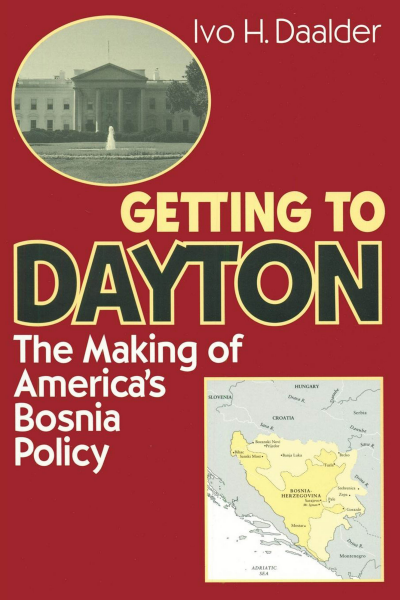
Getting to Dayton
The Making of America's Bosnia Policy
Authors:
Publisher:
2014
Summary
For over four years, Washington responded to war in Bosnia by handing the problem to the Europeans to resolve and substituting high-minded rhetoric for concerted action. Then, in the summer of 1995, the Clinton administration suddenly shifted course, deciding to assert the leadership that would prove necessary to end the war in Bosnia. This bookbased on numerous interviews with key participants in the decisionmaking process and written by a former National Security Council aideexamines how the policy to end the war took shape. Getting to Dayton is a powerful case study of how determined individuals can exploit their positions to change U.S. government policy on crucial issues. In so doing, Daalder not only explains how Washington launched the diplomacy that culminated at Dayton, but also why the subsequent peace proved to be difficult to establish. Ivo H. Daalder is a senior fellow at the Brookings Institution. From 1995 to 1996 he served on the National Security Council staff as Director for European Affairs, where he was responsible for coordinating U.S. policy for Bosnia. His most recent publications include The United States and Europe in the Global Arena (1998) and Bosnia After SFOR: Options for Continued U.S. Engagement (1997). He is co-author of Winning Ugly: NATO's War to Save Kosovo, which will be published in 2000.
Search publication
Bibliographic data
Edition
1/2014
Copyright Year
2014
ISBN-Print
978-0-8157-1692-1
ISBN-Online
978-0-8157-1562-7
Publisher
Rowman & Littlefield, Lanham
Language
English
Pages
204
Product Type
Monograph
Table of contents
ChapterPages
Cover No access
Contents No access
CHRONOLOGY No access
INTRODUCTION No access Pages 1 - 4
CHAPTER ONE: "The Problem from Hell" No access Pages 5 - 36
CHAPTER TWO: From Containment to Engagement No access Pages 37 - 80
CHAPTER THREE: The Endgame Strategy No access Pages 81 - 116
CHAPTER FOUR: The Road to Dayton No access Pages 117 - 161
CHAPTER FIVE: Conclusions and Implications No access Pages 162 - 190