, to see if you have full access to this publication.
Monograph No access
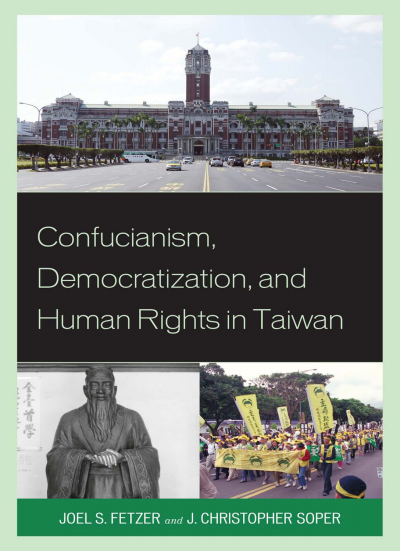
Confucianism, Democratization, and Human Rights in Taiwan
Authors:
|
Publisher:
2012
Summary
Responding to the “Asian values” debate over the compatibility of Confucianism and liberal democracy, Confucianism, Democratization, and Human Rights in Taiwan, by Joel S. Fetzer and J. Christopher Soper, offers a rigorous, systematic investigation of the contributions of Confucian thought to democratization and the protection of women, indigenous peoples, and press freedom in Taiwan. Relying upon a unique combination of empirical analysis of public opinion surveys, legislative debates, public school textbooks, and interviews with leading Taiwanese political actors, this essential study documents the changing role of Confucianism in Taiwan’s recent political history. While the ideology largely bolstered authoritarian rule in the past and played little role in Taiwan’s democratization, the belief system is now in the process of transforming itself in a pro-democratic direction. In contrast to those who argue that Confucianism is inherently authoritarian, the authors contend that Confucianism is capable of multiple interpretations, including ones that legitimate democratic forms of government. At both the mass and the elite levels, Confucianism remains a powerful ideology in Taiwan despite or even because of the island’s democratization. Borrowing from Max Weber’s sociology of religion, the writers provide a distinctive theoretical argument for how an ideology like Confucianism can simultaneously accommodate itself to modernity and remain faithful to its core teachings as it decouples itself from the state. In doing so, Fetzer and Soper argue, Confucianism is behaving much like Catholicism, which moved from a position of ambivalence or even opposition to democracy to one of full support. The results of this study have profound implications for other Asian countries such as China and Singapore, which are also Confucian but have not yet made a full transition to democracy.
Keywords
Search publication
Bibliographic data
Edition
1/2012
Copyright Year
2012
ISBN-Print
978-0-7391-7300-8
ISBN-Online
978-0-7391-7301-5
Publisher
Lexington, Lanham
Language
English
Pages
107
Product Type
Monograph
Table of contents
ChapterPages
Contents No access
Figures No access
Tables No access
Abbreviations No access
Acknowledgments No access
1 Confucianism and Democratization in East Asia No access Pages 1 - 16
2 Confucian Values and Elite Support for Liberal Democracy in Taiwan No access Pages 17 - 36
3 The Effect of Confucian Values on Public Support for Democratization and Human Rights in Taiwan No access Pages 37 - 44
4 The Treatment of Confucianism in Taiwanese Textbooks Before and After Democratization No access Pages 45 - 55
5 The Role of Confucianism in Taiwanese Legislative Debates over Democratization and Human Rights No access Pages 57 - 68
6 Toward a Liberal-Democratic Confucianism: Evidence from Taiwan No access Pages 69 - 77
Glossary of Non-English Terms No access Pages 79 - 81
Statistical Appendix No access Pages 83 - 84
Bibliography No access Pages 85 - 98
Index No access Pages 99 - 105
About the Authors No access Pages 107 - 107
Similar publications
from the topics "Religion und Theologie allgemein"