, to see if you have full access to this publication.
Monograph No access
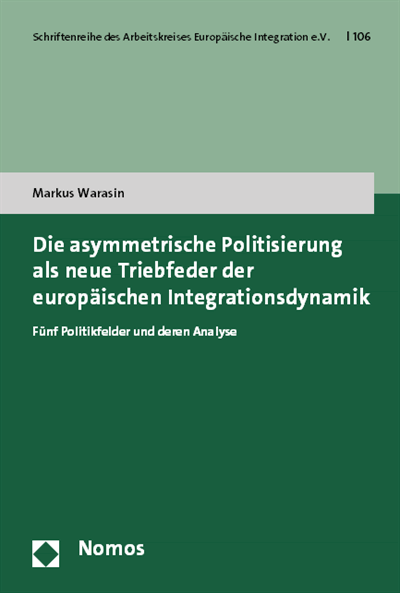
Die asymmetrische Politisierung als neue Triebfeder der europäischen Integrationsdynamik
Fünf Politikfelder und deren Analyse- Authors:
- Series:
- Schriftenreihe des Arbeitskreises Europäische Integration e.V., Volume 106
- Publisher:
- 2019
Keywords
Search publication
Bibliographic data
- Edition
- 1/2019
- Copyright Year
- 2019
- ISBN-Print
- 978-3-8487-5619-3
- ISBN-Online
- 978-3-8452-9794-1
- Publisher
- Nomos, Baden-Baden
- Series
- Schriftenreihe des Arbeitskreises Europäische Integration e.V.
- Volume
- 106
- Language
- German
- Pages
- 378
- Product Type
- Monograph
Table of contents
ChapterPages
- Titelei/Inhaltsverzeichnis No access Pages 1 - 8
- 1.1. Zur Politisierung der Informations- und Kommunikationspolitik des Europäischen Parlaments No access
- 1.2. Zum Versuch der De-Politisierung der Minderheitenpolitik während des Konvents zur Zukunft der Europäischen Union No access
- 1.3. Politisierung der EU-Gleichstellungspolitik: politische Dynamiken im parlamentarischen Ausschuss für die Rechte der Frau und die Gleichstellung der Geschlechter No access
- 1.4. Die Politisierung der Informationsgesellschaft No access
- 1.5. Die Politisierung des Erweiterungsprozesses der EU No access
- 1.6. Abschließender Befund und Ausblick No access
- 2.1. Vom Friedensprojekt zum politischen Akteur No access
- 2.2. Paradigmenwechsel in der Standortbestimmung Europas No access
- 2.3. Vom Eliteprojekt zur EU-isierung der Politik No access
- 2.4. Vom Popularitätsdefizit der EU zur Wahl einer europäischen Regierung No access
- 2.5. Politisierung der Integration – Rendez-vous 2014 No access
- 2.6. Demokratisierung der Integration No access
- 2.7. Die Politisierung der Integration und die Rolle der politischen Parteien No access
- 2.8. EU-Informations- und Kommunikationspolitik im Wandel No access
- 2.9. Schlussbemerkungen No access
- 3.1. Versuch einer Typologisierung No access
- 3.2. Bildung, Medien und öffentlicher Dienst No access
- 3.3. Meilensteine in der Anerkennung sprachlicher Rechte in Europa No access
- 3.4. Zusammenfassung und Schlussfolgerungen No access
- Auswahlbibliographie No access
- 4.1. Initiatives for the promotion of lesser-used languages No access
- 4.2. Amending Legislation No access
- 4.3. Implications of the New Context No access
- Bibliography No access
- Websites No access
- 5.1. Minority Languages—Languages of Minorities: Two Decades of Compromises No access
- The European Bureau for Lesser-Used Languages No access
- The Europa Diversa Group No access
- Amending Article 13 on Non-Discrimination in the Treaty of the European Community (TEC) No access
- Introducing Qualified Majority Voting in Article 151 EC on Cultural Policies No access
- Working Group V on „Complementary Competencies“ No access
- The Working Group IX. on „Simplification“ No access
- 5.4. A New Impetus No access
- 5.5. Conclusions No access
- 6.1. Theoretical framework: Cohesion and coalitions in the EP and constructions of gender equality No access
- 6.2. Representation of women and gender equality infrastructure of the European Parliament No access
- 6.3. Intra-group cohesion in gender equality policy areas and overall No access
- 6.4. Inter-group coalitions at plenary and committee level No access
- Bibliography No access
- Das Weißbuch der EU-Kommission über „Wachstum, Wettbewerbsfähigkeit, Beschäftigung“. No access
- „Europas Weg in die Informationsgesellschaft. Ein Aktionsplan“ No access
- Die Gruppe hochrangiger Experten und das Forum für Informationsgesellschaft No access
- „Leben und Arbeiten in der Informationsgesellschaft: Im Vordergrund der Mensch“ No access
- „Die Informationsgesellschaft – von Korfu bis Dublin. Neue Prioritäten“ und „Die Bedeutung der Informationsgesellschaft für die Politik der Europäischen Union – Vorbereitung auf die nächsten Schritte“ No access
- „Europa als Wegbereiter der globalen Informationsgesellschaft: Dynamischer Aktionsplan“ und eEurope No access
- 7.2. Die Ministerkonferenz der G-7 über die „Globale Informationsgesellschaft“ No access
- 7.3. Die moderne Informationsgesellschaft aus der Sicht der UNESCO No access
- 7.4. Schlussbemerkungen No access
- 8.1. Die erste Etappe in Richtung Osterweiterung – Die Entwicklungen von 1989 bis 1997 No access
- Geopolitischer und historischer Kontext No access
- Stellungnahme der Europäischen Kommission No access
- Geopolitischer und historischer Kontext No access
- Stellungnahme der Europäischen Kommission No access
- Geopolitischer und historischer Kontext No access
- Stellungnahme der Europäischen Kommission No access
- Geopolitischer und historischer Kontext No access
- Stellungnahme der Europäischen Kommission No access
- Geopolitischer und historischer Kontext No access
- Stellungnahme der Europäischen Kommission No access
- Geopolitischer und historischer Kontext No access
- Stellungnahme der Europäischen Kommission No access
- Geopolitischer und historischer Kontext No access
- Stellungnahme der Europäischen Kommission No access
- Geopolitischer und historischer Kontext No access
- Stellungnahme der Europäischen Kommission No access
- Geopolitischer und historischer Kontext No access
- Stellungnahme der Europäischen Kommission No access
- Geopolitischer und historischer Kontext No access
- Stellungnahme der Europäischen Kommission No access
- 8.3.1. Politische Kriterien No access
- Aufbau der Legislative No access
- Aufbau der Exekutive No access
- Aufbau der Judikative No access
- Menschenrechte und Minderheitenschutz No access
- Einstellungen zum politischen System und zur Europäischen Union No access
- Aufbau der Legislative No access
- Aufbau der Exekutive No access
- Aufbau der Judikative No access
- Menschenrechte und Minderheitenschutz No access
- Einstellung zum politischen System und zur Europäischen Union No access
- Aufbau der Legislative No access
- Aufbau der Exekutive No access
- Aufbau der Judikative No access
- Menschenrechte und Minderheitenschutz No access
- Einstellung zum politischen System und zur Europäischen Union No access
- Aufbau der Legislative No access
- Aufbau der Exekutive No access
- Aufbau der Judikative No access
- Menschenrechte und Minderheitenschutz No access
- Einstellungen zum politischen System und zur Europäischen Union No access
- Aufbau der Legislative No access
- Aufbau der Exekutive No access
- Aufbau der Judikative No access
- Menschenrechte und Minderheitenschutz No access
- Einstellung zum politischen System und zur Europäischen Union No access
- 8.3.7. Wirtschaftliche Kriterien No access
- Wirtschaftsindikatoren Ungarns No access
- Wirtschaftsindikatoren Polens No access
- Wirtschaftsindikatoren Estlands No access
- Wirtschaftsindikatoren der Tschechischen Republik No access
- Wirtschaftsindikatoren Sloweniens No access
- 8.3.13. Sonstige Verpflichtungen No access
- 8.3.14. Das vierte Kriterium von Kopenhagen No access
- 8.4. Europa – Traum oder Trauma? No access
- Verzeichnis No access