, to see if you have full access to this publication.
Monograph No access
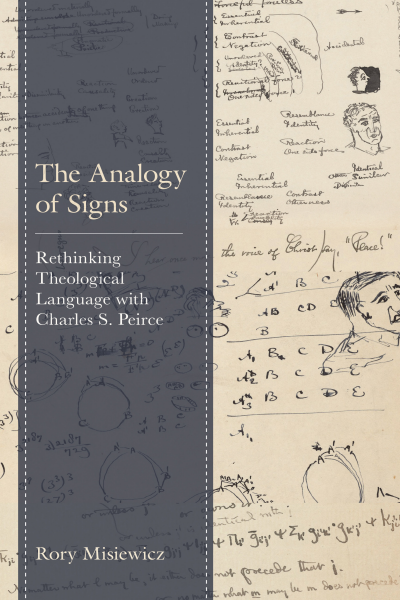
The Analogy of Signs
Rethinking Theological Language with Charles S. Peirce
Authors:
Publisher:
2021
Summary
The longstanding debate over how God-talk is intelligible gravitates around how we should understand the putative answer, “by analogy.” For some contemporary Christian theologians, analogy involves an ontological claim about creaturely and divine being (i.e., an analogy of being). For others, it involves a semantic or syntactical structure that legitimates the linguistic performances associated with analogy (i.e., a grammatical analogy). Still others appeal to faith in God’s self-disclosure in Jesus Christ (i.e., an analogy of faith).
Rory Misiewicz argues that all of these approaches fall flat in their explanatory efforts. He draws upon the work of American philosopher Charles Sanders Peirce to rethink the relation between God and human beings. He argues that Christian theologians may view that relation as being established by an “analogy of signs”: both God and human beings are univocally involved in semiosis, or sign-process, and the confirmation of God’s semiotic identity is found in the revelation of God in the person of Jesus, the incarnate Son of God. Therefore, ordinary analogical language is intelligible, for divine signs are commensurate with human signs.
Keywords
Search publication
Bibliographic data
Edition
1/2021
Copyright Year
2021
ISBN-Print
978-1-9787-1002-3
ISBN-Online
978-1-9787-1003-0
Publisher
Lexington, Lanham
Language
English
Pages
296
Product Type
Monograph
Table of contents
ChapterPages
Contents No access
List of Figures and Table No access
Acknowledgments No access
Abbreviations No access
Chapter 1 Introduction No access Pages 1 - 18
Chapter 2 How Analogy Works No access
Chapter 3 Analogia Entis No access
Chapter 4 Grammatical Thomism and Analogy No access
Chapter 5 Analogia Fidei No access
Chapter 6 Peirce’s Philosophy and Intelligibility No access
Chapter 7 Analogia Signorum No access
Conclusion No access Pages 269 - 276
Bibliography No access Pages 277 - 286
Index No access Pages 287 - 294
About the Author No access Pages 295 - 296
Similar publications
from the topics "Religion und Theologie allgemein"
Edited Book No access
Jan Hermelink, Alexander Deeg, Michael Domsgen, Kristin Merle, Marcell Saß