, to see if you have full access to this publication.
Monograph No access
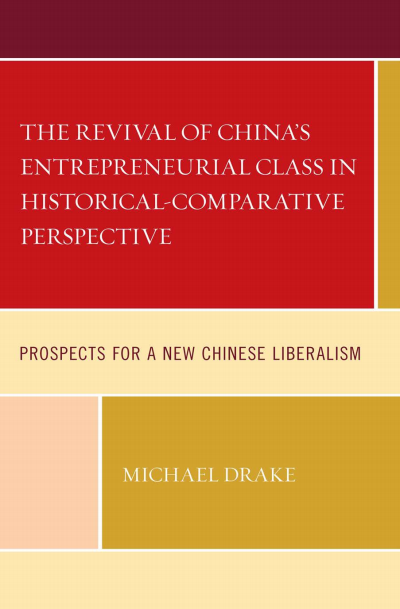
The Revival of China's Entrepreneurial Class in Historical-Comparative Perspective
Prospects for a New Chinese Liberalism
Authors:
Publisher:
2020
Summary
The Revival of China's Entrepreneurial Class in Historical-Comparative Perspective: Prospects for a New Chinese Liberalism examines the evolution of China’s entrepreneurial class and prospects for entrepreneurial-driven political institutional change. Michael Drake posits that decades of economic reforms and social transformation have illuminated a fundamental contradiction in contemporary China—a rule-by-law closed political system governing over an emergent entrepreneurial class requiring property protection—that requires resolution. Drake argues that the Chinese Communist Party has one of two choices: crush the entrepreneurial class, and with it, economic growth and the party’s legitimacy, or cede to the entrepreneurs’ demands for the rule of law and political representation. Drake’s research shows the rise of liberal qualities—rationality, autonomy, property-law interests, political awareness, and political agency—among China’s emergent entrepreneurial class. As such, Drake argues that this liberal trajectory, in conjunction with a lack of viable alternatives for the party, will translate into a new Chinese liberalism, and ultimately, political change.
Keywords
Search publication
Bibliographic data
Edition
1/2020
Copyright Year
2020
ISBN-Print
978-1-7936-1997-6
ISBN-Online
978-1-7936-1998-3
Publisher
Lexington, Lanham
Language
English
Pages
159
Product Type
Monograph
Table of contents
ChapterPages
Contents No access
Acknowledgments No access
1 Introduction: The Search for a Renewed Chinese Liberalism No access Pages 1 - 20
2 Liberal Class Development in England and France No access Pages 21 - 40
3 Illiberal Class Development in China: 907–1976 No access Pages 41 - 68
4 China’s Private Entrepreneurs: Economic Rationality and Autonomy No access Pages 69 - 84
5 China’s Private Entrepreneurs: State Predation and the Rise of Property-Law Interests No access Pages 85 - 108
6 China’s Private Entrepreneurs: The Formation of Liberal Political Values? No access Pages 109 - 134
7 Conclusion: Prospects for a Contemporary Chinese Bourgeoisie No access Pages 135 - 140
Appendix: Interview Questions (English and Chinese Versions) No access Pages 141 - 144