, to see if you have full access to this publication.
Book Titles Partial access
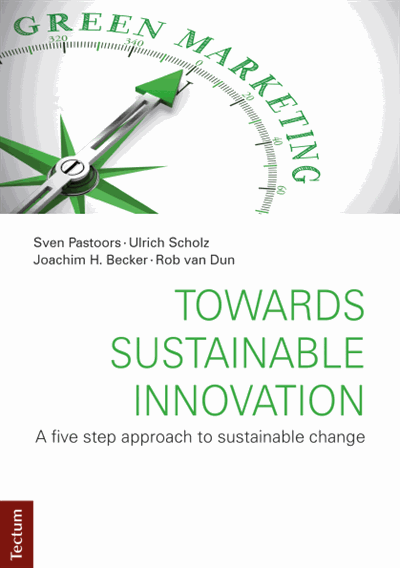
Towards Sustainable Innovation
A five step approach to sustainable change- Authors:
- | | |
- Publisher:
- 2017
Search publication
Bibliographic data
- Copyright year
- 2017
- ISBN-Print
- 978-3-8288-3903-8
- ISBN-Online
- 978-3-8288-6655-3
- Publisher
- Tectum, Baden-Baden
- Language
- German
- Pages
- 333
- Product type
- Book Titles
Table of contents
ChapterPages
- Titelei/Inhaltsverzeichnis Partial access Pages 1 - 8 Download chapter (PDF)
- Introduction No access Pages 9 - 16
- 1.1 The concept of sustainability No access
- 1.2 Problem statement No access
- 1.3 Social-economic effects making sustainable acting difficult No access
- 1.4 different ways to measure the sustainability of a product No access
- 1.5 Eco-efficiency vs. Eco-effectiveness No access
- 2.1 An introduction to corporate sustainability No access
- 2.2 Th e emergence of sustainability in business No access
- 2.3 Moving from Obligation to Opportunity No access
- 2.4 The Triple Bottom Line Framework No access
- 2.5 Sustainable Innovation: Challenges and Opportunities No access
- 3.1 The term innovation No access
- 3.2 Types of Innovation No access
- 3.3 The (closed) innovation process No access
- 3.4 The open innovation process No access
- 4.1 Introduction to systematic innovation No access
- 4.2 Concept of Systematic Innovation No access
- 4.3 Internal Sources for Innovation No access
- 4.4 External Sources for Innovation No access
- 5.1 The significance of entrepreneurial management No access
- 5.2.1 Change, hit the ground running No access
- 5.2.2 From Threat to Opportunity No access
- 5.2.3 Management Structure No access
- 5.3.1 The idea No access
- 5.3.2 Focus on the market No access
- 5.3.3 Human Resources No access
- 5.3.4 Financing No access
- 6.1 The significance of innovation strategies No access
- 6.2 Going All-In (“Being fustest with the mostest”) No access
- 6.3 Hit them where they ain’t No access
- 6.4 Finding a Niche No access
- 6.5 Disruptive Innovation No access
- 7.1 Innovation is Change No access
- 7.2.1 Time and Space No access
- 7.2.2 Maximize Diversity No access
- 7.2.3 Interaction and Connection No access
- Chapter 8: The Birth of the iPod No access Pages 159 - 170
- 9.1 Creative problem solving No access
- 9.2 The creative problem solving process No access
- 9.3 Questioning techniques to identify a problem No access
- 9.4 Analytical techniques to identify a problem No access
- 9.5 techniques to visualize a problem No access
- 10.1 Customer insight No access
- 10.2 Incorporation of Customer Insight in the Market Research Process No access
- 10.3 Taking advantage of the customer knowledge No access
- 10.4 The phase concept of customer insight No access
- 11.1 Ideation and creativity techniques No access
- 11.2 Creative-Intuitive Methods No access
- 11.3 Analytical-Systematic Methods No access
- 11.4 What should be used when? No access
- 11.5 Sustainable innovation workshops No access
- 12.1 Pre-Selection of ideas No access
- 12.2 Decision-making methods No access
- 12.3 Evaluation of ideas No access
- 13.1 Quality management: Product and process aspects No access
- 13.2 Social Responsibility No access
- 13.3 ecological Management No access
- 13.4 Life cycle assessment No access
- 14.1 Cradle to Cradle as the new philosophy of sustainable innovation No access
- 14.2 The four golden rules of Cradle to Cradle No access
- 14.3 Certification of the Cradle-to-Cradle principle No access
- 15.1 Generation of the term green marketing No access
- 15.2 Sustainable marketing and Green marketing No access
- 15.3 Strategic green marketing No access
- 15.4 The “LOHAS ” segment No access
- 15.5 Green marketing and sustainable innovation No access
- Books No access
- Abstracts No access
- Official Documents No access
- Internet resources No access
- Glossary No access Pages 309 - 333