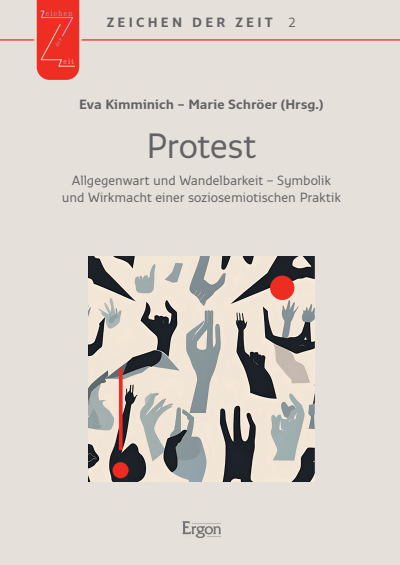
Protest
Allgegenwart und Wandelbarkeit – Symbolik und Wirkmacht einer soziosemiotischen Praktik- Editors:
- |
- Series:
- Zeichen der Zeit, Volume 2
- Publisher:
- 2024
Summary
Protest is a socio-cultural practice without which society cannot develop. Protest has an impact in the public sphere through concrete action and semantically through the (re)formation of meaning. The authors of this volume explore the diversity of its forms of expression. On the one hand, they demonstrate how symbols are used as semiotic tools: in doing so, they demonstrate how symbols are used to subvert domination and negotiate patterns of interpretation and show how identities are (re)constructed and collective consciousness is created. The contributions also demonstrate how the symbolic dimension of protest is cited and instrumentalized in popular culture and advertising. With contributions byJan Oliver Decker | Peter Jehle | Joseph Jurt | Pauline Kling | Eva Kimminich | Tobias Mönch | Brigitte Obermayr | Orestis Pangalos | Marie Schröer | Franciscu Sedda
Keywords
Search publication
Bibliographic data
- Edition
- 1/2024
- Copyright Year
- 2024
- ISBN-Print
- 978-3-98740-149-7
- ISBN-Online
- 978-3-98740-150-3
- Publisher
- Ergon, Baden-Baden
- Series
- Zeichen der Zeit
- Volume
- 2
- Language
- German
- Pages
- 194
- Product Type
- Edited Book
Table of contents
- Titelei/Inhaltsverzeichnis No access Pages 1 - 6
- Authors: |
- Bibliographie No access
- Authors:
- 1. Was kann/will Protest bewirken? No access
- 2. Der protestierende Körper No access
- 3. Protest und Internet No access
- 4. Bemerkungen zum Symbolrepertoire des Protests No access
- 5. Wie entstehen Protestsymbole? No access
- 6. Protestzeichen: semiotische Werkzeuge gesellschaftlicher Wirklichkeits(re)konstruktion No access
- Bibliographie No access
- Authors:
- 1. Die eigene Erfahrung No access
- 2. Das Wort ergreifen No access
- 3. Die Barrikade No access
- 4. Demos und symbolischer Raum No access
- 5. Die internationale Dimension No access
- 6. Die Bilder, die (nicht) blieben No access
- 7. Umbrüche der symbolischen Ordnung No access
- 8. Befreiung der schöpferischen Kraft No access
- 9. Bibliographie No access
- Authors:
- 1. Das Spannungsfeld von Kunst und Politik No access
- 2. Platon und das politische Potenzial der Kunst No access
- 3.1. Prekarität und Stabilisierung der Ordnung No access
- 3.2. Die Strukturierung des Subjekts: Diskurse und ihre fixierende Wirkung auf Denk- und Handlungsweisen No access
- 3.3. Das ästhetische Erkennen als das Reale des Logozentrismus No access
- 4.1. Freiheit und Gleichheit des ästhetischen Regimes No access
- 4.2. Der Wahrheitsgehalt der Kunst No access
- 4.3. Erfahrungen, Wahrnehmung und die Aufteilung des Sinnlichen No access
- 4.4. Die Offenheit ästhetischer Erfahrung No access
- 5.1. Kunst als heterotopischer Erfahrungs- und Interventionsraum No access
- 5.2. Zwei Beispiele zur Veranschaulichung No access
- 6. Schlussfolgerung: Wandel durch Neujustierung der Subjektivitäten im heterotropischen Raum No access
- Bibliographie No access
- Authors:
- 1. The Logic of Succession No access
- 2. Attack on Symbols and Crisis of Times No access
- 3. On Statues: Perspectivism, Absence, Systemic Effect No access
- 4. Against Statues: Affirmations of Knowledge, Compensations of Power No access
- 5. Aspects of Iconoclasm in the Era of Social Media Life No access
- 6. Cancel culture, reputation, contemporaneism No access
- 7. Monumentalizing Experience, Turning the Monument into a Palimpsest No access
- 8. Every day a new monument No access
- 9. The sense of time for the iconoclastic generation No access
- Appendix No access
- Bibliography No access
- Authors:
- 1. Introduction and issues of terminology No access
- 2. Political aspects and other signifiers of graffiti and street art No access
- 3. Commodified versions and subsequent signifiers No access
- 4. Epilogue. A set of multiple perceptions, misconceptions, interpretations, meanings and signifiers. No access
- Bibliography No access
- Authors:
- 1. Leere Zeichen vs. Multiple Zeichen No access
- 2. Revisiting „Wild Style“ No access
- 3. Überall „wilde Zeichen“? No access
- 4. Deutsche Aneignungskontexte No access
- 5. Stimmen gegen den „verräumlichten“ Rassismus No access
- 6. „Urbaner Kolonialismus“ vs. „Urbane Indigenitäten“ No access
- 7. Shaman*innen und symbolische Alchemie No access
- 8. Widerstand und Reproduktion No access
- 9. Exotik, Protest und Uneindeutigkeit No access
- 10. Gemeinsam neue Bilder erschaffen No access
- 11. Bibliographie No access
- 12. Medienlinks No access
- Authors:
- 1. Methodische Vorbemerkungen No access
- 2. Zum Verhältnis von Protest und Populärkultur No access
- 3. Musikvideos des Mainstreams und Protest No access
- 4. Madonnavideos und Semiosphäre No access
- 5. Madonna God Control als Protest gegen fehlende Waffenkontrolle in den USA No access
- 6. Childish Gambino This Is America. Gewalt als künstlerische Ausdrucksform No access
- 7. Schlussbemerkung No access
- Quellenverzeichnis No access
- Bibliographie No access
- Authors:
- 1. Moralische Ökonomie No access
- 2.1. Vercors No access
- 2.2. Irène Némirovsky No access
- 3.1. Zum Kontext No access
- 3.2. Zum Roman No access
- 4. Bibliographie No access
- Authors:
- 1. „Net vojne“ – „Nein zum Krieg“: Fragen ethischer und moralischer Legitimität von Protesten No access
- 2. „Wir können das Blut nicht abwaschen“: Aktionen zu Schuld und Verantwortung No access
- 3. Interventionen gegen Desinformation No access
- 4. Horizontale Aktionen – sozial engagierte Aktionskunst No access
- Bibliographie No access
- Die Autorinnen und Autoren No access Pages 193 - 194