, to see if you have full access to this publication.
Book Titles No access
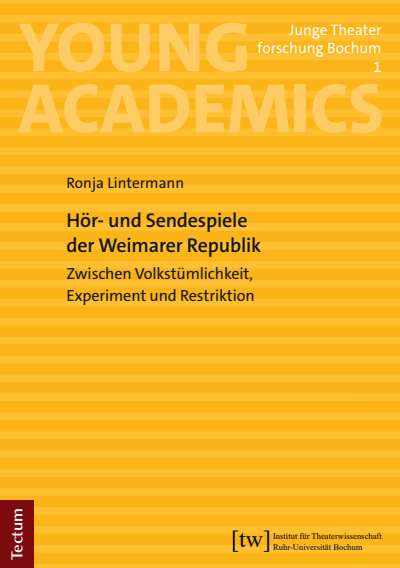
Hör- und Sendespiele der Weimarer Republik
Zwischen Volkstümlichkeit, Experiment und Restriktion- Authors:
- Series:
- Young Academics: Junge Theaterforschung Bochum, Volume 1
- Publisher:
- 24.10.2024
Summary
In 1923, German radio goes on air in Berlin during the Weimar Republic. For the first time, sounds, music and human voices could be transmitted directly into listeners' homes. As a result, artists and cultural workers explore the possibilities of the new medium. The radio play, a theatre piece adapted for the radio, was soon followed by the radio drama, an original form of radio art.Ronja Lintermann traces the search for an independent form of radio drama in an age of increasing political restrictions, from the first original German radio play Zauberei auf dem Sender to Brecht's radio theory. Special attention is given to the radio experiments of avant-garde intellectuals.
Keywords
Search publication
Bibliographic data
- Publication year
- 2024
- Publication date
- 24.10.2024
- ISBN-Print
- 978-3-68900-163-6
- ISBN-Online
- 978-3-68900-164-3
- Publisher
- Tectum, Baden-Baden
- Series
- Young Academics: Junge Theaterforschung Bochum
- Volume
- 1
- Language
- German
- Pages
- 126
- Product type
- Book Titles
Table of contents
ChapterPages
- Titelei/Inhaltsverzeichnis No access Pages I - VIII
- 1 Einleitung No access Pages 1 - 4
- 2.1 Geschichtliche Einordnung und Entstehung des Rundfunks No access
- 2.2 Der Rundfunk als Kulturfaktor und Stellvertreter für das Theater No access
- 2.3.1 Das Hörspiel als Schauspiel für Blinde No access
- 2.3.2 Das Hörspiel als Wortkunstwerk No access
- 2.3.3 Das Hörspiel als Schallspiel No access
- 2.3.4 Kurt Weill: Absolute Radiokunst No access
- 3.1.1 Fleschs Theorie und Vision No access
- 3.1.2 Die Rundfunkgroteske No access
- 3.2 Fritz Walter Bischoff: Hallo! Hier Welle Erdball (1928) No access
- 3.3 Walter Ruttmann: Weekend (1930) No access
- 4.1.1 Von der Demokratisierung zur Umfunktionierung des Rundfunks No access
- 4.1.2 Der Ozeanflug (1929) No access
- 4.2.1 Volkstümlichkeit und Popularisierung No access
- 4.2.2 Das sachverständige Publikum und die Stimme als Gast No access
- 4.2.3 Das Hörmodell als Lehrgegenstand No access
- 4.2.4 Volkstümlichkeit im Hörspiel: Radau um Kasperl (1932) No access
- 5 Schlussbetrachtung No access Pages 107 - 118
- Literaturverzeichnis No access Pages 119 - 126