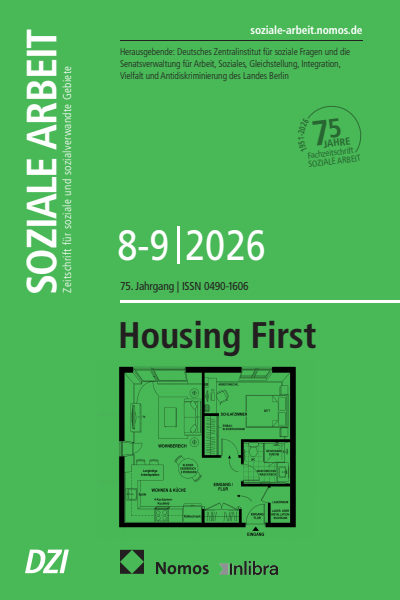
Soziale Arbeit, founded in 1951, is an independent academic journal which addresses developments in the context of social work. It is one of the most important publication media in its field and is read by teachers, students and researchers in social work and social pedagogy as well as by professionals and managers from associations and institutions. The journal’s aim is to promote professional development in social work fields by presenting methods and new concepts, in addition to subject-specific practical reports. In the ‘Rundschau’ (Review) section, information from all social fields is compiled. The ‘Tagungskalender’ (Conference Calendar) refers to important events, and the ‘Zeitschriftenbibliographie’ (Bibliography of Journals) lists current articles from professional journals. Soziale Arbeit is published 11 times a year with an annual focus issue published as a double issue. All scholarly articles submitted for publication in the journal undergo a double-blind peer review process. The editorial board is supported in an advisory capacity by a professional advisory board consisting of individuals from associations, universities, politics and administrative bodies. The journal cooperates with the academic societies of social work from Germany (DGSA) and Austria (OGSA). All social work contributions are indexed in the literature database DZI SoLit.
The exploratory qualitative study reconstructs the perspectives of single mothers on social pedagogical family support. It discusses their perceptions of everyday life realities, relationships with professionals, and changes experienced over the...
Against the backdrop of 40 years of experience in child protection, this article outlines the prerequisites that have proven relevant for consultation by the qualified specialist pursuant to Section 8a of the German Social Code, Book VIII (SGB...
The article discusses diversity and intersectionality as key perspectives in Social Work. It examines their theoretical foundations, societal relevance, and professional application across four levels: the descriptive, normative, analytical, and...
This article examines digital legacy as an increasingly relevant field of action in social work. While legal and technical barriers often burden grieving relatives, there is a societal lack of early preventive planning. The article emphasizes the...