, to see if you have full access to this publication.
Monograph No access
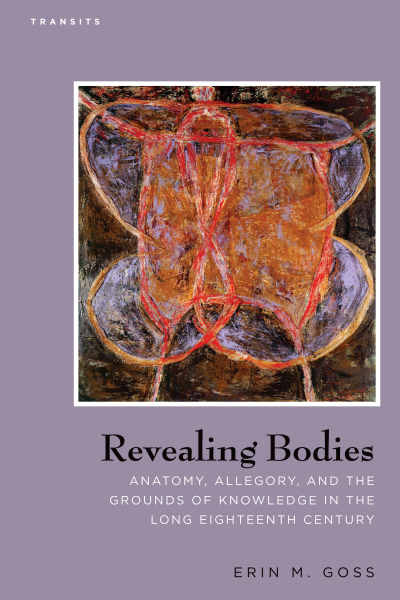
Revealing Bodies
Anatomy, Allegory, and the Grounds of Knowledge in the Long Eighteenth Century
Authors:
Publisher:
2012
Summary
Revealing Bodies turns to the eighteenth century to ask a question with continuing relevance: what kinds of knowledge condition our understanding of our own bodies? Focusing on the tension between particularity and generality that inheres in intellectual discourse about the body, Revealing Bodies explores the disconnection between the body understood as a general form available to knowledge and the body experienced as particularly one's own. Erin Goss locates this division in contemporary bodily exhibits, such as Gunther von Hagens' Body Worlds, and in eighteenth-century anatomical discourse. Her readings of the corporeal aesthetics of Edmund Burke's Philosophical Enquiry, William Blake's cosmological depiction of the body's origin in such works as The [First] Book of Urizen, and Mary Tighe's reflection on the relation between love and the soul in Psyche; or, The Legend of Love demonstrate that the idea of the body that grounds knowledge in an understanding of anatomy emerges not as fact but as fiction. Ultimately, Revealing Bodies describes how thinkers in the eighteenth and nineteenth centuries and bodily exhibitions in the twentieth and twenty-first call upon allegorized figurations of the body to conceal the absence of any other available means to understand that which is uniquely our own: our existence as bodies in the world.
Keywords
Search publication
Bibliographic data
Edition
1/2012
Copyright Year
2012
ISBN-Print
978-1-61148-394-9
ISBN-Online
978-1-61148-395-6
Publisher
Lexington, Lanham
Language
English
Pages
224
Product Type
Monograph
Table of contents
ChapterPages
CONTENTS No access
LIST OF ILLUSTRATIONS No access
ACKNOWLEDGMENTS No access
INTRODUCTION. Revealing Bodies No access Pages 1 - 16
CHAPTER 1. NAMING THE BODY No access Pages 17 - 48
CHAPTER 2. BODIES WITHOUT BODIES: Burke’s Corporeal Aesthetics No access Pages 49 - 86
CHAPTER 3. WHAT IS CALLED CORPOREAL: Blake and the Body’s Origin No access Pages 87 - 118
CHAPTER 4. BODIES OF MEANING: Tighe and the Body’s Apotheosis No access Pages 119 - 154
CONCLUSION. The Body as Allegory No access Pages 155 - 166