, to see if you have full access to this publication.
Monograph No access
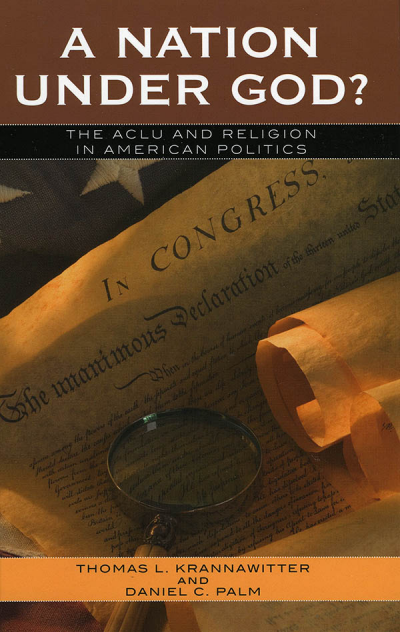
A Nation under God?
The ACLU and Religion in American Politics
Authors:
|
Publisher:
2005
Summary
A Nation Under God? raises the question of why the ACLU relentlessly attacks public expressions of mainstream religious faith. The answer, according to the book's argument, is that the work of the ACLU is informed by a larger political project-modern liberalism-to transform American government and society into an administrative-welfare state. Modern liberalism requires two decisive changes in American politics if it is to be successful: First, the government of limited powers mandated by the Constitution must become a government of unlimited powers and scope. Second, free, self-reliant, and independent citizens must become dependent on and understand themselves as subservient to government. The ACLU's drive to remove religion and morality from the public square advances both goals.
Limited, constitutional government rests on the idea that rights come from God; the power of government should be limited commensurate to the limited purpose of legitimate government: to protect our natural, God-given rights. With God removed from the public square, it becomes much easier politically to argue that government is the source of rights, and that every expansion of government power is tantamount to an expansion of rights.
Further, self-reliant citizens are not in need of and are unlikely to support large government welfare programs. But self-reliancy is largely a function of self-control and moral responsibility. Immoral and irresponsible citizens are incapable of providing for themselves and their families. Driving God and morality out of the public square serves to break down public morality, which in turn creates classes of citizens who are dependent on government assistance and regulation.
Through endless litigation against public expressions of religion and morality and its distorted interpretations of the Establishment and Free Exercise Clauses, the ACLU reveals its real agenda and its real allegiance, which is not to the Constitution or Bill of Rights, but to a radical liberal ideology that seeks
Search publication
Bibliographic data
Edition
1/2005
Copyright Year
2005
ISBN-Print
978-0-7425-5088-9
ISBN-Online
978-1-4616-0994-0
Publisher
Rowman & Littlefield, Lanham
Language
English
Pages
248
Product Type
Monograph
Table of contents
ChapterPages
TABLE OF CONTENTS No access
ACKNOWLEDGEMENTS No access
INTRODUCTION No access
CHAPTER ONE: THE ACLU AND RELIGION IN AMERICAN POLITICS TODAY No access Pages 1 - 10
CHAPTER TWO: RELIGION AND POLITICS IN HISTORICAL PERSPECTIVE No access Pages 11 - 24
CHAPTER THREE: RELIGION AND THE MORAL CONDITIONS OF FREEDOM IN THE AMERICAN FOUNDING No access Pages 25 - 44
CHAPTER FOUR: THE PROGRESSIVE REJECTION OF THE PRINCIPLES OF THE AMERICAN FOUNDING No access Pages 45 - 56
CHAPTER FIVE: THE BIRTH OF THE ACLU AND THE RISE OF MODERN LIBERALISM No access Pages 57 - 66
CHAPTER SIX: BUILDING THE WALL OF SEPARATION: THE ACLU TAKES RELIGION TO COURT No access Pages 67 - 92
CHAPTER SEVEN: IMMORAL RELIGION? THE ACLU's SELECT DEFENSE OF RELIGIOUS FREE EXERCISE No access Pages 93 - 114
CONCLUSION No access Pages 115 - 126
APPENDIX: DOCUMENTS FROM THE FOUNDING ON RELIGION AND RELIGIOUS LIBERTY No access Pages 127 - 242