, to see if you have full access to this publication.
Monograph No access
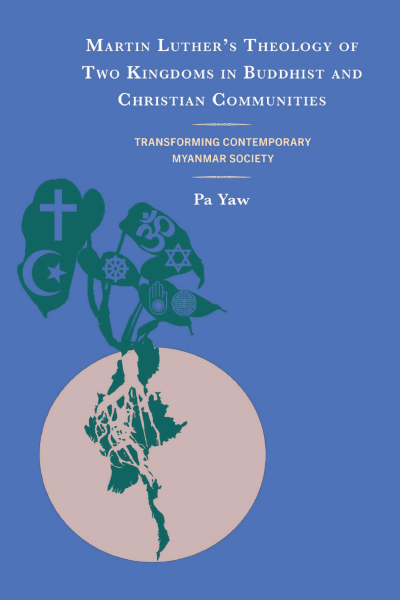
Martin Luther's Theology of Two Kingdoms in Buddhist and Christian Communities
Transforming Contemporary Myanmar Society
Authors:
Publisher:
2024
Summary
Religion is a set of beliefs and practices that help form our relationship to God and to our fellow human beings. Religion can inspire commitment to nonviolence and peaceful coexistence in a pluralistic world. However, throughout history, efforts to protect religion, the nation, and the foundations of belief have often made violence a part of religion. As a result, religion becomes a source of both violence and nonviolence. This fact about religion is a great opportunity for nonviolent religious actors to opt for nonviolent movement. Socially engaged religion teaches that people of faith have a responsibility to address and reduce suffering in all its forms, both physical and spiritual, including suffering resulting from social injustice, exploitation, oppression, false faith, and so forth. True religion engages with society to alleviate suffering and bring transformation. Hence, the ideology of engaged religion supports peace, justice, and freedom, and denounces oppression in every aspect of life. Socially engaged people of faith assume something inherently peaceful and benevolent about religion. Violence in the name of religion is a perversion of true faith. In other words, religious violence is an obscenity, a deviation from the true character of religion.
Martin Luther's Theology of Two Kingdoms in Buddhist and Christian Communities examines the principle of separation between religion and politics in the context of both Buddhist and Christian communities. In predominantly Buddhist context such as Myanmar, where a reciprocal relationship between religion and politics is expected, separation is not effective. Attempts by Christians to separate religion and politics causes the church to run away from tyranny and follow the state with blind obedience. Martin Luther’s model of two distinct but interconnected systems for religion and politics creates space for each institution to give constructive advice and criticism to the other for the health of all human beings.
Keywords
Search publication
Bibliographic data
Edition
1/2024
Copyright Year
2024
ISBN-Print
978-1-9787-1668-1
ISBN-Online
978-1-9787-1669-8
Publisher
Rowman & Littlefield, Lanham
Language
English
Pages
244
Product Type
Monograph
Table of contents
ChapterPages
Contents No access
Acknowledgments No access
Introduction No access Pages 1 - 6
Persecution of Ethnic and Religious Minorities in Myanmar No access Pages 7 - 58
Martin Luther’s Theology of Two Kingdoms as a Tool for Transformation in Myanmar Society No access Pages 59 - 84
Dietrich Bonhoeffer’s Theology of Political Resistance in Light of Luther’s Theology of Two Kingdoms No access Pages 85 - 114
Social and Religious Engagement in Myanmar Society No access Pages 115 - 158
The Implications of Luther’s Theology of Two Kingdoms in Dialogue with Engaged Religious Communities in Myanmar Today No access Pages 159 - 198
Conclusion No access Pages 199 - 208
List of Abbreviations No access Pages 209 - 210
Bibliography No access Pages 211 - 228
Index No access Pages 229 - 242
About the Author No access Pages 243 - 244
Similar publications
from the topics "Religion und Theologie allgemein"