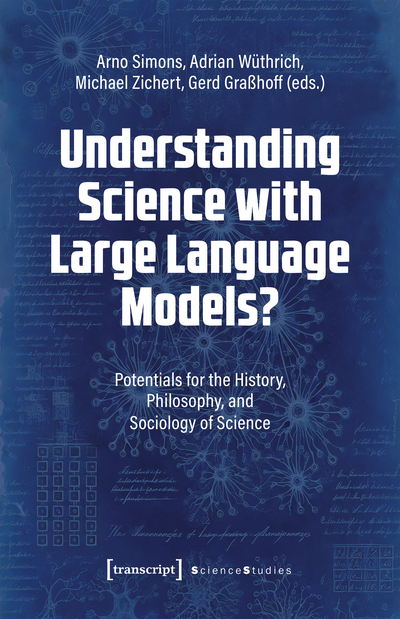
Cover of book: Understanding Science with Large Language Models?
Edited Book Open Access Full access

Understanding Science with Large Language Models?

Potentials for the History, Philosophy, and Sociology of Science
Editors:
Publisher:
 2026

Summary

How are large language models (LLMs) changing research in the history, philosophy, and sociology of science (HPSS)? The contributors to this volume show how these tools open new possibilities for interpretative scholarship while posing fresh challenges for fields that thrive on qualitative methods, nuance, and historical depth. In essays, dialogues, and provocations, they capture a field in motion at a pivotal moment, driven by the rise of AI. These insights speak not only to HPSS scholars but also to readers across the humanities, social sciences, and AI-related fields, positioning HPSS as a bridge for understanding and shaping how LLMs enter research and society.
Keywords


Bibliographic data

Edition
1/2026
Copyright Year
2026
ISBN-Print
978-3-8376-7994-6
ISBN-Online
978-3-8394-4752-9
Publisher
transcript, Bielefeld
Series
Science Studies
Volume
0
Language
English
Pages
523
Product Type
Edited Book

Table of contents

ChapterPages
  1. FrontmatterPages 1 - 8
    Authors:
    Download chapter (PDF)
  2. ForewordPages 9 - 11
    Authors:
    Download chapter (PDF)
  3. Doing science studies with large language modelsPages 13 - 32
    Authors:
    Download chapter (PDF)
  4. Critical concerns for using LLMs in the (computational) humanities and beyondPages 35 - 50
    Authors:
    Download chapter (PDF)
  5. AI and the scientistPages 51 - 55
    Authors:
    Download chapter (PDF)
  6. Grounding AI in humanistic inquiryPages 57 - 69
    Authors:
    Download chapter (PDF)
  7. On the use and limitations of large language models in historical scholarshipPages 71 - 99
    Authors:
    Download chapter (PDF)
  8. Encoded humanities, or: not everything has to be generativePages 101 - 114
    Authors:
    Download chapter (PDF)
  9. LLMs as philosophersPages 115 - 123
    Authors:
    Download chapter (PDF)
  10. Why pursue temporally‐grounded AI for historical disciplines, and what makes it so challenging?Pages 127 - 141
    Authors:
    Download chapter (PDF)
  11. Generative LLMs and history researchPages 143 - 150
    Authors:
    Download chapter (PDF)
  12. Zero‐shot generation of synthetic historical data with LLMsPages 151 - 177
    Authors:
    Download chapter (PDF)
  13. LLMs and multilingual historical corpora in a digital history projectPages 179 - 187
    Authors:
    Download chapter (PDF)
  14. Epistemic framings in sciencePages 191 - 196
    Authors:
    Download chapter (PDF)
  15. Computational conceptual history of scientific conceptsPages 197 - 215
    Authors:
    Download chapter (PDF)
  16. Meaning at the Planck scale?Pages 217 - 241
    Authors:
    Download chapter (PDF)
  17. Exploring disciplinary differences in semantic uniformityPages 243 - 256
    Authors:
    Download chapter (PDF)
  18. Use of large language models in the classification of scientific texts into disciplinesPages 257 - 270
    Authors:
    Download chapter (PDF)
  19. Discursive parallels of the chemical revolutionPages 271 - 290
    Authors:
    Download chapter (PDF)
  20. The potential of LLMs for constructing a socio‐legal knowledge graphPages 293 - 305
    Authors:
    Download chapter (PDF)
  21. From source to structurePages 307 - 334
    Authors:
    Download chapter (PDF)
  22. Large language models in interdisciplinary research settingsPages 335 - 342
    Authors:
    Download chapter (PDF)
  23. When less is more?Pages 343 - 350
    Authors:
    Download chapter (PDF)
  24. From RAGs to rich responsesPages 353 - 368
    Authors:
    Download chapter (PDF)
  25. The data interviewPages 369 - 382
    Authors:
    Download chapter (PDF)
  26. Co‑creation of AI technology, empowering curators of cultural heritage information and guarding research commonsPages 383 - 412
    Authors:
    Download chapter (PDF)
  27. AI‑Reporter: a path to a new genre of scientific communicationPages 413 - 438
    Authors:
    Download chapter (PDF)
  28. Recursive reflectionsPages 439 - 450
    Authors:
    Download chapter (PDF)
  29. Supporting citation context analysis with large language models raises questions that should have been asked 40 years agoPages 453 - 469
    Authors:
    Download chapter (PDF)
  30. Reconstructive citation context analysis using large language modelsPages 471 - 492
    Authors:
    Download chapter (PDF)
  31. Scaling In, Not Up?Pages 493 - 518
    Authors:
    Download chapter (PDF)

Similar publications

from the series "Science Studies"
Cover of book: The Order of People
Edited Book Full access
Nils Ellebrecht, Tino Plümecke, Isabelle Bartram, Veronika Lipphardt, Jenny Reardon, Andrea zur Nieden
The Order of People
Cover of book: Collecting Seeds, Assembling Worlds
Monograph Full access
Franziska von Verschuer
Collecting Seeds, Assembling Worlds
Cover of book: The Making of Scientific Knowledge
Monograph Full access
Jana Thierfelder
The Making of Scientific Knowledge
Cover of book: Envisaging Dataist Modernity
Monograph Partial access
Nicolas Zehner
Envisaging Dataist Modernity
Cover of book: Emotional Drivers of Innovation
Monograph Full access
Franziska Sörgel
Emotional Drivers of Innovation