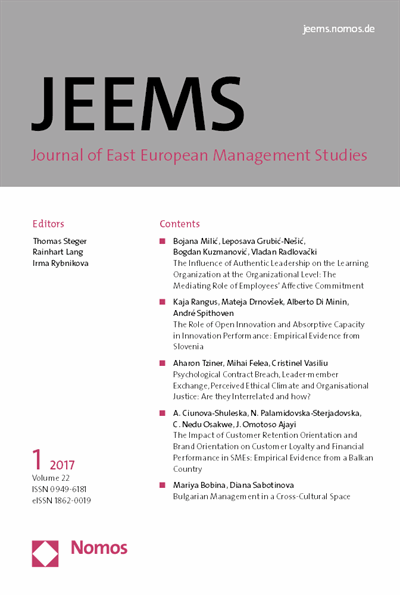
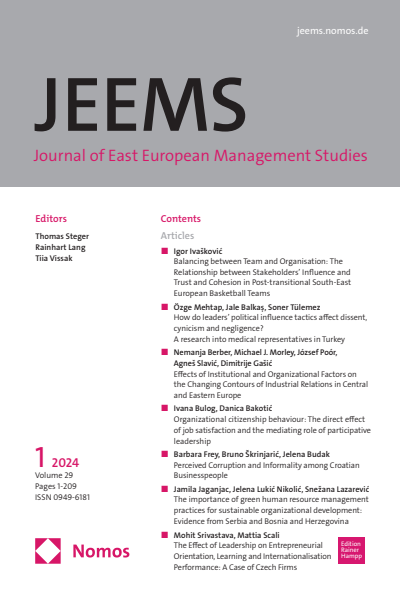
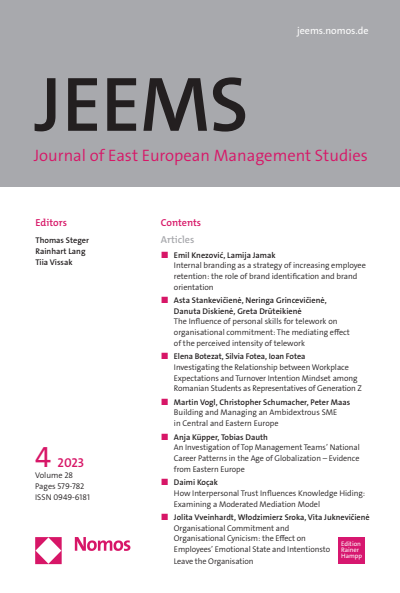
The Journal of East European Management Studies aims to promote dialogue and cooperation among scholars seeking to examine,explore and explain the behaviour and practices of management within the transforming societies of Central and Eastern Europe.The theoretical interests of the journal areorganisational and management change,Central and East European societies (including those on the fringes of Europe) undergoing processes of transition or transformation, andscientific issues of business, management and organisation that arise in such contexts.The JEEMS aims to attract social scientific contributions from scholars of any nation and region, but particularly wishes to encourageauthors from those countries directly experiencing transformational change. Its potential readership is international, comprising academicsand practitioners with an involvement or interest in the management of change in transforming societies in Central and Eastern Europe.
This study examines the impact of authentic leadership capabilities on the learning organization at the organizational level through employee affective commitment in Serbian organizations. Although these indirect interrelations are very important...
Although research on open innovation practices in larger and smaller organisations has been growing for over a decade, there has been limited evidence on the topic related to new and candidate members of the European Union. Existing studies of open...
Psychological contract breach (PCB) received theoretical and research attention due to its prevalence and its severe individual and organisational consequences. Responding to calls to study organisational contexts and theoretically based moderators...
The goal of this paper is to explore the impact of SMEs’ strategic orientations on customer loyalty and financial performance. SEM analysis was employed in order to test the proposed hypotheses. Our study suggests that SMEs can improve their...
The study of the cultural profile of Bulgarian management research is based on the survey of 125 Bulgarian managers (2014-2015), GLOBE methodology, and analysis of Bulgaria’s cultural distance measures relative to 57 societies. It highlights...