, to see if you have full access to this publication.
Monograph No access
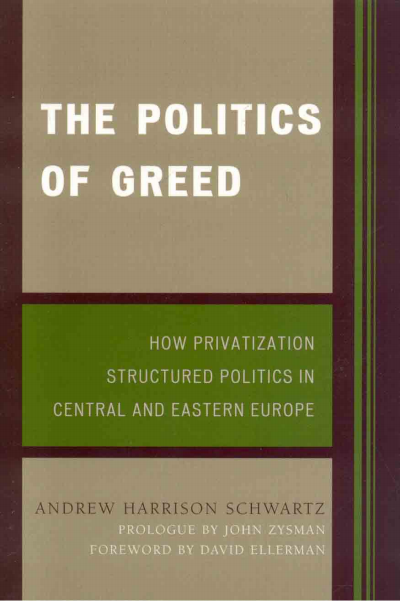
The Politics of Greed
How Privatization Structured Politics in Central and Eastern Europe
Authors:
Publisher:
2006
Summary
With the dissolution of the Soviet Empire, it seemed that market capitalism had triumphed and that democracy might replace authoritarian regimes. Economic reformers in the former Eastern Bloc rushed to liberalize prices and transfer state assets to private hands. They assumed that private owners in a market setting would have no choice but to behave rationally—that is, to invest in restructuring privatized enterprises so as to maximize profits. They also assumed that these owners would perceive a stable institutional environment as conducive to economic success and thus become a powerful lobby in favor of the rule of law, paving the way for democracy.
The post-communist reality turned out to be very different. Private owners found that in a weak state with limited laws and regulations and ineffective corporate governance structures, it was more lucrative to steal enterprise assets and exploit opportunities for arbitrage than to restructure enterprises. The lesson learned is that not all forms of private ownership are the same. As this book's in-depth political history of privatization in Central and Eastern Europe demonstrates, the way that assets are privatized matters, both with respect to national economic performance and the successful development of the rule of law. Andrew Harrison Schwartz had unprecedented access to high-level Czech government officials during the Czech Republic's privatization process. This book is the result of the unique insights he gained and the innovative analytical framework he subsequently developed—ownership regime theory—which for the first time places ownership structures at the center of political transition analysis. Engaging and important, The Politics of Greed applies ownership regime theory to a broad range of post-communist privatization cases, including those of the Czech Republic, Poland, Hungary, Russia, and Ukraine.
Search publication
Bibliographic data
Edition
1/2006
Copyright Year
2006
ISBN-Print
978-1-122-34032-8
ISBN-Online
978-1-4616-4515-3
Publisher
Rowman & Littlefield, Lanham
Language
English
Pages
357
Product Type
Monograph
Table of contents
ChapterPages
Contents No access
List of Figures No access
Notes and Abbreviations No access
Prologue John Zysman No access
Foreword David Ellerman No access
Acknowledgments No access
Introduction—Politics and Privatization No access Pages 1 - 20
1 Neoliberal Privatization—The Drearn That if You Create Private Owners, Democracy and the Market Economy Will Follow No access
2 Institutional Policy Design, Politics, and the Creation of Capitalism No access
3 Ownership Regilnes—The Basic Model of How They Form No access
4 The Two Trajectories of Ownership Regime Evolution No access
5 Elite Approval—November 1989 to May 1990 No access
6 Legitimating the Giveaway—June 1990 to February 1991 No access
7 Creating Plutocracy—February 1991 to May 1992 No access
8 Implementing the Ownership Regime—February 1991 to December 1995 No access
9 The Abuses of Plutocracy, the Failure of Czech Neoliberalism—January 1996 to December 1997 No access
10 Political and Economic Implications of Czech Rapid Privatization Andrew Harrison Schwartz and Jiří Havel No access
11 Plutocracy Escaped, Plutocracy Avoided, Plutocracy Embedded Andrew Harrison Schwartz and Jordan Gans-Morse No access