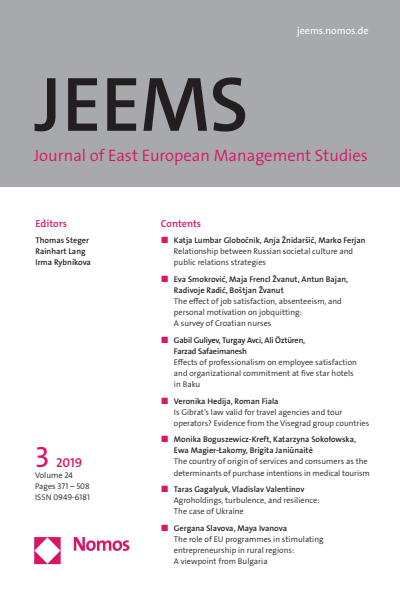
The Journal of East European Management Studies aims to promote dialogue and cooperation among scholars seeking to examine,explore and explain the behaviour and practices of management within the transforming societies of Central and Eastern Europe.The theoretical interests of the journal areorganisational and management change,Central and East European societies (including those on the fringes of Europe) undergoing processes of transition or transformation, andscientific issues of business, management and organisation that arise in such contexts.The JEEMS aims to attract social scientific contributions from scholars of any nation and region, but particularly wishes to encourageauthors from those countries directly experiencing transformational change. Its potential readership is international, comprising academicsand practitioners with an involvement or interest in the management of change in transforming societies in Central and Eastern Europe.
The study is a part of the dissertation about the influence of environmental variables on public relations in companies in Russia. This paper is focused on the relationship between public relations strategies and societal culture as defined in the...
Previous studies point to many inconsistencies regarding the determinants of job quitting. This study focuses on the impact of nurses’ job satisfaction, work motivation, nursing practice environment, personal characteristics and absenteeism on...
Professionalism is one of the necessities for service operations in order to be sustainable at the current competitive markets. The purpose of the study is to evaluate the effect of attitudinal professionalism on employees’ job satisfaction and...
The purpose of this paper is to investigate the validity of Gibrat’s law for a sample of travel agents from the Visegrad group (V4) countries and to identify the size-growth relationship. Using a linear auto-regressive model and ordinary least...
The aim of the study is to find the determinants of the decision to purchase medical services in other countries. The following hypothesis is tested: the image of the country of origin, the power of the country and the origin of the consumer...
The agricultural sector in transitional and emerging market economies is marked by the prominence of agroholdings, i.e., conglomerates of agricultural enterprises controlling up to hundreds of thousands of hectares of farmland. Drawing on secondary...
The paper aims to examine rural entrepreneurship and the way it is enhanced by the EAFRD programme. The specific focus is on the perceptions and entrepreneurial behaviour of beneficiaries of hospitality and rural tourism projects in Bulgaria. The...